I hereby give notice that the
Ahuriri Community Board Meeting
will be held on:
|
Date:
|
Monday, 10 November 2025
|
|
Time:
|
2pm
|
|
Location:
|
Otematata Community Centre
|
Agenda
Ahuriri Community Board Meeting
10 November 2025
Alex Parmley
Chief Executive
|
Ahuriri Community Board
Meeting Agenda
|
10 November 2025
|
|
Ahuriri Community Board
Meeting Agenda
|
10 November 2025
|
4 Decision
Reports
4.1 Declarations
by Ahuriri Community Board Members 2025-2028 Triennium
Author: Allyson
Woock, Governance Services Officer
Authoriser: Arlene
Goss, Governance Lead
Attachments: 1. Declarations
⇩ 
|
Recommendation
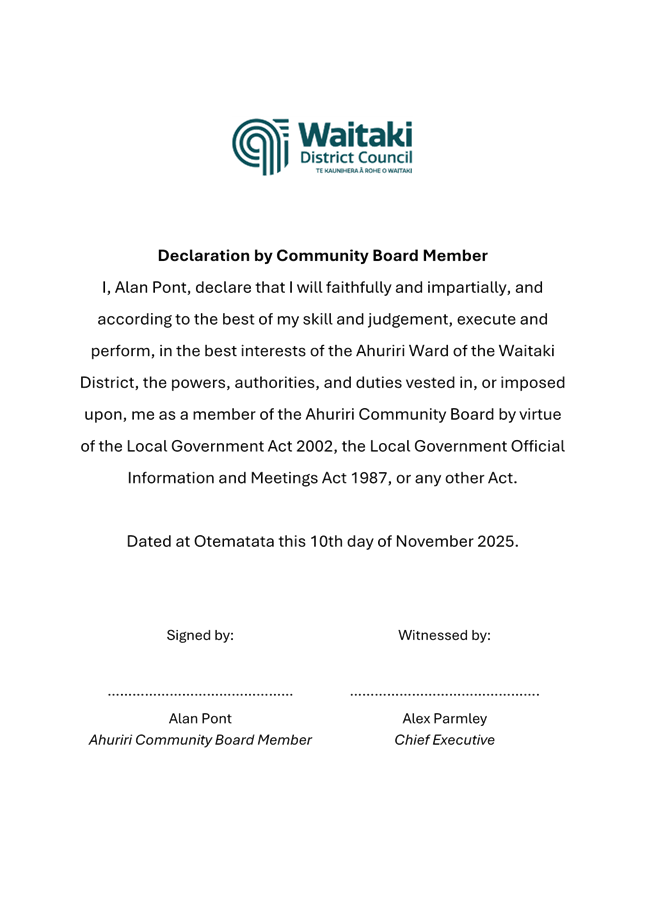
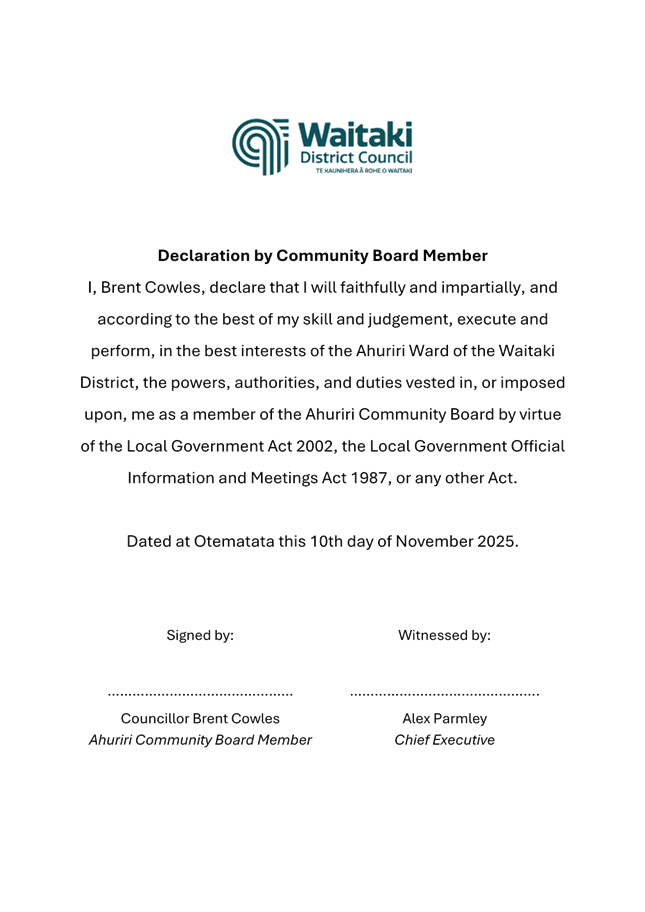
That the incoming Ahuriri Community Board member-elect
Alan Pont and the Ahuriri Ward Councillor Brent Cowles make their
declarations to the Mayor of Waitaki, Melanie Tavendale and are witnessed by
the Chief Executive, pursuant to Schedule 7, Part 1, clause 14 of the Local
Government Act 2002.
|
Purpose
The purpose of this report is to formally record the
declarations sworn by the elected members of the Ahuriri Community Board for
the 2025-2028 triennium.
Background
On Thursday 16 October 2025, the final result of the 2025
Triennial Elections was declared by the electoral officer. A copy of this is
attached to the Election Report in this agenda.
A public inauguration ceremony was held at the Ōamaru
Opera House auditorium at 5:30pm on Wednesday 22 October 2025.
Declarations by the following members of the Ahuriri
Community Board were taken at the inauguration ceremony:
Steve Dalley
Mike King
Calum Reid
Karen Turner
An apology for the inauguration ceremony was received from
Ahuriri Community Board member-elect Alan Pont, who arranged to swear his
declaration at the first meeting of the Ahuriri Community Board on Monday 10
November 2025.
Ahuriri Ward Councillor Brent Cowles made his Council
declaration at the inauguration ceremony but not his Ahuriri Community Board
declaration.
Under the Local Government Act 2002, Councillors appointed
to community boards must be make the community board declaration as well as
their declaration as a councillor.
Ahuriri Community Board member-elect and Ahuriri Ward
Councillor Brent Cowles will make and sign their declarations in the first part
of this Inaugural Meeting of the Board (copy of declarations attached).
They will read out their declaration to the Mayor of Waitaki
Melanie Tavendale, and each declaration will then be signed by the respective
member and then by the Chief Executive as witness, pursuant to the Provisions
of the Local Government Act 2002, Schedule 7, Part 1, clause 14.
|
Ahuriri Community Board
Meeting Agenda
|
10 November 2025
|
|
Ahuriri Community Board
Meeting Agenda
|
10 November 2025
|
4.2 Election of
Ahuriri Community Board Chairperson 2025-2028 Triennium
Author: Allyson
Woock, Governance Services Officer
Authoriser: Arlene
Goss, Governance Services Lead
|
Recommendations
That, pursuant to Part 2 of Schedule 7 of the Local
Government Act 2002, the Ahuriri Community Board:
1. Firstly,
decides to use either election System A or System B as specified in the Act
under reference to elect the Chairperson of the Ahuriri Community Board for
the 2025 – 2028 triennium and confirms that decision as point 1 in the
meeting resolution relating to this agenda item; and
2. Secondly,
uses the System adopted in (1) to formally elect the Chairperson of the
Ahuriri Community Board for the 2025 – 2028 Triennium and confirms the
name of the person elected as Chairperson as point 2 in the meeting
resolution relating to this agenda item; and
3. Thirdly,
decides whether it wishes to appoint a Deputy Chairperson for the 2025
– 2028 triennium and confirms that decision as point 3 in the meeting
resolution relating to this agenda item; and
4. Fourthly,
if a decision is taken under (3) to appoint a Deputy Chairperson, then to
formally elect the Deputy Chairperson using the agreed election System in (1)
above and confirms that decision as point 4 in the meeting resolution for
this agenda item, if such an appointment is made.
|
Decision Objective
The purpose of this report is to provide information on the
legislative process to be followed, and to facilitate that process at this
inaugural meeting, for the election of the Chairperson of the Ahuriri Community
Board for the 2025 – 2028 Triennium in accordance with Part 2 of Schedule
7 of the Local Government Act 2002. It also provides similar information
relating to the potential election of a Deputy Chairperson if the Board decides
to make such an appointment at this meeting.
Summary
Under Schedule 7 of the Local
Government Act 2002 (“the Act”), a Community Board must have a
Chairperson. The legislation is very specific in the process of electing a
Chairperson and requires the use of either one of two systems set out in the
Act. While the legislation requires a Community Board to have a Chairperson, it
is silent on whether a Community Board should have a Deputy Chairperson. The
decision to elect a Deputy is the choice of the Community Board.
decision-making expectations
|
Governance
Decision-Making:
|
To appoint a
Chairperson of the Ahuriri Community Board for the 2025 – 2028
triennium, and to decide whether to appoint a Deputy Chairperson or not.
|
|
Operational Decision-Making:
|
To implement the
decision of the Ahuriri Community Board in relation to the appointment of
Chairperson and Deputy Chairperson (if appropriate) in accordance with
statutory requirements.
|
|
Communications
|
Media Releases –
contributed to by officers and Elected Members
Media/public enquiries
regarding governance decision-making topics above can be addressed by
governance
Media/public enquiries
regarding operational decision-making topics above can be addressed by
officers
|
Summary of Decision-Making Criteria
|
|
No/Moderate/Key
|
|
No/Moderate/Key
|
|
Policy/Plan
|
No
|
Environmental Considerations
|
No
|
|
Legal
|
Key
|
Cultural Considerations
|
No
|
|
Significance
|
No
|
Social Considerations
|
No
|
|
Financial Criteria
|
Moderate
|
Economic Considerations
|
No
|
|
Community Views
|
No
|
Community Board Views
|
Key
|
|
Consultation
|
No
|
Publicity and Communication
|
Moderate
|
The recommendations in this report are
within the scope of the purpose and amendments to the Local Government Act 2002
to enable democratic local decision-making and action by, and on behalf
of, communities; and to meet the current and future needs of communities for
good quality local infrastructure, local public services, and performance of
regulatory functions in a way that is most cost-effective for households and
businesses.
Background
Part 2 of Schedule 7 of the Local Government Act states that
a Community Board must have a Chairperson and that Clause 25 applies to the
election of Chairpersons of Community Boards.
Summary of Options Considered
The appointment of Chairperson by the incoming Ahuriri
Community Board is a legislative requirement under the Local Government Act
2002. The only options available to the community board are whether it wishes
to use System A or System B in electing a Chairperson/Deputy Chair, and whether
it wishes to appoint a Deputy Chair.
LEGAL PROCESS FOR THE ELECTION OF CHAIRPERSONS FOR
COMMUNITY BOARDS
Part 2 of Schedule 7 of the Local Government Act states that
a Community Board must have a chairperson and that Clause 25 applies to the
election of Chairpersons of Community Boards. Clause 25, Schedule 7 of
the Local Government Act 2002 outlines the process to be followed:
“…a local authority must determine by
resolution that a person be elected by using one of the following systems of
voting:
System A
(a) Requires
that a person is elected or appointed if he or she receives the votes of a
majority of the members of the local authority or committee present and voting;
and
(b) Has
the following characteristics:
i. There is a first
round of voting for all candidates; and
ii. If no candidate is
successful in that round, there is a second round of voting from which the
candidate with the fewest votes in the first round is excluded; and
iii. If no candidate is
successful in the second round, there is a third, and if necessary subsequent,
round of voting from which, each time, the candidate with the fewest votes in
the previous round is excluded; and
iv. In any round of voting,
if two or more candidates tie for the lowest number of votes, the person
excluded from the next round is resolved by lot.
System B
(a) Requires
that a person is elected or appointed if he or she receives more votes than any
other candidate; and
(b) Has
the following characteristics:
i. There is only one
round of voting; and
ii. If two or more
candidates tie for the most votes, the tie is resolved by lot.”
Prior to electing a
Chair, the Community Board must resolve which system to use.
Under System A, a
majority will always prevail unless the final two candidates receive equal
votes.
Under System B, a
minority candidate can theoretically be elected.
As the Act calls for an
election, there will still be a vote even if only one candidate were to be
nominated.
APPOINTMENT OF A
DEPUTY CHAIRPERSON
The Ahuriri Community
Board can also appoint a Deputy Chairperson at this meeting if it so wishes.
The Board may wish to consider the workload of the Chairperson for the next
three years in considering whether there is a need for more formal support in the
form of having an appointed Deputy Chair to stand in for them at specific
times.
Additional Decision-Making Considerations
Outcomes
We keep our district affordable
We enable opportunities for new and existing business
We provide and enable services and facilities, so people
want to stay and move here
We understand the diverse needs of our community
Waitaki’s distinctive environment is valued and
protected
We maintain the safest community we can
Legal
Considerations
Appointment of a Chairperson for a Community Board is a
statutory requirement, under Part 2 of Schedule 7 of the Local Government Act
2002. The appointment of a Deputy Chairperson is not statutory, but the
Community Board has the option of choosing to appoint one.
|
Ahuriri Community Board
Meeting Agenda
|
10 November 2025
|
4.3 Adoption of
Code of Conduct
Author: Arlene
Goss, Governance Services Lead
Authoriser: Paul
Hope, Director Support Services
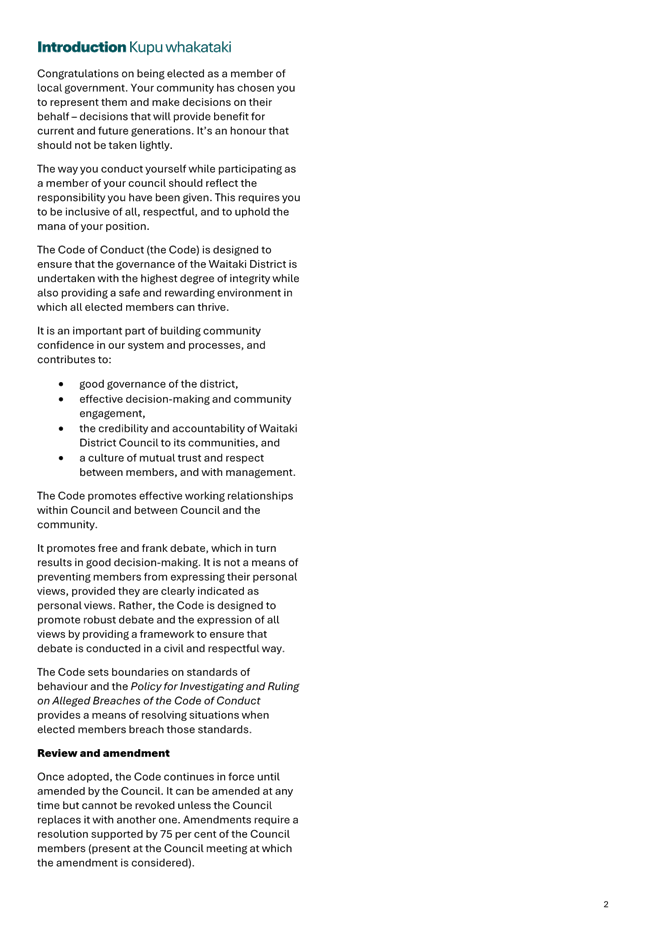
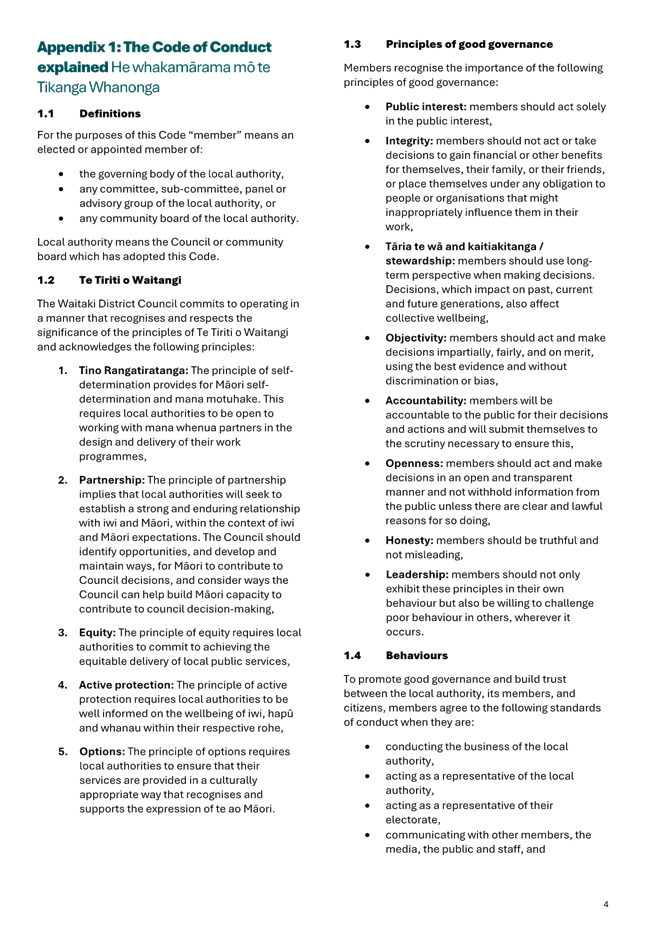
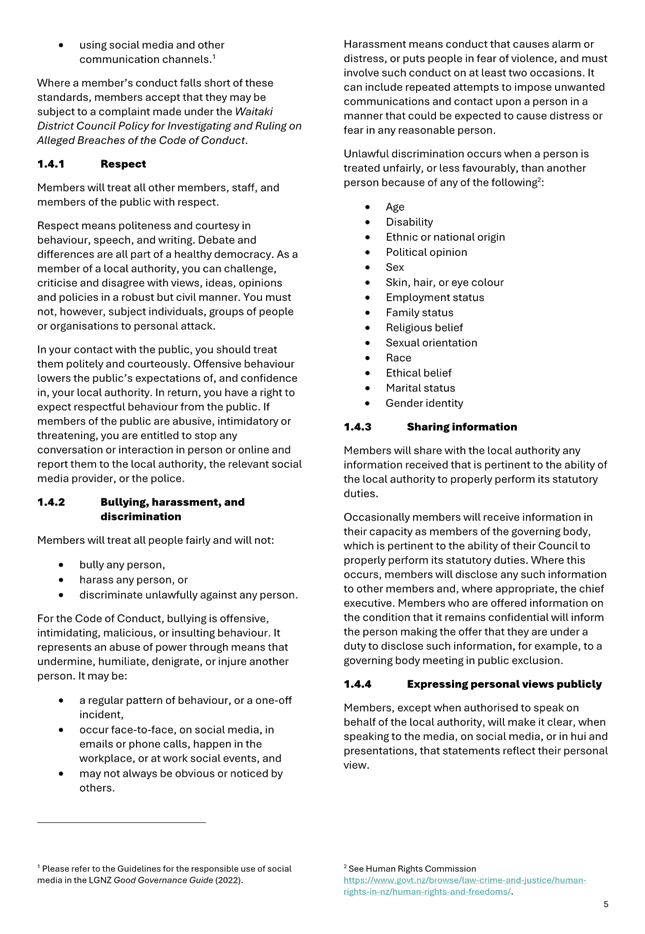
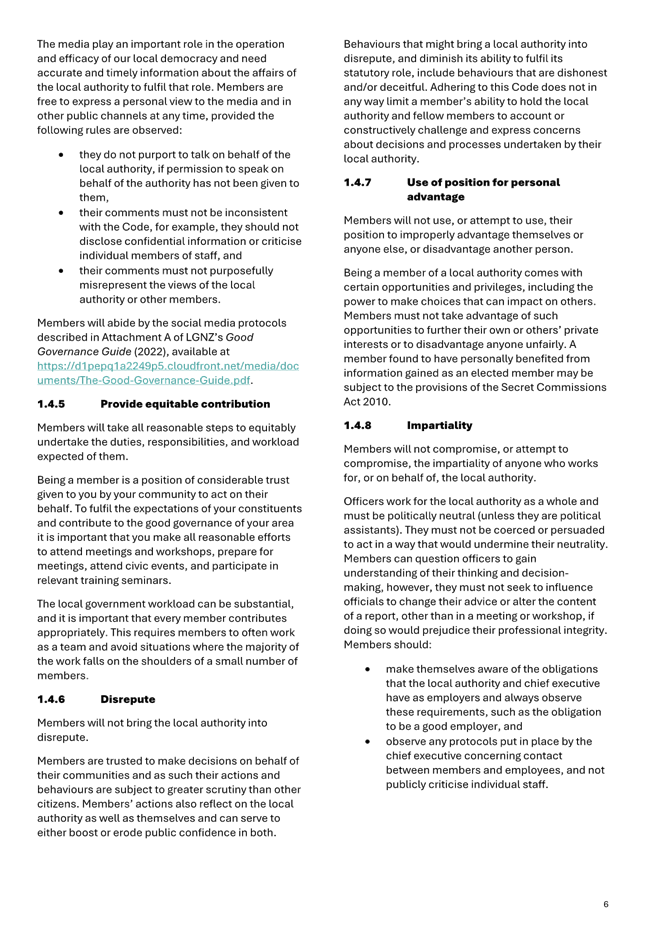
Attachments: 1. Draft
Code of Conduct ⇩ 
2. Draft
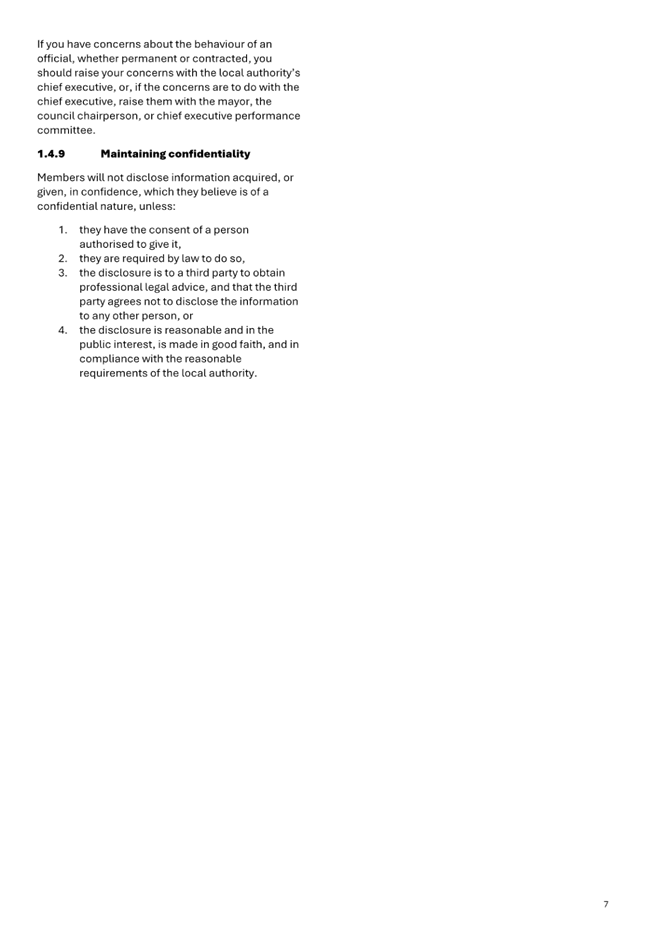
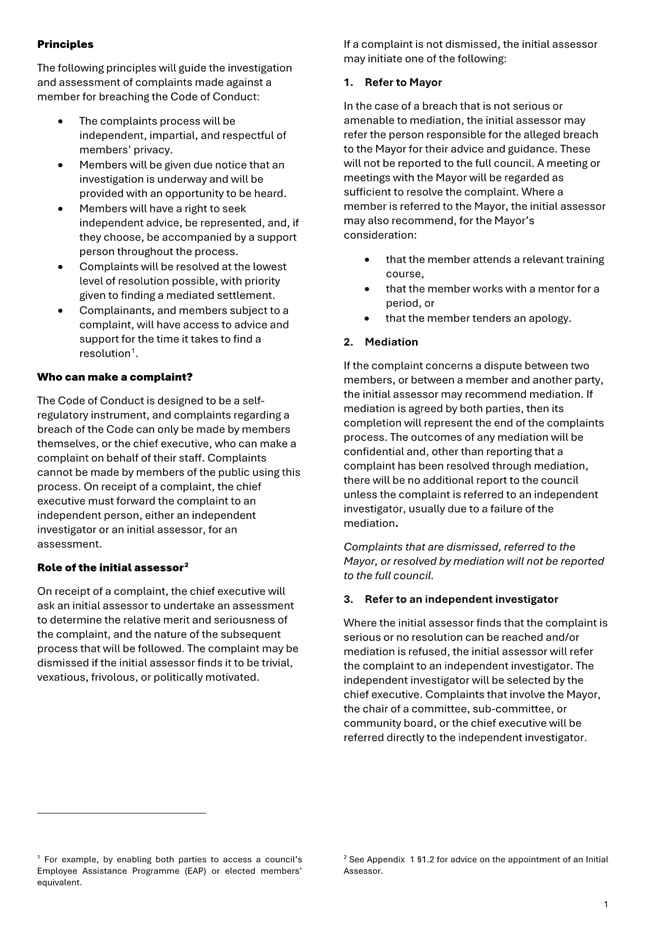
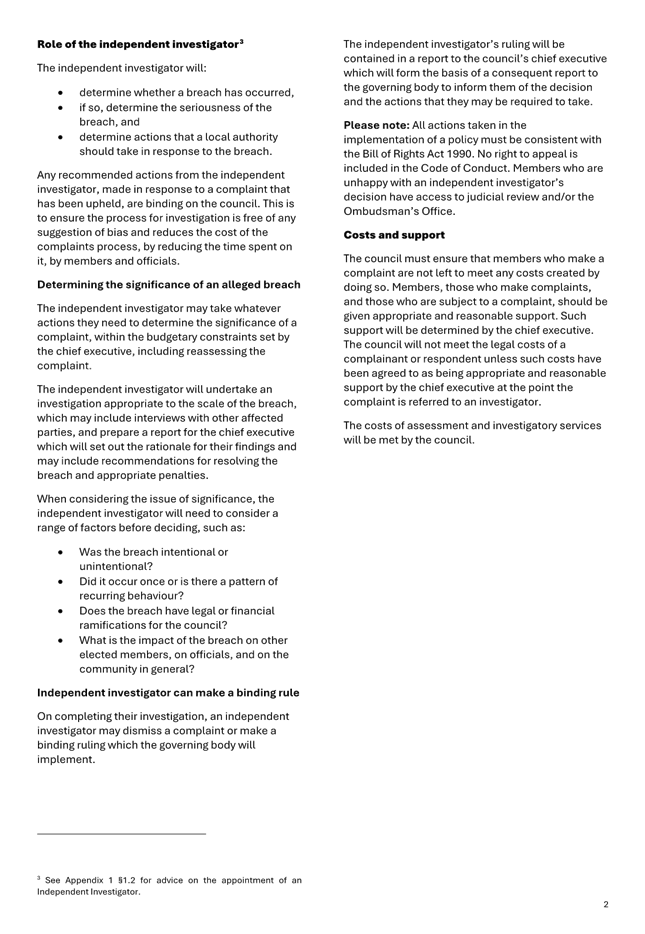
Policy for Investigating and Ruling on Breaches of the Code of Conduct ⇩ 
|
RecommendationS
That the Ahuriri Community Board:
1. Adopts
the Draft Code of Conduct for Elected Members 2025-2028 Triennium as
attached, in accordance with Schedule 7 Clause 15 of the Local Government Act
2002, until the government provides a standardised document as a replacement.
2. Adopts
the Draft Policy for Investigating and Ruling on Alleged Breaches of the
Elected Member Code of Conduct 2025-2028 Triennium, as attached, until the
government provides a standardised document as a replacement.
3. Agrees
to continue with the current arrangements of a two-step investigation
process, and the investigator’s decision being binding, for as long as
the code is in place.
Note: The adoption of the
Code of Conduct requires a supporting vote of not less than 75% of the
members present.
|
PURPOSE
The purpose of this report is to
ensure that the Ahuriri Community Board has a Code of Conduct in place to
enhance:
· The effectiveness
of the Ahuriri Community Board for the good local governance of the Ahuriri
Ward; and
· The credibility
and accountability of the Ahuriri Community Board within its community; and
· Mutual trust,
respect, and tolerance between the elected members as a group and between the
elected members and management.
Summary
The recommendations of this report relate to statutory requirements.
Schedule 7 Clause 15(1) of the Local Government Act 2002 states that a local
authority must adopt a code of conduct for members of the local authority.
Clause 15(4) states that a member of the local authority must comply with the
code of conduct of that local authority.
Background
All elected members are required to adhere
to a Code of Conduct. Once adopted, such a code may only be amended by a 75% or
more vote of the Ahuriri Community Board. The code sets out the board's agreed
standards of behaviour in the following circumstances:
· relationships with other elected members
· relationships with staff
· relationships with the community
· contact with the media
· confidential information
· conflicts of interest
· standing orders
· ethics
· disqualification of members from office or if an elected member is
or has become an undischarged bankrupt
Upcoming Changes to
Legislation
The Local Government (System Improvements)
Amendment Bill is currently before the Governance and Administration Select
Committee.
As part of a package of local government
reform, the Bill will make a range of changes to local governance frameworks
including providing standardised Standing Orders and Codes of Conduct for use
by all councils.
You can read the Bill online: Local
Government (System Improvements) Amendment Bill 180-1 (2025), Government Bill
– New Zealand Legislation.
This
means that if the attached documents are adopted, they will only remain in
place until the standardised document is supplied to councils by the
government. This is expected to happen in 2026.
Options
Option 1 – Not adopt a code of conduct.
If the board chooses this option, the existing code of
conduct will remain in effect until the government issues a standardised
document.
Option 2 – Vote that the matter “lie on
the table” and request a workshop to refine the documents. If the board
chooses this option a workshop will be arranged and the updated code will come
back to a future board meeting with the changes requested at the workshop.
Option 3 – Adopt the code and policy
with any changes requested at this meeting. This is the recommended option.
Conclusion
It is recommended that the Ahuriri Community Board adopts
the attached Code of Conduct and Policy to cover the period between the 2025
election and the issuing of standardised documents by central government.
Additional considerations
Legal Considerations
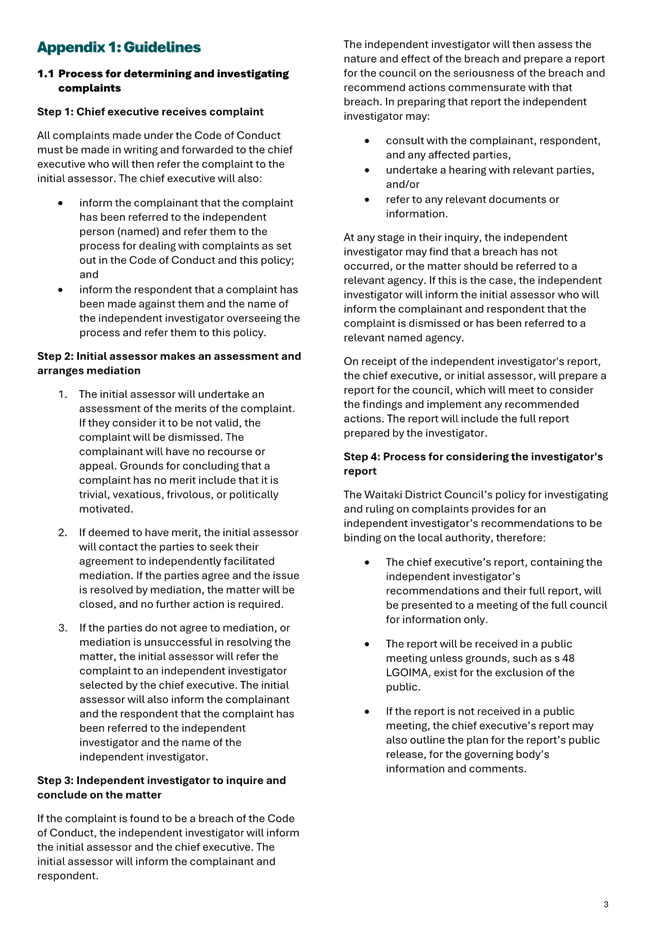
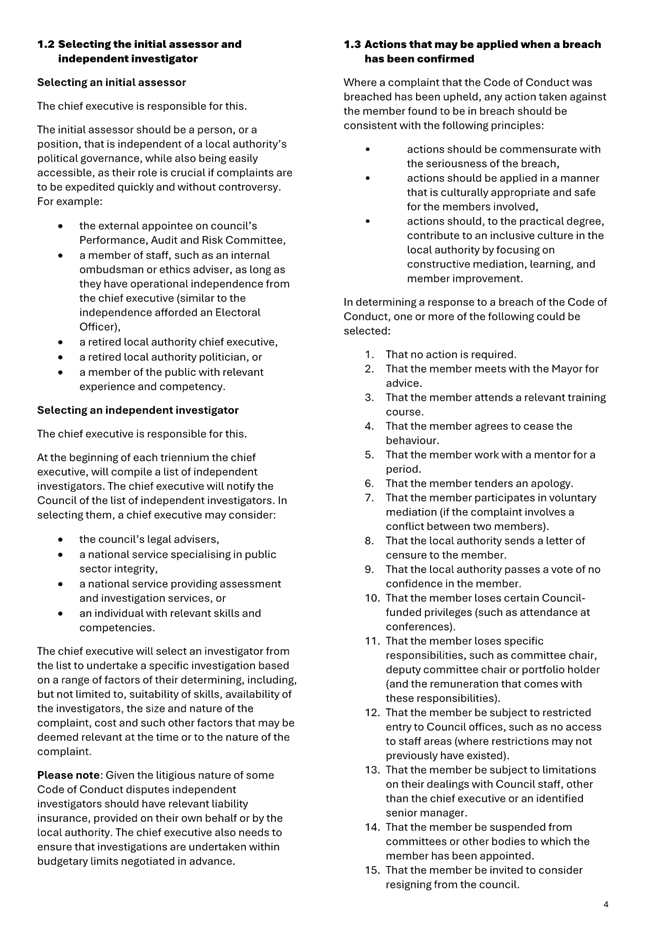
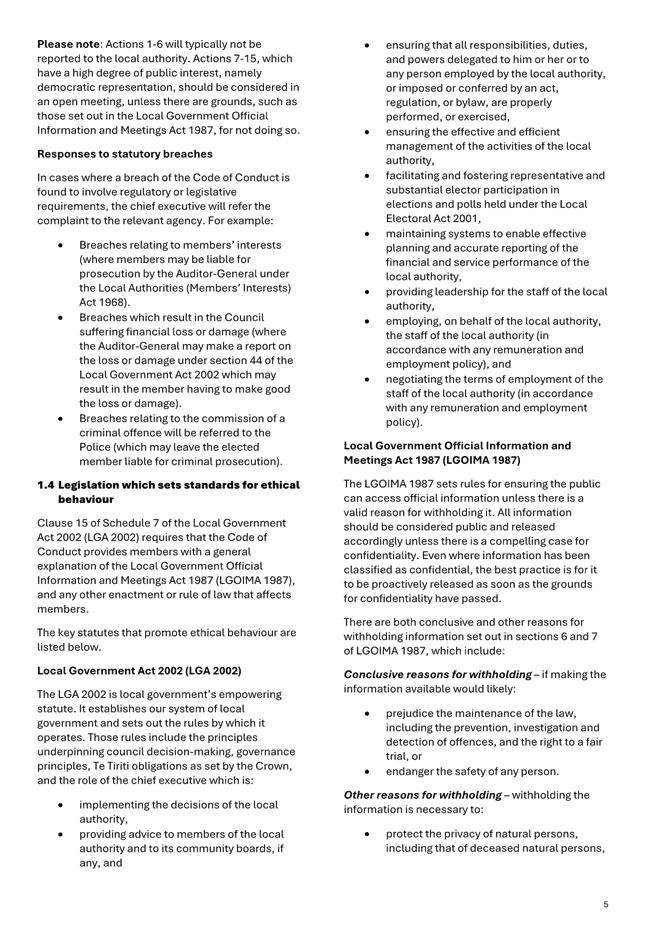
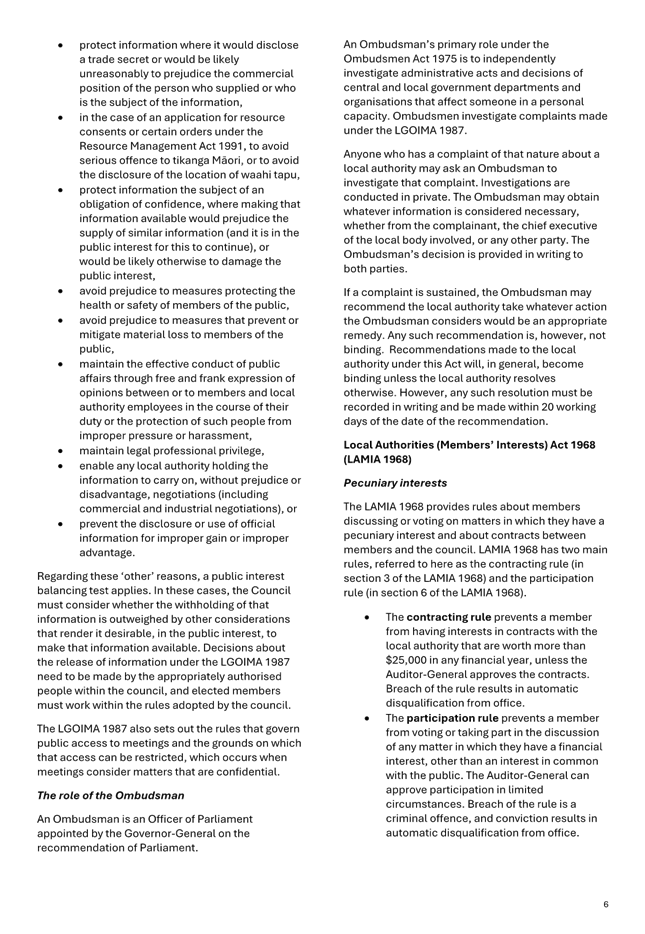
Appendix 2: Schedule
7, Clause 15 Local Government Act 2002 (LGA02)
The LGA02 requires all local authorities to adopt a Code of
Conduct for members as follows:
(1) A local
authority must adopt a code of conduct for members of the local authority as
soon as practicable after the commencement of this Act.
(2) The code of
conduct must set out:
a. Understandings
and expectations adopted by the local authority about the manner in which
members may conduct themselves while acting in their capacity as members
including:
i. Behavior toward
one another, staff, and the public; and
a. Is received by,
or in the possession of, an elected member in his/her capacity as an elected
member; and
b. Relates to the
ability of the local authority to give effect to any provision of this Act; and
b. A
general explanation of:
i. The Local
Government Official Information and Meetings Act 1987; and
ii. Any other
enactment or rule of law applicable to members.
(3) A local
authority may amend or replace its code of conduct, but may not revoke it
without replacement.
(4) A member of a
local authority must comply with the code of conduct of that local authority.
(5) A local
authority must, when adopting a code of conduct, consider whether it must
require a member or newly elected member to declare whether or not the member
or newly elected member is an undischarged bankrupt.
(6) After the
adoption of the code of conduct, an amendment of the code of conduct or the
adoption of a new code of conduct requires, in every case, a vote in support of
the amendment of not less than 75% of the members present.
(7) To avoid doubt,
a breach of the code of conduct does not constitute an offence under this Act.
|
Ahuriri Community Board
Meeting Agenda
|
10 November 2025
|


|
Ahuriri Community Board
Meeting Agenda
|
10 November 2025
|
|
Ahuriri Community Board
Meeting Agenda
|
10 November 2025
|
4.4 Adoption of
Standing Orders
Author: Arlene
Goss, Governance Services Lead
Authoriser: Paul
Hope, Director Support Services
Attachments: 1. Draft
Waitaki District Council Standing Orders 2025 (under separate cover) 
|
RecommendationS
That the Ahuriri Community Board:
1. Adopts
the Standing Orders for Council and Community Boards, as attached, until the
government provides a standardised document to all councils.
2. Agrees
to provide a casting vote to the community board chairperson in the event of
equal votes (see item 19.3 in the attachment).
3. Agrees
to continue with Option C as the default option for speaking to and moving
motions (see item 22.2 in the attachment).
4. Notes
that the Local Government Act 2002 (Clause 16 of Schedule 7) requires members
to comply with the Standing Orders.
Note: The adoption of Standing Orders requires a
supporting vote of not less than 75% of the members present.
|
PURPOSE
The purpose of this report is to
ensure that the Ahuriri Community Board has appropriate and relevant guidance
and rules for the conduct of meetings. This supports good governance practice
and meets the requirements of Schedule 7 27(1) Local Government Act 2002.
Summary
The recommendations in this report relate to statutory requirements.
Schedule 7 27(1) of the Local Government Act 2002 states that a local authority
must adopt a set of Standing Orders for the conduct of its meetings and those
of its committees. Once adopted, Standing Orders may be amended at any time,
but only with a 75% voting majority. Legislation requires all elected members
to follow the Standing Orders.
Upcoming Changes to
Legislation
The Local Government (System Improvements) Amendment Bill is
currently before the Governance and Administration Select Committee.
As part of a package of local government reform, the Bill will make
a range of changes to local governance frameworks including providing
standardised Standing Orders and Codes of Conduct for use by all councils.
You can read the Bill online: Local
Government (System Improvements) Amendment Bill 180-1 (2025), Government Bill
– New Zealand Legislation.
This means that if the attached
Standing Orders are adopted, they will only remain in place until the
standardised document is supplied by the government. This is expected to happen
in 2026.
Options
Option 1 – Not adopt the Standing Orders.
If the board chooses this option, the existing standing
orders will remain in effect until the government issues a standardised
document.
Option 2 – Vote that the matter “lie on
the table” and request a workshop to refine the documents. If the board
chooses this option a workshop will be arranged and the updated code will come
back to a future board meeting with the changes requested at the workshop.
Option 3 – Adopt the Standing Orders
with any changes requested at this meeting. This is the recommended option.
Conclusion
It is recommended that the Ahuriri Community
Board adopts the attached Standing Orders to cover the period between the 2025
election and the issuing of standardised documents by central government.
|
Ahuriri Community Board
Meeting Agenda
|
10 November 2025
|
4.5 Reserve
Classification and Gifting of Kurow School Building (Former)
Author: Suzanne
Clark, Property Officer
Authoriser: Joanne
O'Neill, Director Strategy, Performance, and Design
Attachments: 1. Kurow
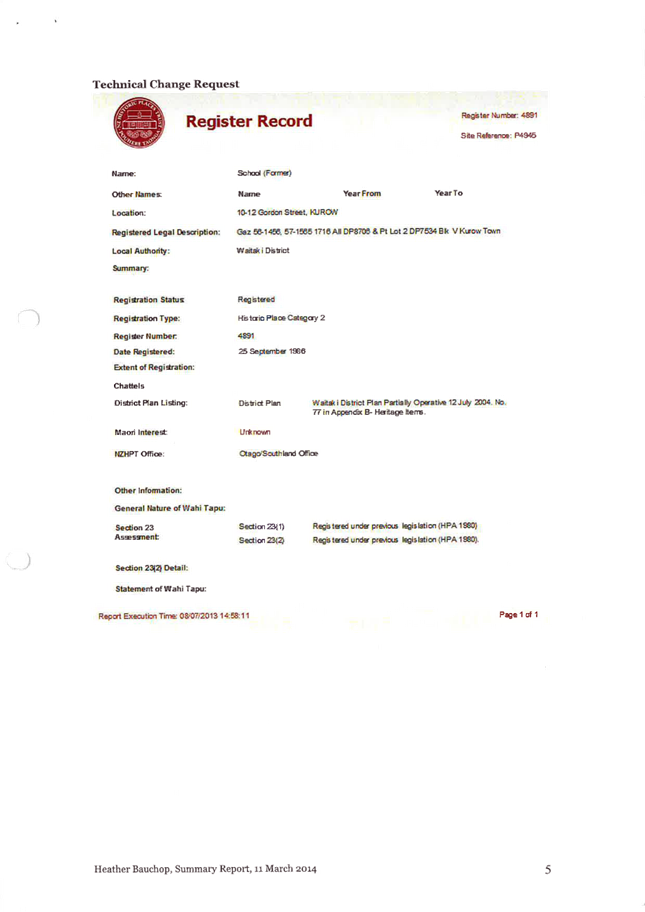
School (Former): Heritage NZ Category 2 Listing (register no. 4891) ⇩ 
2. Reserve
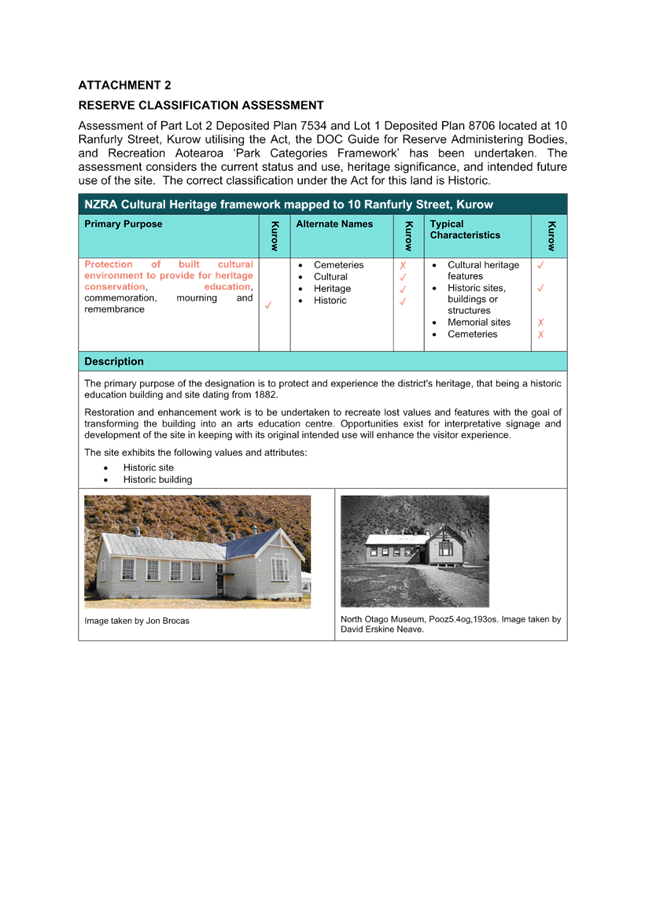
Classification Assessment ⇩
3. Kurow
School (Former) Conservation Plan ⇩
4. Charity
Register - South Star School Charitable Trust ⇩
|
Recommendation
That the Ahuriri Community Board recommends:
That Council:
1. Resolves,
pursuant to Section 24(1)(b) of the Reserves Act 1977, to reclassify Part Lot
2 Deposited Plan 7534 and Lot 1 Deposited Plan 8706 from ‘Recreation
Reserve’ to ‘Historic Reserve’ subject to the completion of
all statutory processes.
2. Authorises
officers to publicly notify the reclassification in accordance with statutory
requirements.
3. Resolves
to transfer ownership of the former Kurow School building and storage shed to
the South Star School Trust by way of gift and grant a peppercorn ground
lease subject to public notification in accordance with statutory
requirements.
That the Ahuriri Community Board:
1. Resolves
to fund all required statutory notification and gazettal, estimated to cost
up to $800 plus GST.
|
Decision Objective
To seek a recommendation to Council to publicly notify the
proposed reclassification of Part Lot 2 DP 7534 and Lot 1 DP 8706, located at
10 Ranfurly Street, Kurow, to an historic reserve under the Reserves Act 1977,
to gift the Kurow School Building (former) to the South Star School Trust, and
to notify the intention to grant a lease on the Reserve.
Summary
A proposal from a community member was received to establish
a Trust to oversee the restoration of the former Kurow School building at 10
Ranfurly Street, Kurow. The vision is to locate Waitaki Art School within part
of the building as well as make space available for community use.
At the Community Board of
the 8 September 2025 an information report was presented outlining the options
for consideration.
The school building holds significant heritage value. It is
located on the original Education Department site, is listed as a Category B
heritage item in the Waitaki District Plan and is registered as a Category 2
historic place by Heritage New Zealand (Register No. 4891), refer Attachment 1.
The land is currently classified as a Recreation Reserve and
vested in Waitaki District Council under the Act. Commercial activity is listed
as a discretionary activity in the Reserves Management Plan. Although a
charitable Trust will oversee the operation and management of the building,
officers have assessed that the activity is commercial as income for
individuals will be generated. Under Section 54(1)(d) of the Reserves Act 1977
(the Act), commercial activity may be permitted on a recreation reserve only
where it is necessary to enable public benefit and enjoyment of the reserve, or
for the convenience of users.
The proposed activity is ancillary to but not complementary
with the primary recreational purpose of the reserve. This has prompted a
review of whether the current reserve classification is appropriate and aligns
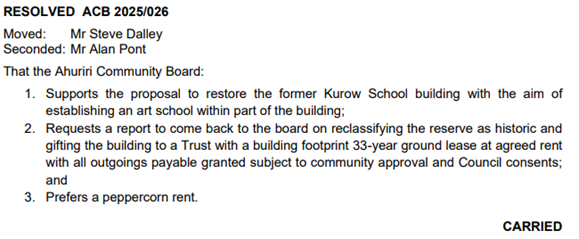
with the direction given by the Community Board and recorded in resolution
ACB2025/026 “to come back to the board on reclassifying the reserve as
historic and gifting the building to a Trust with a building footprint 33-year
ground lease at agreed rent with all outgoings payable granted subject to community
approval and Council consents”.
The Act provides for various classifications based on the
primary purpose of the land, including Recreation, Historic, Scenic, Nature,
Scientific, Local Purpose, and Government Purpose.
This report recommends reclassifying the land to a Historic
Reserve to better reflect its heritage significance and support the proposed
future use.
Council approval is also sought to transfer ownership of the
school building and outside shed to the South Star School Trust and to publicly
notify the intention to grant a ground lease to the Trust.
decision-making expectations
|
Governance Decision-Making:
|
Approve proposal to reclassify Kurow Recreation Reserve to Historic
Reserve and to transfer by way of gift to South Star School Trust, the Kurow
School Building (former) located at 10 Ranfurly Street, Kurow.
|
|
Operational
Decision-Making:
|
Delegate the Chief Executive to implement Council’s resolution
including completion of all statutory processes under the Reserves Act and
the transfer of the building to the Trust.
A ground lease will be negotiated with the Trust.
|
|
Communications
|
Media Releases – contributed to by officers and Elected
Members.
Media/public enquiries regarding governance decision-making topics
above can be addressed by governance.
Media/public enquiries regarding operational decision-making topics
above can be addressed by officers.
|
Summary of Decision-Making Criteria
|
|
No/Moderate/Key
|
|
No/Moderate/Key
|
|
Policy/Plan
|
Moderate
|
Environmental
Considerations
|
No
|
|
Legal
|
Moderate
|
Cultural Considerations
|
Moderate
|
|
Significance
|
No
|
Social Considerations
|
No
|
|
Financial Criteria
|
No
|
Economic Considerations
|
No
|
|
Community Views
|
Key
|
Community Board Views
|
Key
|
|
Consultation
|
No
|
Publicity and
Communication
|
Moderate
|
Background
Land and building status
The land located at 10 Ranfurly Street,
Kurow is currently classified as Recreation Reserve under the Act and is
managed by Waitaki District Council as a neighbourhood reserve, in accordance
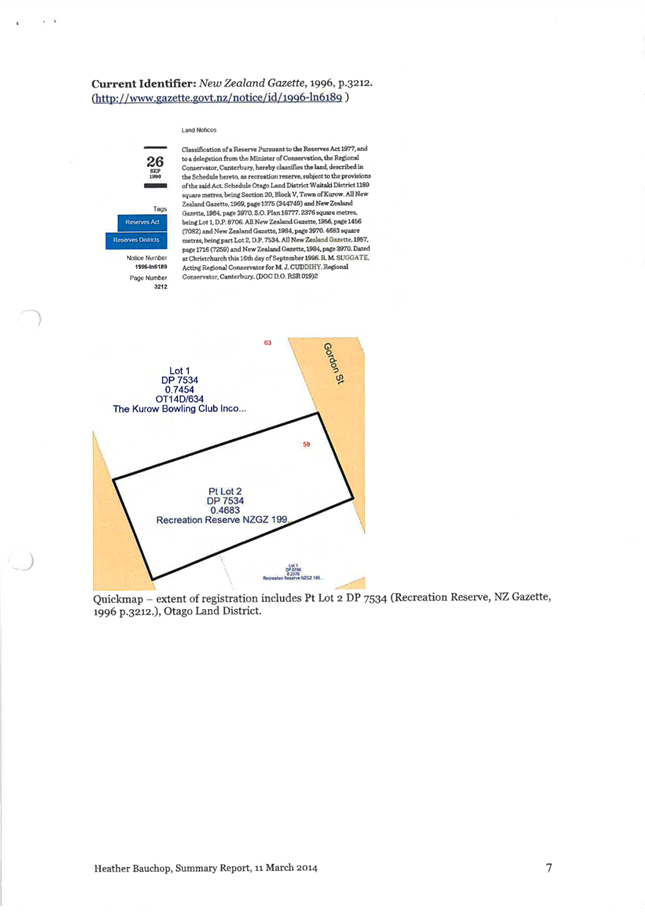
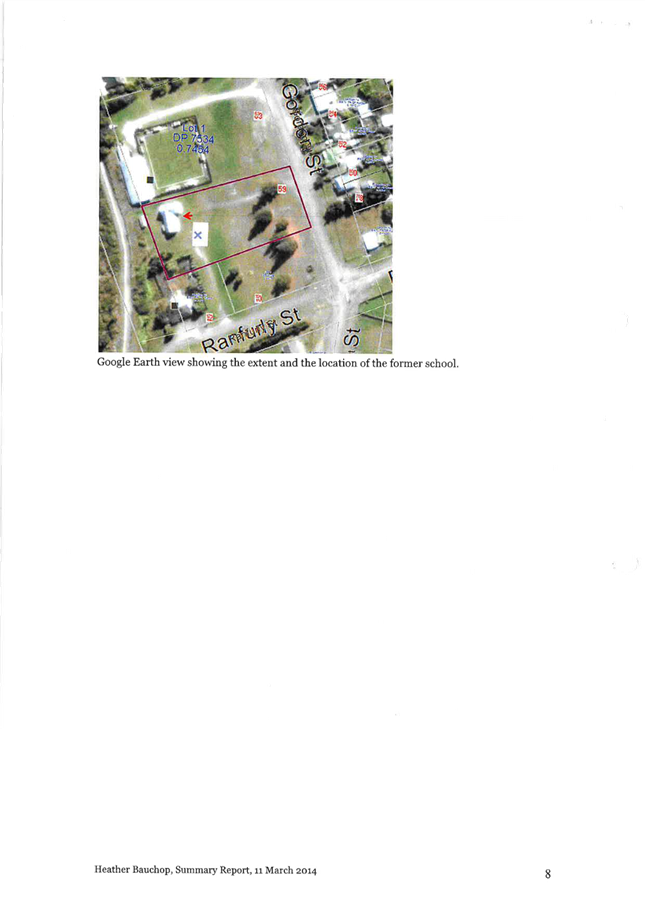
with the adopted Reserves Management Plan (see Image A).
The reserve is undeveloped with no built
recreation infrastructure and consists of wide-open mowed grass areas with
several specimen trees. The Kurow Bowling Club owns the neighbouring
parcel of land. Nearby Kurow Railway Reserve has been developed to
provide the community with recreation opportunities e.g. playground, bike
tracks, basketball hoop, skateboard ramps, and a large continuous walking
area. The community also has access to many other recreational
opportunities within the local area.

Image A
Summary of Options Considered
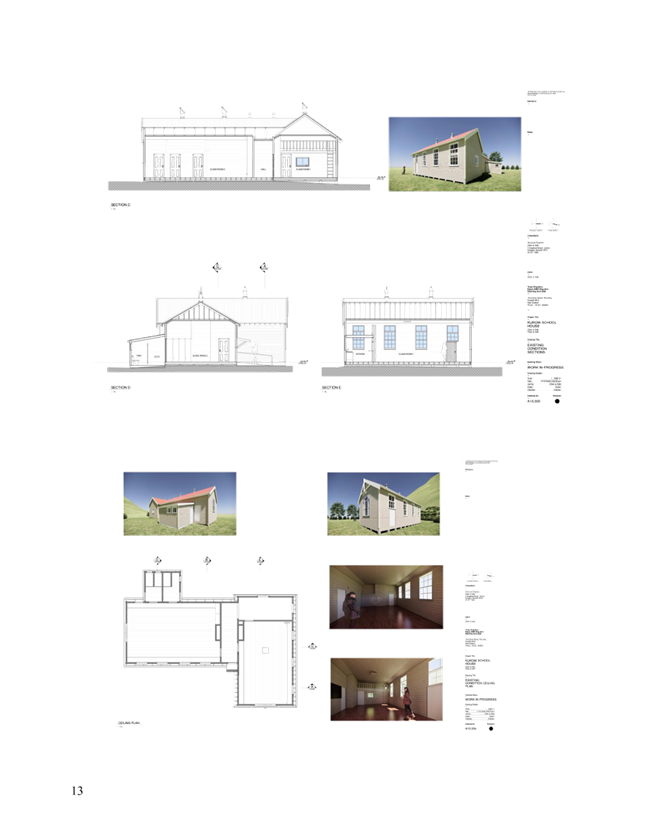
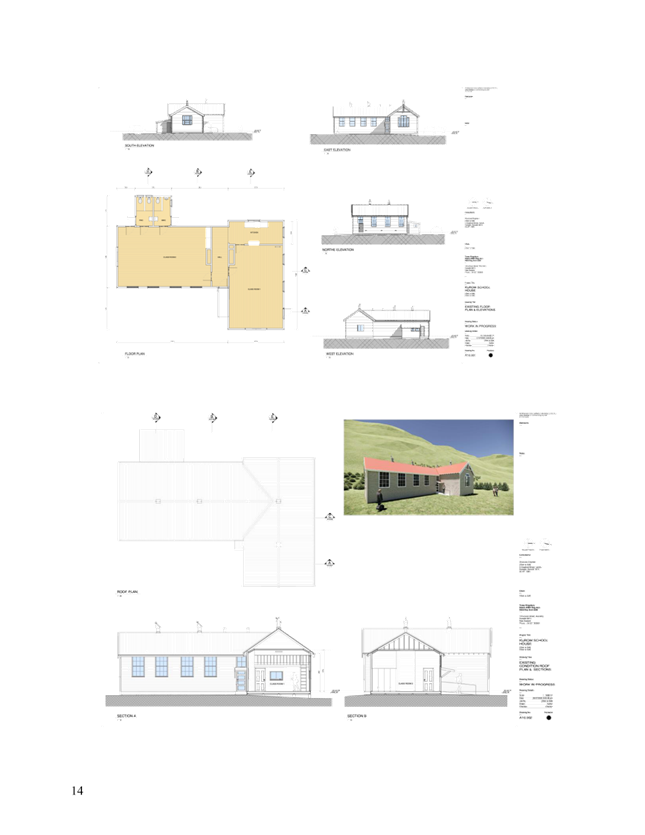
The site contains the former Kurow School building which is
not listed on Council’s asset register. However, advice from the
Department of Conservation indicates that ownership likely transferred to the
former Waitaki County Council when the land was vested in 1984.
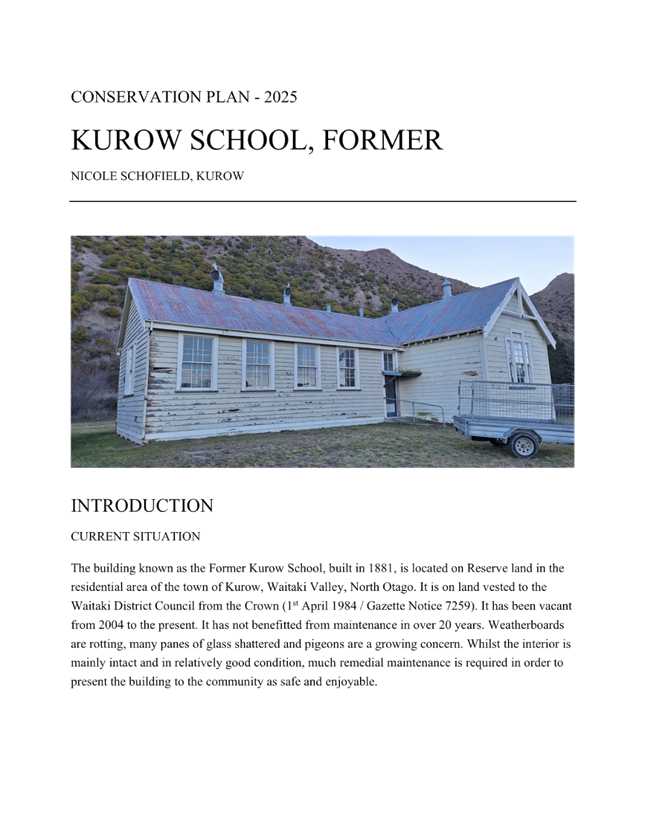
Historically, the former Kurow School building has been used
by the Kurow Scouts, and it is currently utilised by the Kurow Museum for
storage. There is no active lease in place.
The building and the land
both hold heritage value. The building and Part Lot 2 DP 7534 is registered as a Category 2 historic place by Heritage NZ
(register no. 4891) and the building has a Category B
listing in the Waitaki District Plan.
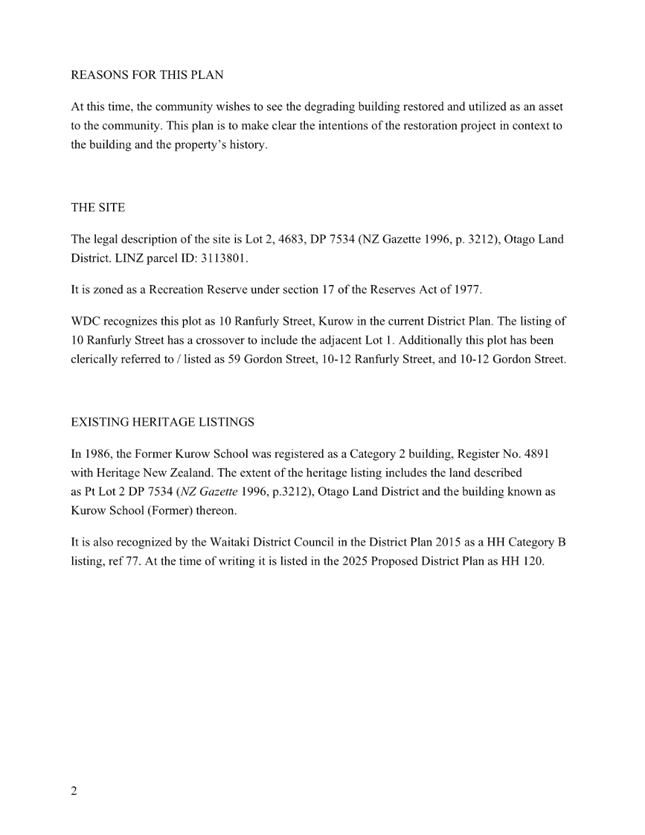
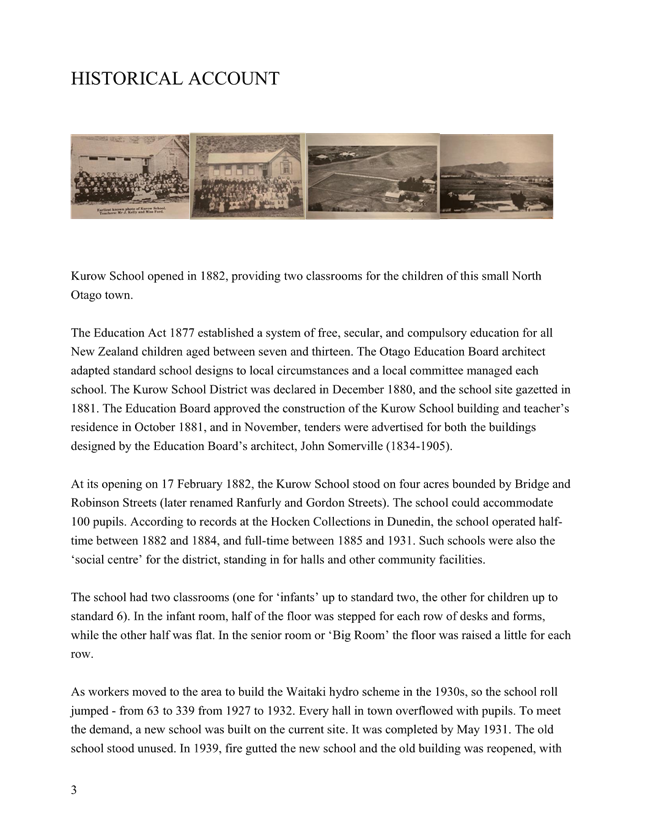
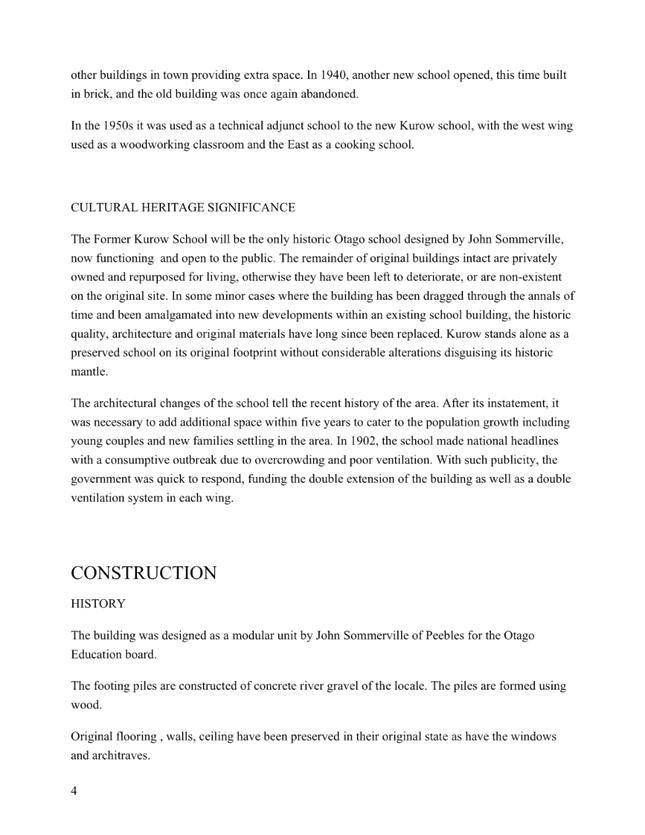
Opened in 1882, the school
was the first in Upper Waitaki. Its design reflects 19th-century school
architecture and is a rare surviving example of a wooden school building from
that era. The original site spanned 4 acres, allowing students to graze their
horses during the school day. The building’s exterior remains largely
unchanged, though both the interior and exterior require extensive restoration.
The shed is not original and
doesn’t form part of the Heritage NZ listing.
Reclassification -
Reserves Act Process
Under Section 24 of the Reserves Act 1977, Council may, by
resolution and following public notification, reclassify reserve land to better
reflect its current and intended use. The Act and the Department of
Conservation’s (DOC) Guide for Reserve Administering Bodies outline the
statutory process for this. Recreation Aotearoa’s Parks Category
Framework was also used to assist with the assessment.
The reserve’s present and future values have been
assessed as primarily cultural and heritage (see Attachment 2).
It is recommended that the reserve be reclassified as a
Historic Reserve to acknowledge the site’s educational and cultural
heritage.
The reserve parcel
described below is proposed to be reclassified Historic Reserve
|
Reserve Location
|
10 Ranfurly Street, Kurow
|
|
Legal Description
|
Part Lot 2 DP 7534, Lot 1
DP 8706
|
|
Area
|
.7059 ha
|
|
Current Classification
|
Recreation Reserve
|
Reason
for reclassification: The land’s primary purpose is
to preserve the historic Kurow School building, located on its original
Education Department site. Reclassifying it as a Historic Reserve better
reflects its heritage value and supports the future intended use.
The Reserves Management Plan will be updated during the
review scheduled to start in 2026.
Proposed
future use of land and buildings
The South Star School Trust
has signalled their interest in restoring the former school building. Once
restored, the building would serve as a gallery showcasing local artists and a
school offering classes in visual arts, dance, music, drama, and crafts. The
Waitaki Art School, which currently operates across multiple locations in
Kurow, would be consolidated into this historic site, supporting its operation
and enhancing its role within the community.
The South Star School Trust has prepared a Conservation Plan
to restore the building (refer Attachment 3). The restoration is estimated to
cost approximately $450,000, with funding expected to come from a combination
of community grants, donations, and contributions from local artists. Volunteer
tradespeople and labour will also support the restoration effort.
This proposed use of the
building aligns well with the Historic Reserve classification and the
underlying Heritage NZ and Waitaki District Plan heritage listings.
Under this scenario, the land
will still be available to the community to use for passive recreation or
community events. It is anticipated that Council would continue to
maintain the grassed area at the same level of service as currently provided.
Gifting
of building and transferring of Council ownership
Under Section 12 of the Local Government Act 2002 (LGA02),
Council is authorised to dispose of the building, provided it complies with the
requirements of Section 14 of the LGA02.
An option for council is to gift the buildings to the Trust
in their current condition, with the Trust assuming full responsibility for
restoration, maintenance, and ongoing operational costs. The storage shed could
be demolished for materials if there was no use for it. A lease would be
granted, and officers recommend that rent be set at a nominal rate, with
provisions for future rent reviews.
A transfer of ownership to the Trust would significantly
improve its ability to secure external funding; refer to Attachment 4 for the
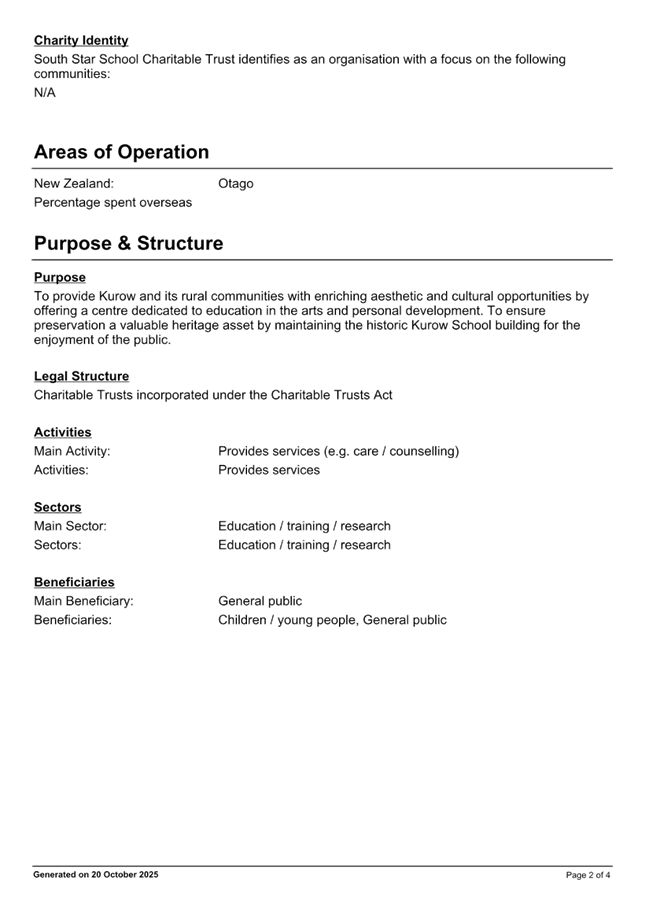
Trust’s charities registration.
Appointment of a board or voluntary organisation to
control and manage the reserve
The Ahuriri Community Board requested information on the
process for appointing a non-Council organisation to control and manage a
reserve.
Under Section 30 of the Act, Council may relinquish its
vesting in a reserve, returning the ownership to the Crown and allowing the
Department of Conservation to appoint a board to manage the land. Before
agreeing to such an arrangement, the Department of Conservation typically
expects a clear rationale for the change, evidence of community and iwi
support, proposed board membership details, a commitment to prepare a
management plan, an understanding of legal obligations, agreement to audit
requirements, and clarity around the board’s term, structure, and
chairperson appointment.
Alternatively, under Section 29 of the Act, Council may
formally appoint a voluntary organisation to control and manage a reserve. This
process requires a formal gazettal and compliance by the voluntary organisation
with statutory obligations, including financial reporting and management
planning.
In practice, it is more common for voluntary or not for
profit organisations to manage reserves through a Memorandum of Understanding
(MOU) with the local council rather than through formal appointment under the
Act. MOUs are non-legally binding agreements that outline roles,
responsibilities, and shared goals. They offer flexibility, are easier to
establish, and can be tailored to suit local needs.
An example of an MOU approach is the Puketapu Community
Trust, which has an MOU with Council for the maintenance of the Puketapu
Recreation Reserve. The Trust is responsible for maintenance activities and
works in alignment with an agreed vision for the reserve’s restoration.
Summary of options considered
Option 1
(preferred option):
1. Reclassify
Part Lot 2 Deposited Plan 7534 and Lot 1 Deposited Plan 8706 from
‘Recreation Reserve to ‘Historic Reserve’ under the Reserves
Act 1977 subject to completion of all statutory processes; and
2. Transfer
ownership of the former Kurow School building and storage shed to the South
Star School Trust by way of gift and grant a peppercorn ground lease subject to
public notification in accordance with statutory requirements.
This option recognises the historical significance of both
the building and the land and will ensure preservation of both the building and
the site. Transferring ownership of the historic, but currently rundown
building, to the South Star School Trust—alongside a peppercorn ground
lease—would enable the Trust to undertake restoration and utilise the
space.
|
Advantages
|
Disadvantages
|
Risks
|
|
· Provides formal recognition of the site’s
heritage value under the Reserves Act.
· Enables the Trust to pursue external funding
opportunities, as ownership strengthens eligibility for grants.
· Transfers financial responsibility for restoration
and ongoing maintenance away from Council.
· Supported by the South Star School Trust and aligns
with community desires.
· Enhances local arts and culture, will attracting
visitors and support economic development.
· Recognition of a heritage building and land under
the Act as well as provides a good legal fit for the future art school.
· Ground lease conditions can include clauses for
improvements to revert to Council if the Trust is dissolved.
· A building in use is the best form of protection
against vandalism/arson and loss of heritage value.
|
· Reclassification from Historic Reserve to another
purpose is difficult to reverse and will limit future alternative uses of the
land.
· Should the Trust dissolve, Council will be expected
to fund the operation of a community facility.
|
· The Trust may be unable to raise sufficient capital
for restoration or ongoing operations, leading to project failure.
· Lack of long-term viability or governance capacity
within the Trust could result in underuse or deterioration of the building.
|
Option 2: Transfer
ownership of the former Kurow School building and storage shed to the South
Star School Trust by way of gift, subject to the building’s removal from
the reserve site.
This option seeks to reduce
Council’s long-term financial responsibility by removing the building
from the land, while still enabling its preservation by the Trust. The reserve
land would be retained for recreational purposes, and the building could be
relocated to a more prominent location within the community.
|
Advantages
|
Disadvantages
|
Risks
|
|
· Permanently removes the building from
Council’s responsibility, reducing future financial obligations for
ratepayers.
· No formal statutory process is required for land
reclassification, allowing the transfer to proceed once the Trust is formed.
· Frees up reserve land for recreational use,
consistent with its current classification.
· Relocation to a main street or high-visibility
location could see the restored building well frequented by visitors.
|
· Not supported by the Trust, which prefers to retain
the building on its original site.
· A suitable relocation site would need to be
identified and secured.
· The Trust would incur additional costs and face
regulatory requirements related to relocation, consenting and securing
suitable land.
|
· The Trust may not be willing or able to proceed with
relocation and restoration, as this option does not align with its vision.
· Additional regulatory oversight and costs could
delay or jeopardize the project.
· If relocation proves unfeasible, the building may
remain unused or deteriorate further, undermining heritage preservation
goals.
|
Option
3: Status Quo
Under this option, no action is taken. The reserve remains
classified as a Recreation Reserve, and the former Kurow School building
remains in Council ownership on site, with no formal restoration or transfer
arrangements in place.
|
Advantages
|
Disadvantages
|
Risks
|
|
· No immediate administrative or legal processes are
required.
|
· The
heritage building continues to deteriorate due to lack of restoration or
active use.
· Increased
risk of vandalism and associated cleanup costs.
· Opportunity to support a community-led initiative
and preserve a significant heritage asset is lost.
|
· Reputational risk to Council for not supporting a
heritage and community project.
· Potential future costs to ratepayers if Council is
later required to restore or demolish the building due to deterioration.
· Missed opportunity to activate the site for cultural
and educational use.
|
Assessment of Preferred Option
Option 1 is the preferred option. This involves
reclassifying the reserve as a Historic Reserve and transferring
ownership of the former Kurow School building and storage shed to the South
Star School Trust by way of gift and grant a peppercorn ground lease subject to
public notification in accordance with statutory requirements.
This approach is considered the most effective as it
delivers positive outcomes for the Trust, Council, and the wider community. It
supports heritage preservation, encourages creative and educational activity,
and reduces long-term financial responsibility for Council.
Conclusion
Council officers recommend proceeding with reclassifying
Part Lot 2 DP 7534 and Lot 1 DP 8706 from Recreation Reserve to Historic
Reserve, and to transfer ownership of the former Kurow School building and
storage shed at 10 Ranfurly Street, Kurow to the South Star School Trust.
This approach appropriately recognises the site's
significant heritage value as the location of Upper Waitaki's first school,
enables the Trust to secure external funding for the restoration project, and
supports the development of a consolidated Waitaki Art School that will enhance
cultural and educational opportunities in Kurow. By transferring the buildings
to community ownership while retaining the land in Council's control through a
peppercorn ground lease, this option balances heritage preservation with fiscal
responsibility, ensures the building's activation rather than continued
deterioration, and aligns with both community aspirations and the statutory
framework of the Reserves Act 1977.
The proposal represents a prudent investment in Kurow's
cultural infrastructure that will benefit current and future generations while
relieving ratepayers of ongoing maintenance obligations.
Council approval is sought to proceed with the
reclassification, and transfer of the building to the South Star School Trust
and public notification of the proposed ground lease.
Additional Decision-Making Considerations
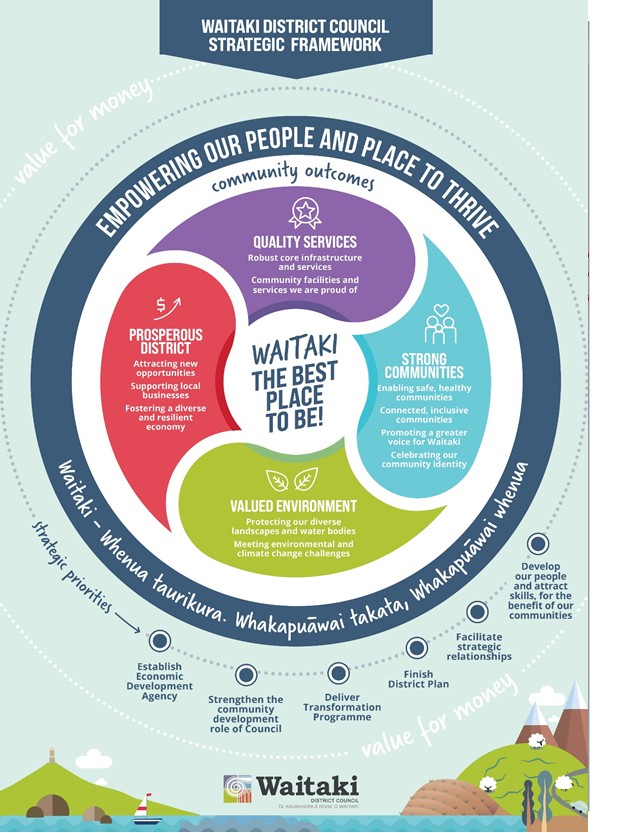
Waitaki District Council Strategic Framework
Outcomes
Community Outcomes
Prosperous District
· Attractive
to new opportunities
· Supporting
local businesses
· Fostering
a diverse and resilient economy
Strong Communities
· Enabling
safe, healthy communities
· Connected,
inclusive communities
· Promoting
a greater voice for Waitaki
· Celebrating
our community identity
Quality Services
· Robust
core infrastructure and services
· Community
facilities and services we are proud of
Valued Environment
· Protecting
our diverse landscapes and water bodies
· Meeting
environmental and climate change challenges
Policy
and Plan Considerations
The preferred option aligns with the objectives of
Council’s Culture and Heritage Strategy, which supports the
preservation, restoration, and activation of heritage assets for community
benefit.
Community
Views
Written support for the building restoration and
establishment of the Waitaki Art School has been received from Heritage New
Zealand and the Waitaki Valley Community Society.
Two submissions were received through the Long-Term Plan
2025–2034 process relating to the reserve:
· Submission
#322 (Waitaki Valley Community Society Inc) requested that Council undertake
maintenance on the former school building. The Society are in full
support of the Trust’s proposal.
· Submission
#325 proposed that the reserve be developed into an off-leash dog area. Council
officers responded that the Kurow Rail Reserve has already been designated for
this purpose.
An article published in the Otago Daily Times on 16
October 2025 suggests there is strong community support for the proposal.
In accordance with the Act, a one-month public notification
period is required for both the proposed reclassification and the intention to
grant a lease.
Any objections received during this period will be
considered by Council or a Council Hearings Committee.
Financial
Considerations
There has been no recent Council expenditure on the
building. As the building is not listed on Council’s asset register, its
disposal will not result in an accounting loss or have any direct cash impact
on Council’s financial position.
Costs will be incurred to complete the reclassification and
gifting process, specifically the public notifications and gazettals. There is
currently no Council budget allocated for this purpose. The estimated cost is
$500–$800, which would cover advertisements in the Kurow Bugle,
Council’s Waitaki Weekly page, and the final Gazette notice. A
recommendation has been made for the Community Board to cover this cost.
Legal
Considerations
The preferred option complies with the Reserves Act 1977 in
relation to both reserve reclassification and lease arrangements. It also
satisfies Council’s legal obligations for asset disposal under Sections
12 and 14 of the Local Government Act 2002.
Once the reserve is reclassified as ‘historic’,
section 24(5) of the Reserves Act requires that a report from Heritage New
Zealand be prepared before any future reclassification can occur. A historic
classification will be difficult to reverse, and future development of the land
will be limited to activities that support and align with its historic status.
|
Ahuriri Community Board
Meeting Agenda
|
10 November 2025
|





|
Ahuriri Community Board
Meeting Agenda
|
10 November 2025
|
|
Ahuriri Community Board
Meeting Agenda
|
10 November 2025
|




|
Ahuriri Community Board
Meeting Agenda
|
10 November 2025
|


|
Ahuriri Community Board
Meeting Agenda
|
10 November 2025
|
5 Memorandum
Reports
5.1 Correspondence
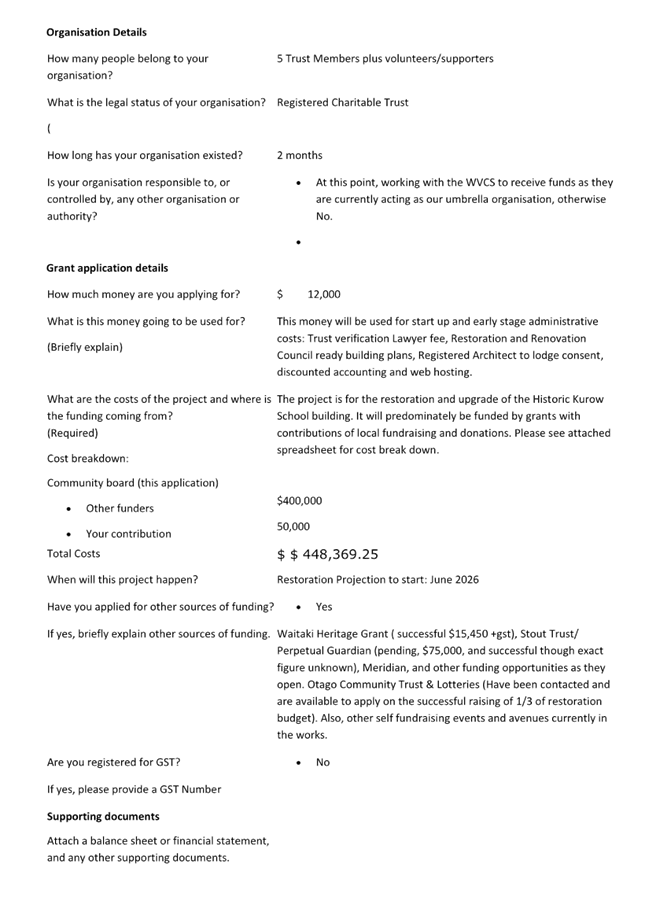
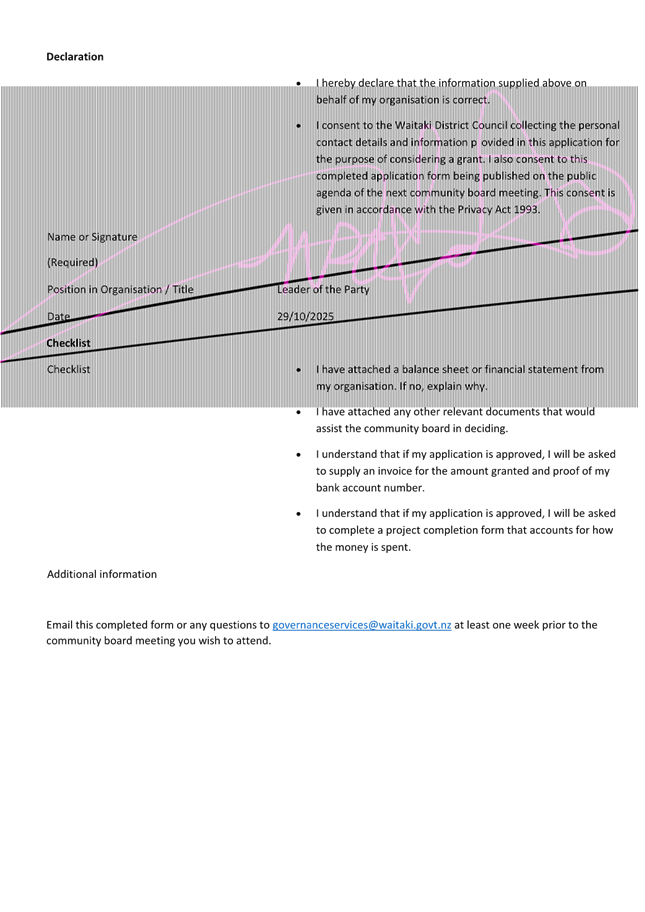
- Community Board Grant Application from South Star School Charitable Trust
Author: Allyson
Woock, Governance Services Officer
Attachments: 1. Community
Board Grant Application Form - South Star School Charitable Trust ⇩ 
2. Grant
Application Attachment - Former Kurow School Restoration Budget ⇩ 
3. Grant
Application Attachment - Aim of Project ⇩ 
4. Grant
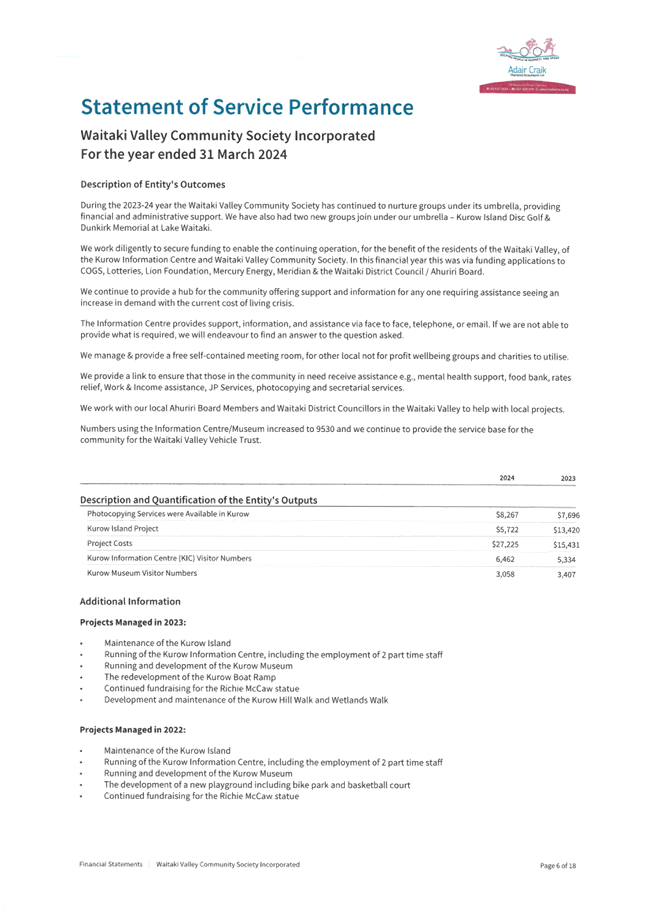
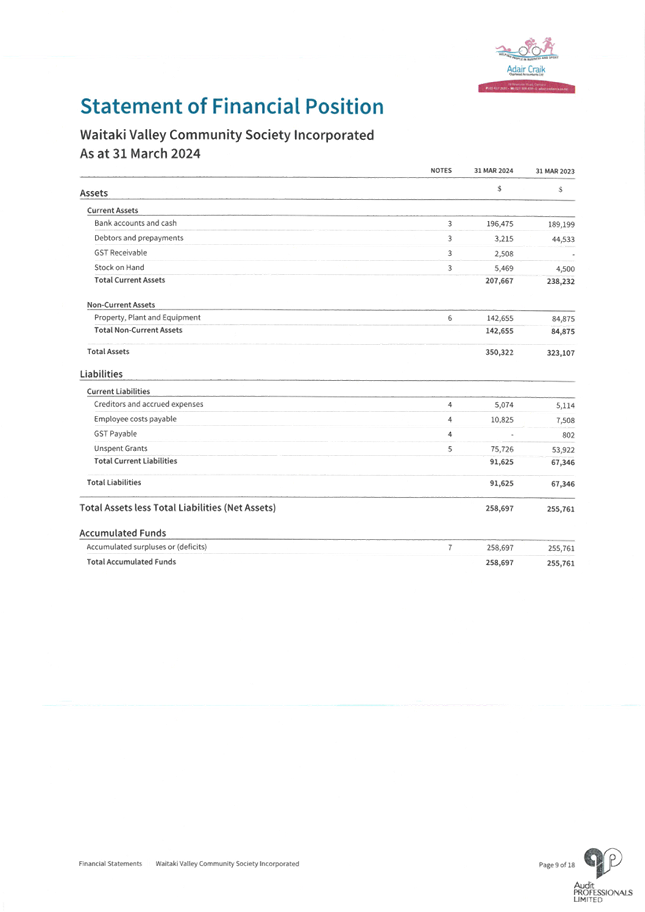
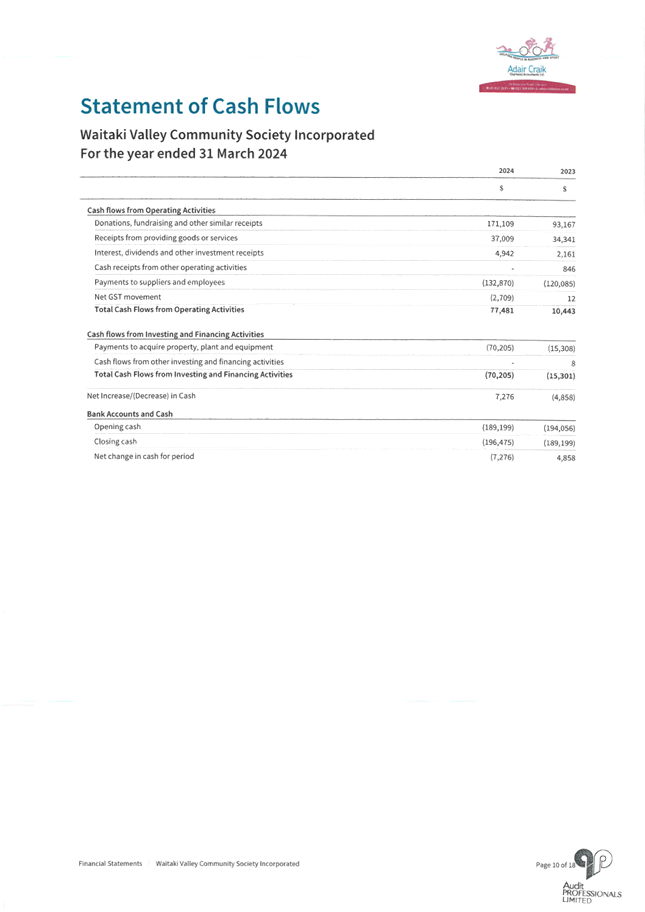
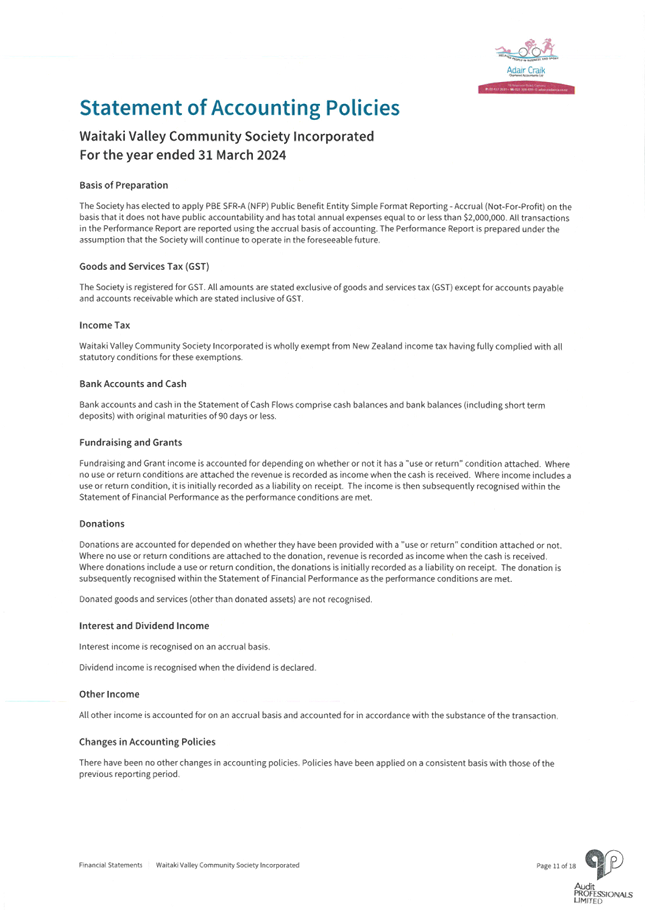
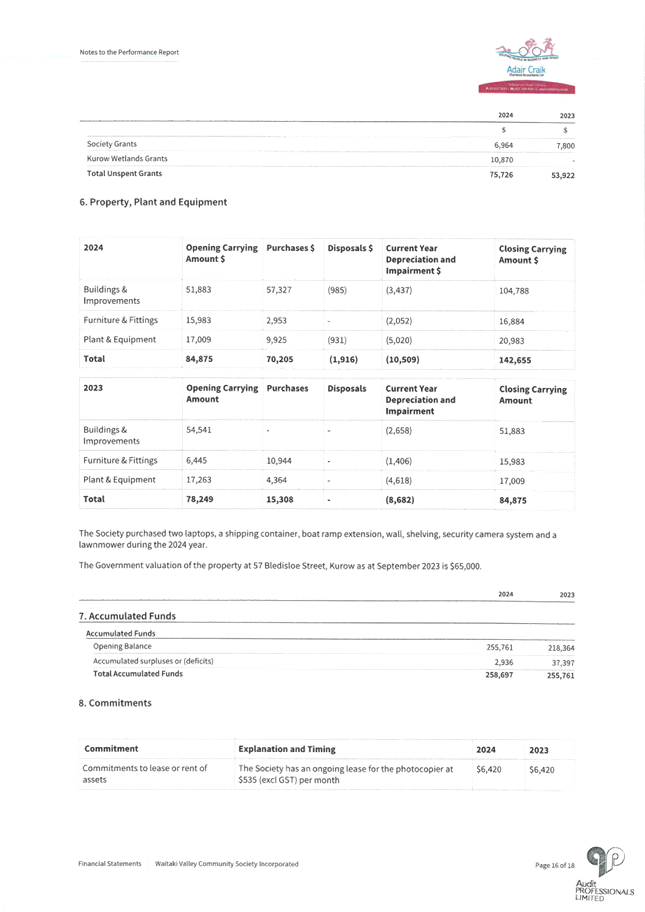
Application Attachment - Waitaki Valley Community Society Incorporated
Financial Statements (for the year ended 31 March 2024) ⇩
|
Recommendation
That the Ahuriri Community Board formally receives the
attached items of correspondence and considers any actions in response.
|
Purpose
The purpose of this report is to present correspondence
surrounding a community board grant application from South Star School
Charitable Trust in relation to the former Kurow School project.
|
Ahuriri Community Board
Meeting Agenda
|
10 November 2025
|

|
Ahuriri Community Board
Meeting Agenda
|
10 November 2025
|

|
Ahuriri Community Board
Meeting Agenda
|
10 November 2025
|

|
Ahuriri Community Board
Meeting Agenda
|
10 November 2025
|













|
Ahuriri Community Board
Meeting Agenda
|
10 November 2025
|
5.2 Explanation
of Legislation by the Chief Executive
Author: Arlene
Goss, Governance Services Lead
|
Recommendation
That the Ahuriri Community Board receives and notes the
information.
|
Purpose
The purpose of this report is to provide a summary of the key
legislation that is of importance to elected members, as required under the
Local Government Act 2002.
SUMMARY
To report on legislation as set out in Section 48 and Clause
21(5)(c) of Schedule 7 of the Local Government Act 2002.
background
The Local Government Act 2002 (“the Act”) requires that,
at the first meeting of the Ahuriri Community Board following the triennial
general election, a general explanation must be given of the Local Government
Official Information and Meetings Act 1987 (LGOIMA 1987) and appropriate
provisions of:
(a) The Local Authorities (Members’
Interests) Act 1968;
(b) Sections 99, 105 and 105A of the Crimes
Act 1961;
(c) The Secret Commissions Act 1910; and
(d) The Financial Markets Conduct Act 2013.
An explanation of the Health and Safety at Work Act 2015 and the
Public Records Act 2005 as it applies to Council and elected members has also
been provided.
LOCAL
GOVERNMENT ACT 2002 (LGA)
The LGA
spells out local government’s purpose, its general powers, specific bylaw
making powers and the principles and processes that councils must abide by when
making decisions.
The purpose of local government is defined in section 10 of the LGA
as:
a. to
enable democratic local decision-making and action by, and on behalf of,
communities; and
b. to
promote the social, economic, environmental, and cultural wellbeing of
communities in the present and for the future.[1]
The role of a local authority is to:
a. give
effect, in relation to its district or region, to the purpose of local
government; and
b. perform
the duties, and exercise the rights, conferred on it by or under this Act and
any other enactment.
The LGA is based on the principle of general competence that enables
a local authority to do whatever is necessary to fulfil its role and achieve
its purpose. Within this framework, there is a considerable degree of
flexibility in deciding what activities are undertaken and how they are carried
out.
As elected members, you are responsible for making key policy
decisions that guide the community board’s activities and provide the
direction for the district’s future.
In performing its role, a community board must act in accordance
with the key principles set out in Section 14 of the LGA (refer Appendix 1).
If any of these principles, or any aspects of wellbeing referred to
in section 10 are in conflict in any particular case, then the community board
should resolve the conflict in accordance with the first key principle –
by conducting its business in an open, transparent, and democratically
accountable manner.
Personal
Liability of Elected Members
Section 43 of the LGA provides an indemnity (by the Council) for
elected members in relation to:
a. civil
liability (both for costs and damages) if the member is acting in good faith
and in pursuance of the responsibilities or powers of the community board;
b. costs
arising from any successfully defended criminal action relating to acts or
omissions in his or her capacity as an elected member.
The LGA
provides for a theoretical personal exposure for elected members in certain
circumstances. The loss must arise out of one of the following situations:
a. the
Council unlawfully spends money;
b. the
Council unlawfully sells or disposes of an asset;
c. the
Council unlawfully incurs a liability; or
d. the
Council intentionally or negligently fails to enforce the collection of money
it is lawfully entitled to receive.
The loss is recoverable as a debt due to the Crown and must be paid
back to the Council from each elected member jointly and severally.
However, as
a member of the Council, you have a defence if you can prove that the act or
failure which led to the loss occurred:
a. without
your knowledge; or
b. with
your knowledge but against your protest made at or before the time when the
loss occurred; or
c. contrary
to the manner in which you voted on the issue at a meeting of the Council; or
d. in
circumstances where you acted in good faith and relied on information, or
professional or expert advice given by a Council officer or professional
advisor on matters which you reasonably believed were within that person's
competency.
LOCAL
GOVERNMENT OFFICIAL IINFORMATION AND MEETINGS ACT 1987 (LGOIMA)
(a) General Principle
The stated purpose
of this Act is to make official information held by local authorities more
freely available, to provide for access to that information, to provide for
admission to meetings of local authorities and to protect official information
held by local authorities consistent with the public interest and preservation
of personal privacy.
The Act is
very broad. It does not define the word “information”. It sees
official information as any item of information held by a local authority. So
official information is not limited to documents like letters, reports,
memoranda, or files, but includes also sound tapes, video tapes, computer tapes
and discs, maps, films, photographs and plans.
The heart of
the Act is contained in the “principle of availability” set out in
Section 5 of the Act:
“The
question whether any official information is to be made available, where that
question arises under this Act, shall be determined, except where this Act
otherwise expressly requires, in accordance with the purposes of this Act and
the principle that the information shall be made available unless there is good
reason for withholding it.”
Therefore, the
fundamental principle of the Act is that information must be made available
unless there is “good reason” under the Act to withhold it.
(b) Requests
Anyone can
make a request for official information.
If the information
sought is not held by the Council, or a Council officer believes the request to
be more closely connected with another organisation, then the officer must,
within 10 working days transfer the request.
Where the Council
holds the information, a decision on whether to release the information must be
made within 20 working days of receipt of a request. Charges may be made for
supplying information.
Where the
information sought is large or consultations are necessary for a proper
response, then the Chief Executive or an authorised officer may extend the time
limit for a “reasonable period”. The requester must be told of the
period of extension, the reasons for the extension, and the fact that the
extension can be referred to the Ombudsman.
Every request
must be dealt with on its merits and a decision whether to refuse or not is
made on the circumstances of each case.
Generally,
where the information is released, then it must be released in the manner
requested.
(c) Refusals
In considering a
refusal of a request for official information, the Act fixes the responsibility
on the Chief Executive, or an officer authorised by him/her. While the
statutory responsibility is placed on the Chief Executive, that officer is not
prevented from consulting the Council or any other person in relation to a
decision to refuse.
The Act sets
out approximately 25 ‘good reasons’ why official information can be
refused. If the grounds for refusal do not fall within one of these “good
reasons”, the information must be released.
‘Good
reasons’ include:
(i) Protecting
the privacy of natural persons;
(ii) Maintaining
the effective conduct of public affairs through free and frank expressions of
opinions by or between elected members and officers;
(iii) Enabling
a local authority to carry out, without prejudice or disadvantage, commercial
activities;
(iv) Enabling
a local authority to carry on, without prejudice or disadvantage, negotiations
(including commercial and industrial negotiations); and
(v) To
maintain legal professional privilege.
All of
the reasons outlined above are subject to a “public interest” test;
that is, even if the information sought falls within one of the refusal
categories, it must be released where the withholding of the information is
outweighed by other considerations rendering it desirable in the public
interest that the information be released.
The Act also contains a number of administrative grounds as to why a
request can be refused. These include the fact that:
(i) The
information is or will soon be publicly available;
(ii) The
information requested cannot be made available without substantial collation
and research.
If a request is refused, the Council must give the requester:
(i) The
reason for its refusal;
(ii) The
grounds in support of that refusal; and
1.
(iii) Advice
as to the right to apply to the Ombudsman to seek a review of the refusal.
(d) Ombudsman’s
Investigation
Under the
Act, the Ombudsman can investigate any refusal by the Council to provide
information and can investigate the charges made by the Council.
If the matter
cannot be resolved during the investigation, the Ombudsman may make a
recommendation to the Council. The Council is under a public duty to observe
that recommendation unless, within 21 working days of receiving the
recommendation, it resolves not to accept it.
A decision not to
accept an Ombudsman’s recommendation must be notified to the applicant
and the Ombudsman and published in the New Zealand Gazette together with the
Council’s reasons for its decision. The applicant may apply to the High
Court for a review of the Council’s decision. Whatever the result of the
High Court hearing, the applicant’s legal costs must be paid by the
Council unless the Court is satisfied the application was not reasonably or
properly brought.
(e) Other Rights of Access
The Act also gives
every person a right of access to any document, including manuals which the
Council holds containing policies, rules, or guidelines by which decisions or
recommendations are made. There are limited rights of refusal available to the
Council.
Section
22 of the Act provides that where the Council makes a decision or
recommendation in respect of any person in that person’s personal
capacity, that person has the right on request to have, within a reasonable
time, a written statement from the Council of:
(i) The
findings on material issues of fact;
(ii) A
reference to the information on which the findings were based; and
(iii) The
reasons for the decision or recommendation.
(f) Access to Meetings
The Act provides
that the public and media have a right of access to all meetings of the
Council, committees, sub-committees (with power to act) and Community Boards
unless the meeting resolves to exclude the public. Copies of meeting agendas
must be available for the public and the media.
The grounds for
excluding the public and the media from a meeting can only be those provided in
the Act and essentially are the same grounds as for withholding official
information. A motion to exclude must state the subject matter of the
‘non-public’ matter and the specific reason provided in the Act.
Even
where a meeting has resolved to exclude the public, a person can request a copy
of the minutes of the meeting and that request must be treated in the same way
as a request for official information and is subject to review by an Ombudsman.
(g) Order Papers (also known as Agenda
Papers)
Order Papers for
meetings must be publicly available at least two working days before the
meeting. Generally, supplementary reports cannot be dealt with unless agreed to
by the meeting and unless the Chairperson explains why the report was not in
the Order Paper and why the subject cannot wait until the next meeting.
(h) Order at Meetings
Section 50 of the Act provides that the chairperson of a meeting may
require a member of the public to leave the meeting if the Chairperson believes
on reasonable grounds that person’s behaviour is “likely to
prejudice or continue to prejudice” the orderly conduct of the meeting.
The Chairperson may
call on a Police Constable or Council officer to remove a person from the
meeting.
(i) Qualified Privilege
Sections 52 and 53
of the Act provide that written or oral statements on any matter before
a meeting of the Council, Committee or Community Board is privileged unless the
statement is proved to be motivated by ill-will. This type of privilege is
known as qualified privilege.
Qualified privilege
is a protection afforded by the law on certain occasions to a person acting in
good faith and without any improper motive who makes a defamatory statement
about another person.
It is established
law that meetings of local authorities are privileged occasions. This would now
include Community Boards. The reason given by the Courts is that those who
represent local government electors should be able to speak freely on any
matter they believe affects the interests of their residents.
The situation
regarding statements made outside a formal meeting is not so clear. Certainly,
the statutory protection of sections 52 and 53 would not necessarily extend
outside a meeting.
What is required
for qualified privilege to apply is a positive belief in the truth of what is
said, and that there is no suggestion of personal spite or ill-will by the
maker.
Local Authorities (Members’ Interests)
Act 1968 (LAMIA)
This Act
contains provisions relating to contracts between elected members and the
Council and provisions relating to elected members voting on matters where they
have a pecuniary interest.
(a) Contracts
The Act provides
that no person can be an elected member if the total of all contract payments
made or to be made by the Council in which that person is ‘concerned or
interested’ exceeds $25,000 in any financial year[2]. Contracts include
sub-contracts.
There are provisions regarding contracts between the Council and a
company in which an elected member or spouse has an interest. Generally, a
person will be concerned or interested in a contract where that person or
spouse holds 10% or more of the issued capital of the company or a controlling
company, or the member or spouse is a shareholder and is either a managing
director or general manager.
Certain exclusions are provided for, such as where the member and
spouse are living apart, or the member did not know and had no reasonable
opportunity of knowing the spouse was a shareholder and managing director or
general manager.
The limit of
$25,000 may be extended by the Office of the Auditor General in special cases.
Such approval can be given retrospectively.
Provision is made
for contracts entered into by the Council before an election and for continuing
contracts.
If a person
breaches the $25,000 limit, that person is disqualified from holding office and
an extraordinary vacancy arises. The disqualification remains until the next
triennial election. Where a disqualified person acts as a member, an offence is
committed with a maximum fine of $200.
(b) Pecuniary Interest
The Act provides
that no elected member shall vote on or take part in the discussion of any
matter in which that person has, directly or indirectly, any “pecuniary
interest” other than an interest in common with the public.
The prohibition
applies where the member’s spouse has a pecuniary interest and where the
member or spouse holds 10% or more of the shares in a company or a controlling
company which has a pecuniary interest, or either person is a shareholder and
is managing director or general manager of the company.
Members who are
prohibited under the Act from voting on or discussing a matter are under a duty
to declare to the meeting their pecuniary interest and their abstention from
discussion or voting must be recorded in the minutes.
The prohibition
against discussing or voting on a matter does not apply in certain situations,
such as:
(i) Members’
remuneration where the maximum rate has already been fixed;
(ii) Election
or appointment of any member to a Council, or community board, office
notwithstanding that remuneration is payable; and
(iii) The
preparation, approval, or review of a district scheme or district plan, unless
the matter relates to any variation or change or departure from a district
scheme or district plan or to the conditional use of land.
The Audit Office
has the power to declare that the prohibition shall not apply in respect of any
particular matter if the Office is satisfied the prohibition would impede the
business of the Council or that it is in the interest of the electors that the prohibition
not apply.
Any member who
contravenes the prohibition commits an offence liable to a fine of $100. Upon
conviction, the member vacates office, and an extraordinary vacancy is created.
CRIMES ACT 1961: SECTIONS 99, 105 AND 105A
(a) Section
99
Section 99 defines,
for the purposes of the Crimes Act 1961, an “official” as any
member or employee of any local authority. Member here would include a
Community Board member.
(b) Section 105
Section 105
provides that it is an offence punishable by seven years imprisonment for an
“official” to corruptly accept or obtain, or to attempt to obtain,
any bribe in respect of anything done or omitted to be done by the official in
an official capacity.
A person making or
attempting to make the bribe is liable to three years’ imprisonment.
(c) Section 105A
Section 105A
provides that every official is liable to seven years imprisonment who
corruptly uses any information acquired in an official capacity, to obtain,
directly or indirectly, an advantage or a pecuniary gain for the official or
any other person.
Secret Commissions Act 1910
This Act puts
in legislation the principle that a person holding a position of trust, such as
elected members, should not make a profit through their office.
The Act
provides that elected members and officers are ‘agents’ of the
Council and that every agent commits an offence who corruptly accepts or
obtains or solicits, for themself or any other person, any gift or other
consideration as an inducement or reward for doing or not doing any act in
relation to the Council’s affairs, or for having shown favour or
disfavour to any person in relation to the Council’s affairs.
Any agent who
diverts, obstructs, or interferes with the proper course of the Council’s
business, or fails to use due diligence in the prosecution of such business
with intent to obtain for themself or any other person any gift or other
consideration shall be deemed to have corruptly solicited a consideration.
While
‘gift’ is not defined, ‘consideration’ is. It
includes discounts, commissions, rebates, bonuses, deductions, percentages,
employment, and money (including loans).
Generally, trade practices or customary gifts do not constitute a
defence to a charge under the Act.
Section 5 of
the Act provides that the agent, who makes a contract on behalf of Council,
must disclose to the Council any pecuniary interest in the contract. This
provision is similar to that contained in the Local Authorities (Members’
Interests) Act 1968.
Also, it is an offence to advise the Council with intent to induce
it to enter into a contract with a third person and receive any gift or
consideration from the third person, without disclosing to the Council the fact
of payment.
Upon
conviction for any offence under the Act, an agent is liable to a maximum fine
of $2,000 or two years imprisonment and would vacate their office.
Financial Markets Conduct Act 2013 (FMCA)
Waitaki
District Council does not currently offer any financial products to the public.
If Council was, in the future, to decide to venture into the area of retail
fund-raising, it would have to comply with the requirements of the Financial
Markets Conduct Act 2013.
The main
purpose of the Financial Markets Conduct Act 2013 is to promote the confident
and informed participation of businesses, investors, and consumers in the
financial markets; and to promote and facilitate the development of fair,
efficient, and transparent financial markets. The Act also provides for timely,
accurate, and understandable information to assist in making decisions about
financial products and the provision of financial services; and to ensure that
appropriate governance and monitoring arrangements apply to financial products
and services.
The
Act essentially places elected members in the same position as company
directors whenever the Council offers financial products (such as an issue of
debt or equity securities). Elected members may be personally liable if
documents that are registered under the Act, such as a product disclosure
statement, contain false or misleading statements. Members may also be liable
if the requirements of the Act are not met in relation to offers of financial
products.
Health and Safety at Work Act 2015 (hswa)
On 4 April 2016, the
Health and Safety at Work Act 2015 (HSWA) came into force. The HSWA provides a
significant change to New Zealand’s current health and safety legislation
and is a response to the scrutiny placed on New Zealand’s health and
safety practices following the Pike River tragedy.
The Act allocates duties
to those people who are in the best position to control risks to health and
safety as appropriate to their role in the workplace, and for the person
conducting a business or undertaking (PCBU) (i.e. the Council) to ensure, as
far as is reasonably practicable, the safety of workers and others who may be
impacted by the work the business undertakes.
One of the significant
changes is the introduction of “Officers”, who is any person
occupying a position in relation to the business or undertaking, that allows
the person to exercise significant influence over the management of the
business or undertaking.
For the purposes of the
HSWA, elected Council members (which include the Mayor and Councillors but
excludes Community Board members) and the Chief Executive are by
default identified as “Officers”.
Officers have obligations
of due diligence, which are:
(a) to acquire, and keep up-to-date,
knowledge of work health and safety matters; and
(b) to gain an understanding of the nature
of the operations of the business or undertaking of the PCBU, and generally of
the hazards and risks associated with those operations; and
(c) to ensure that the PCBU has available
for use, and uses, appropriate resources and processes to eliminate or minimise
risks to health and safety from work carried out as part of the conduct of the
business or undertaking; and
(d) to ensure that the PCBU has appropriate
processes for receiving and considering information regarding incidents,
hazards, and risks and for responding in a timely way to that information; and
(e) to ensure that the PCBU has, and
implements, processes for complying with any duty or obligation of the PCBU
under this Act; and
(f) to verify the provision and use of
the resources and processes referred to in paragraphs (c) to (e).
The duties of the Officers
and of the PCBU are independent of each other. This means that, if a PCBU has
failed to meet its duty but the Officers exercised due diligence, then they may
not be personally liable for the health and safety failings.
Public Records Act 2005 (pra)
The Public Records
Act’s purpose is to provide a framework to keep central and local
government organisations accountable by ensuring records are full and accurate,
well maintained, and accessible. The Public Records Act 2005 provides for the
continuity of the National Archives and the role of the Chief Archivist. The
Act enables accountability by ensuring that full and accurate records of the
affairs of local government are created and maintained. It also provides a
framework within which local authorities create and maintain their records and
has a role in enhancing public confidence in the integrity of local authority
records.
The definition of a record
includes information, whether in its original form or otherwise, and is not
limited to just written information. The definition also includes (but is not
limited to) a signature, a seal, text, images, sound, speech, or data in any
medium and recorded or stored by any electronic device or process.
In the conduct of their
affairs, elected members may receive information directly, for example from
constituents. Members will need to consider whether that information meets the
definition of a local authority record and if so will need to ensure it is included
in the Council’s records.
Appendix
1: LGA Part 2, section 14: Principles relating to local authorities
(1) In
performing its role, a local authority must act in accordance with the
following principles:
(a)
a local authority should—
(i) conduct its business
in an open, transparent, and democratically
accountable manner; and
(ii) give effect to its
identified priorities and desired outcomes in an
efficient and effective
manner:
(b) a local authority should make itself
aware of, and should have regard to,
the views of all of
its communities; and
(c) when making a decision, a local
authority should take account of—
(i) the
diversity of the community, and the community’s interests,
within
its district or region; and
(ii) the
interests of future as well as current communities; and
(iii)
the likely impact of any decision on each aspect of well-being
referred
to in section 10:
(d) a local authority should provide
opportunities for Māori to contribute to
its
decision-making processes:
(e) a
local authority should actively seek to collaborate and co-operate with other
local authorities and bodies to improve the effectiveness and efficiency with
which it achieves its identified priorities and desired outcomes; and
(f) a
local authority should undertake any commercial transactions in accordance with
sound business practices; and
(fa) a
local authority should periodically—
(i) assess
the expected returns to the authority from investing in, or undertaking, a
commercial activity; and
(ii) satisfy
itself that the expected returns are likely to outweigh the risks inherent in
the investment or activity; and
(g) a
local authority should ensure prudent stewardship and the efficient and
effective use of its resources in the interests of its district or region,
including by planning effectively for the future management of its assets; and
(h) in
taking a sustainable development approach, a local authority should take into
account—
(i) the
social, economic, and cultural well-being of people and communities; and
(ii)
the need to maintain and enhance the quality of the environment; and
(iii) the
reasonably foreseeable needs of future generations.
(2) If
any of these principles, or any aspects of well-being referred to in section
10, are in conflict in any particular case, the local authority should resolve
the conflict in accordance with the principle in subsection (1)(a)(i).
|
Ahuriri Community Board
Meeting Agenda
|
10 November 2025
|
5.3 Election
Report
Author: Carole
Hansen, Deputy Electoral Officer
Authoriser: Alex
Parmley, Chief Executive
Attachments: 1. Public
Notice of Final Election Result 2025 ⇩ 
|
Recommendation
That the Ahuriri Community Board receives and notes the
information.
|
Purpose
The purpose of the report is to provide Council with the
results of the 2025 local authority elections conducted in the Waitaki
District.
Summary
This report includes information about voting documents and
results of the 2025 triennial elections which were conducted in accordance with
the Local Electoral 2001 and associated regulations.
Waitaki
District Council
At the close of nominations on 01
August 2025, there were three uncontested issues for the Waitaki District
Council being the Ahuriri Ward, Corriedale Ward, and Ahuriri Community Board.
The following people were elected
unopposed:
Ahuriri
Ward
Brent
Cowles
Corriedale
Ward
John McCone
Sven
Thelning
As the number of nominations
received for the Ahuriri Community Board did not exceed the number of
vacancies, the following people were elected unopposed:
Ahuriri
Community Board
Stephen
Dalley
Calum Reid
Mike King
Alan Pont
Karen Turner
Final Election Results
The final results of the election
were received and published on Council’s website on Thursday 16 October
2025. The successful candidates elected are:
Mayor
Melanie
Tavendale
Oamaru
Ward
Rebecca Ryan
Courtney Linwood
Jeremy Holding
Jim Hopkins
Dan Lewis
Mata’aga Hana Melania
Fanene-Taiti
Corriedale
Ward
John McCone
Sven Thelning
Waihemo
Ward
Frans Schlack
Waihemo
Community Board
Tanya Bell
Heather McGregor
Paul Roy
Clifford Day
Kerry Stevens
Oamaru Licensing Trust
Council undertook the election on
behalf of the Oamaru Licensing Trust. The successful candidates are:
Denise McMillan
Ali Brosnan
Peter Bond
John Bringans
John Clements
Voting Documents
Ordinary
Voting Documents
The number of voting papers issued
to residential and ratepayer electors and the valid returns for each ward
(excluding special votes returned) were as follows:
|
Issue
|
Voting Papers
Issued
|
Returns
|
% Return
|
|
Ahuriri
|
1,231
|
540
|
43.87%
|
|
Corriedale
|
3,022
|
1,612
|
53.34%
|
|
Oamaru
|
10,320
|
5,411
|
52.43%
|
|
Waihemo
|
1,790
|
882
|
49.27%
|
|
Total
|
16,363
|
8,595
|
52.26%
|
The percentage of returns in this
election was 52.26% compared with 49.29% in 2022.
General
Election
Team
The election team consisted of
Electoral Officer Anthony Morton, Electionz.com and Deputy Electoral Officers
Carole Hansen and David Blair. A team of Electoral Officials also
assisted with special voting leading up to election day and collecting orange
voting bins from around the district on election day.
Processing
of Voting Documents
All voting documents were
processed by Electionz.com in Christchurch.
The orange voting bins that we had
situated across the district were emptied every 3 days by couriers and the
voting papers then delivered to Electionz.com in Christchurch for
counting. Voting papers collected from the orange bins and hand-delivered
votes to the Council office on Friday 10 October 2025 were couriered to
Electionz.com at 2.00pm that same day. Any remaining voting papers
hand-delivered to the Council office up until 12.00pm Saturday 11 October 2025
were couriered to Electionz.com at 1.30pm on 11 October 2025.
Orange
Bins
Orange Voting bins were used this
election and were situated in nine places around the district for the ease of
last-minute voting for the community. These bins were very successful as they
were situated in supermarkets, rural towns, library and council headquarters.
Also, given the number of votes collected from these bins, this option appears
to have had a positive impact on our voting percentage.
The communications activities
undertaken during this election were more extensive than we have carried out in
previous elections. Communications via social media and the council website
kept people engaged and the reminder messaging was consistent. Big shout out to
Media and Communications Specialist John Palenthorpe, and the wider Strategic
Communications and Engagement team for their efforts.
Results
Progress results based on 85% of
the voting documents were released on Saturday 11 October 2025.
Preliminary results were received
on Sunday 12 October 2025.
The official results were received
at 8.51pm on Thursday 16 October 2025 and were publicly advertised via
Council’s website that evening 16 October 2025.
|
Ahuriri Community Board
Meeting Agenda
|
10 November 2025
|
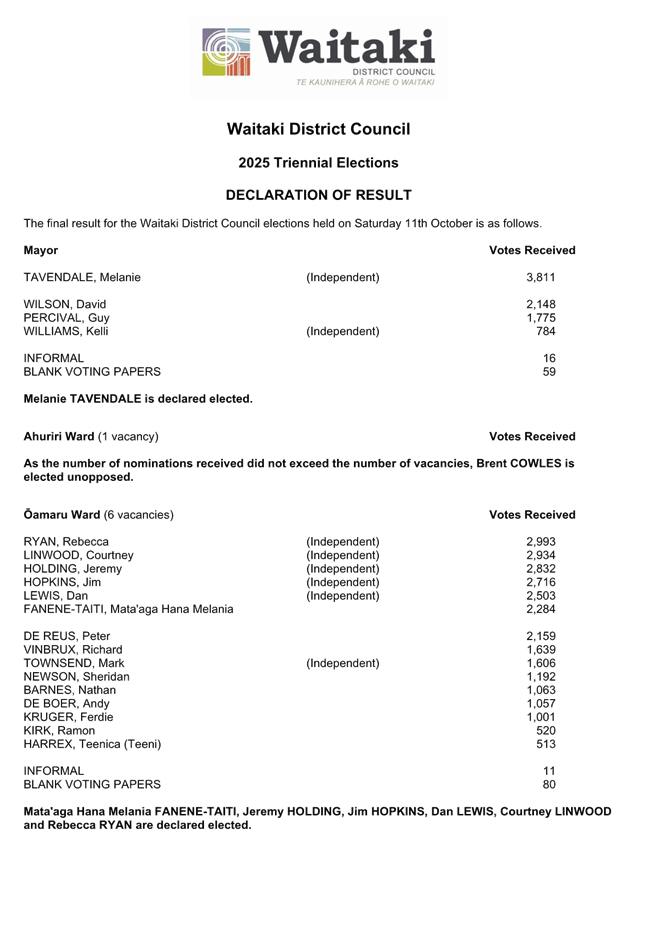
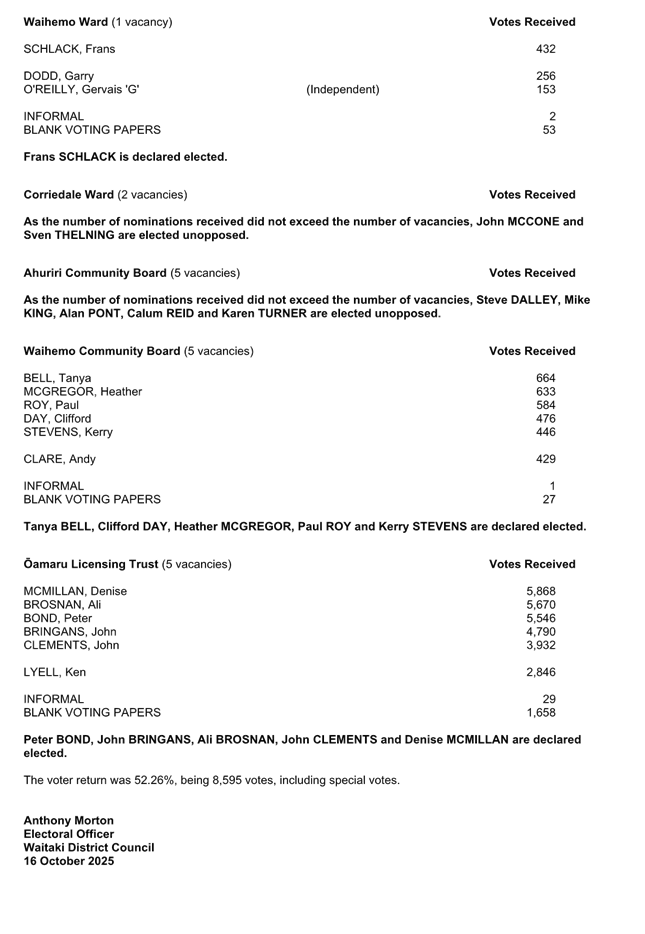
|
Ahuriri Community Board
Meeting Agenda
|
10 November 2025
|
6 Confirmation
of Previous Meeting Minutes
6.1 Public
minutes of the Ahuriri Community Board Meeting held on 8 September 2025
Author: Allyson
Woock, Governance Services Officer
Attachments: 1. Public
minutes of the Ahuriri Community Board Meeting held on 8 September 2025
|
Recommendation
That the Ahuriri Community Board confirms the Public
minutes of the Ahuriri Community Board Meeting held on 8 September 2025, as circulated, as a true and correct
record of that meeting.
|
|
Ahuriri Community Board
Meeting UNCONFIRMED
Minutes
|
8 September 2025
|
DRAFT UNCONFIRMED MINUTES
OF THE Ahuriri Community Board Meeting
HELD IN THE Kurow Community Centre, 31
Gordon Street, Kurow
ON Monday, 8 September 2025 AT 2:00 pm
PRESENT: Member
Calum Reid (Chair), Member Steve Dalley, Member Mike King, Member Alan Pont, Cr
Brent Cowles
IN
ATTENDANCE: Mayor Gary Kircher
Paul
Hope (Support Services Director)
Allyson
Woock (Governance Services Officer)
In
Attendance for Specific Agenda Items:
Nicole
Schofield, Public Forum, Agenda Item 6.1
Claire
Foster (Commercial & Property Lead), Agenda Item 6.1
Paul
Hayes (Assets Planning Manager), Agenda Item 6.2
Gary
Woock (Assets Planning Officer), Agenda Item 6.2
meeting open
The Chair declared the meeting open at 2:00pm and welcomed
everyone present.
1 Apologies
|
Resolved
ACB
2025/022
Moved: Mr
Mike King
Seconded: Mr Alan
Pont
That the apology received from member Karen Turner (for
absence) be accepted.
Carried
|
2 Declarations
of Interest
There were no declarations of interest.
3 Public
Forum
Speaker Nicole Schofield
Nicole Schofield from the Hakataramea Valley presented her
project to restore the former Kurow School and establish it as a not-for-profit
art school.
Ms Schofield tabled a one-page summary outlining the
project’s progress and support sought from the Ahuriri Community Board.
This document is available as an attachment to these minutes upon request.
Ms Schofield advised that a trust was being established to
receive the former Kurow School building.
When asked whether the trust would operate independently or
under the Waitaki Valley Community Society Incorporated (WVCSI), Ms Schofield
explained that during the first year of the project, she would work with WVCSI
on a subcommittee for the project. This arrangement would provide support for
managing funds under the relevant legislation.
Ms Schofield has been working with Heritage New Zealand and
Council’s Heritage Advisor to develop a conservation plan. She confirmed
there was no intended change in the original use of the building as a school.
4 Confirmation
of Previous Meeting Minutes
|
4.1 Public
minutes of the Ahuriri Community Board Meeting held on 1 July 2025
|
|
Resolved ACB 2025/023
Moved: Mr
Alan Pont
Seconded: Mr Mike
King
That the Ahuriri Community Board confirms the Public
minutes of the Ahuriri Community Board Meeting held on 1 July 2025, as circulated, as a true and correct
record of that meeting.
Carried
|
5 Decision
Reports
|
5.1 Ahuriri
Minor Improvements Budget Priorities
|
|
The report sought the board’s agreement on priority
projects for completion from the 2025/26 minor improvements budget.
Chair Calum Reid updated members on projects currently
underway across the ward.
Projects considered for funding from the minor
improvements budget included:
·
Funding towards Waitaki Valley Community Society
Incorporated’s project proposal to install a sheltered seating area on
the site of the overgrown ex-public toilet area in Kurow.
·
A refresh of the Ahuriri Ward township Christmas decorations
which had seen wear and tear. However, it was suggested that there might be
depreciation funds available for this purpose.
Members agreed to meet within the next fortnight to set
priorities and report back to officers.
It was noted that an updated community plan would assist
with prioritising expenditure decisions.
|
|
Resolved ACB 2025/024
Moved: Mr
Steve Dalley
Seconded: Mr Alan
Pont
That the Ahuriri Community Board:
1. Approves three priority projects to progress from the Ahuriri minor
recreation improvement budget.
Carried
|
6 Memorandum
Reports
|
6.1 Former
Kurow School Building
|
|
The report provided the board with information and options
for restoration of the former Kurow School building. Commercial &
Property Lead Claire Foster spoke to the report and answered questions asked
by members.
It was asked whether classifying the land as a historic
reserve would enable a peppercorn lease instead of a commercial lease.
Ms Foster clarified that while it wouldn't be a commercial
lease, any commercial activity would need to be acknowledged in the lease
terms. She noted various rental arrangements could be considered. Given the
substantial funding required for restoration, Council would likely consider a
peppercorn rent arrangement with a 33-year lease term to provide the trust
with better opportunities to secure funding.
Chair Calum Reid noted that relocating the building could
allow the land to be sold to a commercial entity, reducing the burden on
ratepayers. Ms Foster advised that the land is included in Council's current
strategic land review. Disposal would remove Council's maintenance
responsibilities but might not generate substantial revenue.
Ms Schofield asked about the possibility of the land being
transferred to the trust in addition to the building. Ms Foster responded
that this would require investigation and discussion with the Department of
Conservation.
|
|
Resolved ACB 2025/025
Moved: Mr
Mike King
Seconded: Mr
Steve Dalley
That the Ahuriri Community Board receives and notes the
information.
Carried
|
|
Resolved ACB 2025/026
Moved: Mr
Steve Dalley
Seconded: Mr Alan
Pont
That the Ahuriri Community Board:
1. Supports the
proposal to restore the former Kurow School building with the aim of
establishing an art school within part of the building;
2. Requests a
report to come back to the board on reclassifying the reserve as historic and
gifting the building to a Trust with a building footprint 33-year ground
lease at agreed rent with all outgoings payable granted subject to community
approval and Council consents; and
3. Prefers a
peppercorn rent.
Carried
|
|
6.2 Waitaki
Valley School Level Crossing and Footpath Connections from Whalan Lodge
|
|
The report addressed the board’s request for
information on pedestrian safety improvements around the Waitaki Valley
School.
Assets Planning Manager Paul Hayes and Assets Planning
Officer Gary Woock spoke to the report and answered questions asked by
members.
It was noted that funding for any option chosen would likely
need to come from the Kurow amenity rate as no other budget was available.
Chair Calum Reid asked whether using a local contractor
could reduce the cost of any minor safety improvements undertaken. It was
acknowledged this could lower establishment fees but that Council's
procurement process must be followed and improvements must comply with the
design plan.
Mr Reid and member Alan Pont identified the priority
aspects of the work as being the relocation of the crossing point and
extension of the sight rail from Manse Road around the corner to Robinson
Street.
The board agreed that there were some minor low-cost
improvements that could be made to address these priorities.
|
|
Resolved ACB 2025/027
Moved: Mr
Alan Pont
Seconded: Mr
Steve Dalley
1.
That the Ahuriri Community Board receives and notes the information.
2.
That the Ahuriri Community Board approves $20k from the Kurow amenity
fund for minor safety improvements relating to the road crossings, extended sight
rails, and entrance way crossings, with the final approach to be confirmed by
an onsite visit between the Kurow-based board members and officers.
3.
That a report comes back to the board with costings on the complete
footpath project.
Carried
|
|
6.3 Correspondence
|
|
The report presented board correspondence on Waitaki
District Council’s 2025-34 Long Term Plan, the Kurow Island jet boat
ramp, the car park resealing at the Omarama Hall, and community board
delegations.
Chair Calum Reid advised that the correspondence relating
to the Kurow Jet Boat Ramp was in response to issues caused by two new
bridges being installed. Mr Reid has been in discussions with Gary Hawkins
about the ongoing maintenance of the ramp and how this will be paid for. One
of the suggestions is a QR code system which would allow payments to be made
to a bank account for the island.
Member Mike King advised that MCM Contracting Ltd would
commence work on the Omarama Hall carpark after mid-September. This work will
address disability access into the hall.
|
|
Resolved ACB 2025/028
Moved: Member
Mike King
Seconded: Member
Alan Pont
That the Ahuriri Community Board formally receives the
attached items of correspondence and considers officer comments (where
available) and any actions in response.
Carried
|
|
6.4 Council
Information Report
|
|
The report provided links to agenda papers and related
attachments from recent Council Meetings and events for the information of
Community Board members and their ward communities.
Mayor Kircher advised that Council are expecting a
response in late September regarding whether the Department of Internal
Affairs has accepted Council’s Water Services Delivery Plan.
Chair Calum Reid commended Council’s gifting of land
to the Waitaki Valley Health Trust.
|
|
Resolved ACB 2025/029
Moved: Member
Alan Pont
Seconded: Member
Steve Dalley
That the Ahuriri Community Board receives and notes the
information.
Carried
|
|
6.5 Building
Consents issued in the Ahuriri Ward during June and July 2025
|
|
The report provided the Ahuriri Community Board with a
list of building consents issued in the Ahuriri Ward during June and July
2025.
|
|
Resolved ACB 2025/030
Moved: Mr
Mike King
Seconded: Mr Alan
Pont
That the Ahuriri Community Board receives and notes the
information.
Carried
|
|
Financial
Report to Ahuriri Community Board (September 2025)
|
|
The report updated the Ahuriri Community
Board on financial matters and activities within the Ahuriri ward.
|
|
Resolved ACB 2025/031
Moved: Mr
Steve Dalley
Seconded: Mr Alan
Pont
That the Ahuriri Community Board receives and notes the
information.
Carried
|
|
6.7 Community
Board Members' and Ward Councillor's Report
|
|
The report shared updates from the Ahuriri Community Board
Members and the Ahuriri Ward Councillor for the information of communities in
the Ahuriri Ward.
Member Alan Pont reported on the Bright Fern Energy
presentation he attended on 30 July 2025, where he asked about community
funding opportunities. He suggested that the company could contribute to the
community through initiatives such as installing solar panels on local
schools and halls. Bright Fern Energy representatives advised that community
funding requests would be assessed on a case-by-case basis.
Mr Pont also reported that at the Meridian Energy meeting
he attended on 18 August 2025, volunteers poured approximately six metres of
concrete at the beginning of the Kurow wetlands track and installed a
handrail to make it more accessible.
|
|
Resolved ACB 2025/032
Moved: Mr
Mike King
Seconded: Mr Alan
Pont
That the Ahuriri Community Board receives and notes the
information.
Carried
|
|
6.8 Election
Update
|
|
The report provided an update on pre- and post-election
matters.
Chair Calum Reid acknowledged Mayor Kircher’s
retirement. Mr Reid recalled working alongside Mayor Kircher for
approximately nine years while on the Ahuriri Community Board. During this
time, Mr Reid has found Mayor Kircher to be very engaging and open to having
discussions, and he acknowledged the amount of time and effort that Mayor
Kircher has put into the Ahuriri Ward. On behalf of the Ahuriri Community
Board, Mr Reid thanked Mayor Kircher and wished him all the best for the
future.
Mayor Kircher thanked Mr Reid for his kind words and
expressed his appreciation for the working relationships he has had with the
current Ahuriri Community Board members. He acknowledged the strength of the
current board and commended the members’ focus on achieving things for
the communities of the Ahuriri Ward. He thanked the members and wished them
all the best with their work going forward.
It was noted that member Alan
Pont would be unable to make it to the Inauguration Ceremony in Oamaru on the
evening of Wednesday 22 October 2025 and would need to be sworn in at the
first Ahuriri Community Board Meeting of the 2025-2028 triennium which will
be held on Monday 10 November 2025.
|
7 Meeting
Close
The Chair declared the
meeting closed at 3:47pm.
|
Ahuriri Community Board
Meeting Agenda
|
10 November 2025
|
7 Meeting
Close