I hereby give notice that the
Council Meeting
will be held on:
|
Date:
|
Tuesday, 30 September 2025
|
|
Time:
|
9.00 am
|
|
Location:
|
Council Chamber, Third Floor
Office of the Waitaki District Council
20 Thames Street, Oamaru
|
Agenda
Council Meeting
30 September 2025
Alex Parmley
Chief Executive
This
meeting will be livestreamed at –
https://www.youtube.com/live/F5xW6CBK1Cc?si=h5ZnSmd8wtkN_FiC
|
Council
Meeting Agenda
|
30 September 2025
|
1 Apologies
2 Declarations
of Interest
3 Public
Forum
The following registrations have
been received from people wishing to speak at the public forum:
• Frans
Schlack has asked to speak about the District Plan Process.
• Simon
Laming has asked to speak about the financial performance of the Oamaru
Airport.
|
Council
Meeting Agenda
|
30 September 2025
|
4 Leadership
Reports
4.1 Mayor's
Report
Author: Gary
Kircher, Mayor for Waitaki
|
Recommendation
That Council receives and notes the information.
|
Purpose
This report provides an update to Councillors and our community on a
range of issues and matters that I have been involved in over the past few
months, with some commentary on future directions. It is my opportunity to
share details and thoughts or other people’s commentaries on those
matters. This is my last report to Council as Mayor for Waitaki.
Investing our way out of the infrastructure crisis --
Canterbury Mayoral Forum – Guest Speaker, Sam Stubbs
Sam Stubbs is
the co-founder and Managing Director of Simplicity, a KiwiSaver fund that
focuses not just on returns to its clients, but also on the triple bottom line
of investing for social gain as well. Sam was most recently the CEO Of Tower
Investments, another KiwiSaver provider. Before that he was Managing Director
of Hanover Group and spent 10 years working for Goldman Sachs in London and
Hong Kong. He previously worked for Natwest Markets, Fay, Richwhite and IBM New
Zealand.
He spoke at our recent Canterbury Mayoral Forum dinner,
setting out his vision for New Zealand savings and reinvestment.
Sam believes that KiwiSaver represents a transformative opportunity
for New Zealand's economic future, offering a pathway to unprecedented
prosperity and financial dignity for citizens. The current KiwiSaver system is
generating approximately $50 million in daily savings, with the potential to
accumulate $300 billion in investments over the next 25 years.
The most exciting prospect is the ability to reinvest these funds
domestically, which provides significantly greater economic benefits compared
to overseas investments. Economists have demonstrated that domestic investment
generates a two-to-one GDP multiplier, meaning every dollar invested in New
Zealand creates twice the economic growth compared to international
investments.
This domestic investment strategy can address critical
infrastructure needs, with the current infrastructure deficit estimated at $20
billion. KiwiSaver funds could potentially fund every road, hospital, school,
water pipe, and electricity line the country requires, using New Zealanders'
own money.
A practical example of this approach is Simplicity's housing
development, which has already become the country's largest home builder. By
investing KiwiSaver funds in housing construction, they've created 1,000 homes
and generated employment, demonstrating how retirement savings can directly
improve community infrastructure and living conditions.
The proposed "InfraKiwi" concept represents an innovative
model for long-term, ethical investment. This potential vehicle would be 100%
New Zealand-owned, with a charitable foundation holding a golden share to
ensure the investment always serves national interests. The model would
prioritise fair returns and community benefit over maximum profit.
 Comparatively, countries like Australia have shown how systematic
retirement savings can drive national prosperity. Australia has maintained 27
years of continuous economic growth, largely attributed to their robust
retirement savings system, with 50% of their retirement funds invested
domestically.
Comparatively, countries like Australia have shown how systematic
retirement savings can drive national prosperity. Australia has maintained 27
years of continuous economic growth, largely attributed to their robust
retirement savings system, with 50% of their retirement funds invested
domestically.
For individual New Zealanders, this approach means more than just
financial returns. It provides genuine economic choices and dignity, reducing
poverty by creating opportunities through strategic, long-term investment. The
system allows people to build wealth while simultaneously supporting national
development.
The vision is not just about financial growth, but about creating a
sustainable, prosperous future where New Zealanders' savings directly
contribute to their country's infrastructure, housing, and economic resilience.
It represents a fundamental reimagining of retirement savings as a powerful
tool for national development and individual empowerment.
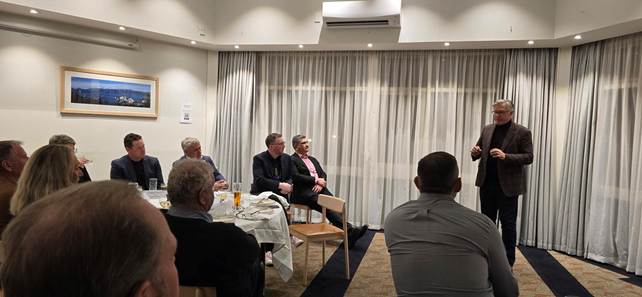
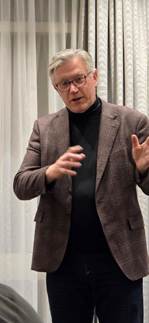
Sam
Stubbs addressing Canterbury Mayoral Forum members
Canterbury Regional Deal
We’re at an exciting
moment for Canterbury (Waitaha). The region is not just preparing for
what’s next, it's in strong shape already. Our collective work has set
Canterbury up as a launchpad for innovation, trade, clean energy, and
resilient, thriving communities. As Waitaki people, we have a lot to gain, and
a lot to contribute, as we shape this opportunity together.
What the regional deal pitch is aiming to do
Establish a clear partnership between central and
local government, with strong involvement from mana whenua and the private
sector. The goal is to ensure Canterbury is “deal-ready”, able to
engage with opportunities for major investment, policy changes and
infrastructure improvements.
Focus investment and action around four
pillars: transport, housing, energy, and infrastructure
– making sure these are fit for the future (climate-resilient,
sustainable, inclusive).
Deliver on the Mayoral Forum’s Plan for Canterbury
2023-25: sustainable environmental management, shared prosperity, climate
change mitigation/adaptation. Also, build, partner and advocate for the type of
governance and funding tools that allow local communities to shape local
solutions.
What this means for Waitaki
Waitaki has both distinct needs and strong potential:
Housing & settlements: As part of Waitaha, Waitaki must be included in
strategies for diverse housing (smaller homes, rentals, housing for older and
seasonal workers). Our rural and coastal settlements need housing that makes
sense for our people, not just urban models.
Connectivity &
infrastructure: Remote areas, coastal
communities, and inland stretches in Waitaki will benefit from improved
transport (roads, public transport where feasible), broadband/internet access,
energy resilience, and investment in infrastructure that can withstand environmental
hazards.
Natural environment and hazard
risk: With coastline, rivers, natural
landscapes, it's critical that any deals address climate exposure (sea level
rise, coastal erosion, severe weather), environmental wellbeing (biodiversity,
water quality). Waitaki’s landscapes can be protected and sustainably
used, contributing to regional natural capital.
Economic opportunities: Waitaki’s agriculture, tourism, small-business
sectors can be boosted through regional investments — whether in
value-adding processing, better transport/logistics, or supporting innovation.
Ensuring our local voice in regulatory/regional planning will help make sure
Waitaki is not overlooked.
Governance & policy fit: A deal that provides tools and support for councils to
have regulatory flexibility, for local decision-making, and for central
government to value rural/less-populated areas will be vital. Waitaki should be
clear about what local levers we need (e.g. for housing regulation,
infrastructure funding, environmental compliance) to deliver for our community.
Some risks / what to watch out for
Of course, not everything proposed may be adopted. Key
risks include:
That investment gets skewed toward
Christchurch/urban areas, with rural Waitaki missing out.
That regulatory/policy changes
don’t account for costs or feasibility in lower-density or more remote
areas.
That infrastructure funding
doesn’t cover the higher per-capita cost of maintaining and upgrading
infrastructure in rural/coastal zones.
Waitaki’s involvement
Our region is strongest when all parts are pulling
together. Waitaki offers landscapes, human capital, and industry that are
central to Canterbury’s identity and economic strength. If the regional
deal recognises and invests in Waitaki, it strengthens the whole region, and
vice versa.
In short, the regional deal offers a real chance for
Canterbury to lift everyone, and Waitaki must be alongside the other districts
in that lifting. The ambitions are strong, the foundations mostly in place, and
if we push hard now for transport, housing, infrastructure, environmental
resilience, we can help make sure the deal is one that respects our coast, our
rural communities, and our people.
For those people who represent our community for this next
term, I hope that we continue to advocate strongly for Waitaki’s needs.
Our next leaders need to carry our voice into these negotiations and seize this
as an opportunity not just for Canterbury, but for the unique standing of
Waitaki within it.
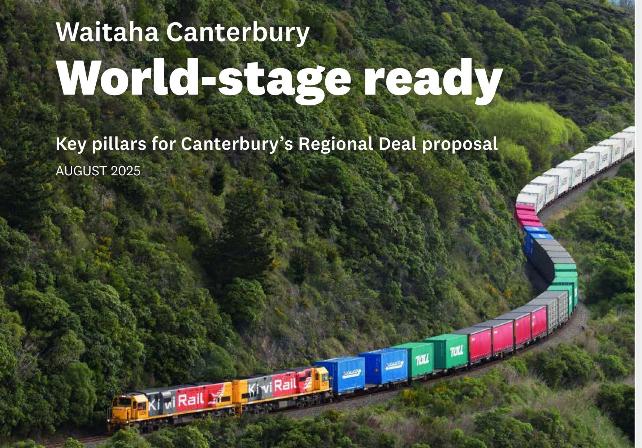
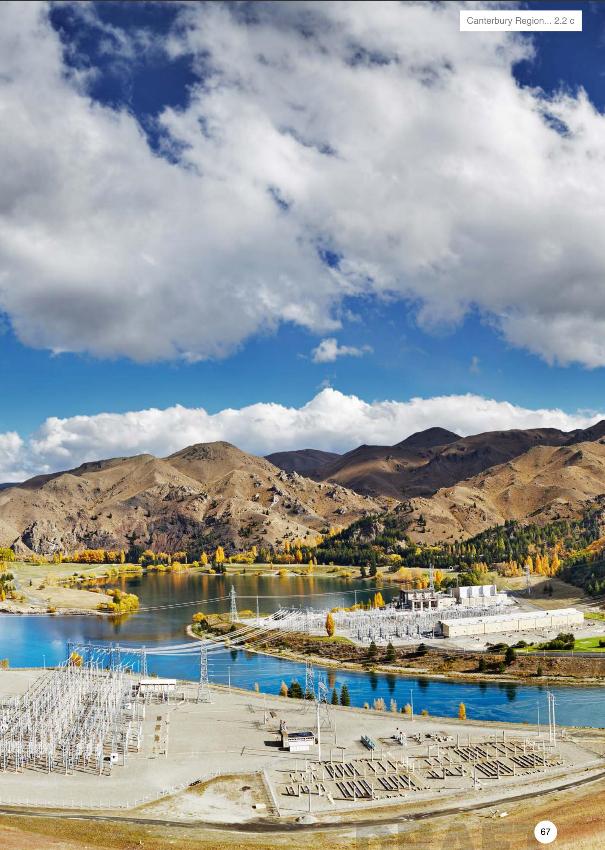
A
significant amount of work has gone into the Canterbury Regional Deal proposal
Otago Mayoral Forum
We held
the last Otago Mayoral Forum on the 29th of August, with a working
dinner the evening before. It was an opportunity to go over the work we have
carried out over the past three years and for me, as Chair of the forum, to
host a number of MPs and Ministers. Being part of two Mayoral Forums is challenging
in itself, but it does bring benefits. Whether the next Mayor decides to
continue participating in both Canterbury and Otago Mayoral Forums is up to
them, but I believe it has been worthwhile having close relationships with
fellow Mayors and CEs to the north and south of us.
This
last forum allowed us to have discussions with our local (Otago) MPs – at
the dinner the evening before, we hosted Minister Mark Patterson, Ingrid Leary
MP, Rachel Brooking MP, and Scott Willis MP.
At the
forum itself, we hosted Todd Stephenson MP and Joseph Mooney MP as well as Mark
Patterson, Ingrid Leary and Rachel Brooking.
We were
able to discuss a range of issues that face local government and our province.
The lack of party politicking was appreciated as we focussed on how we solve
some of those local issues by local government and central government working
together. Topics included regional deals, healthcare for the region, economic
growth, and housing challenges. These discussions don’t achieve much in
themselves, but they do provide an opening on the parliamentary door to
progress the issues that affect us here in the South Island.
Given it
was the last forum for both Bryan Cadogan and me, it was one of the all-too
frequent, bitter-sweet moments for us both. While it may have also been the
last forum for other members, at least Bryan and I have chosen to leave. The
vagaries of politics and the electoral process may be less kind to some of our
colleagues around the country.
On that
note, I want to be clear with my support for the collegiality and working
relationships of groups like the forum. They are not only opportunities to find
ways to work together and to share ideas on how our activities could be carried
out. They are also important opportunities to be with other elected
representatives who understand the challenges and opportunities faced by each
of us as Mayors and regional Council Chairs. I have appreciated those
relationships and cannot overstate just how important they are.
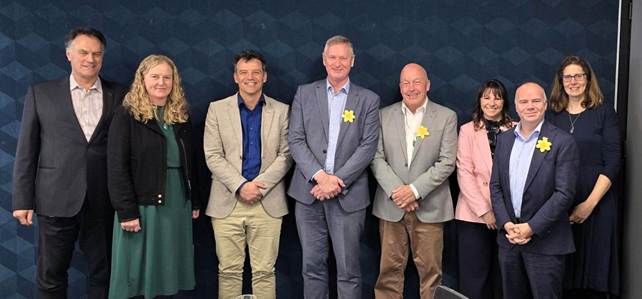
Otago
Mayoral Forum with MPs - Mayor Jules Radich, Chair Gretchen Robertson, Joseph
Mooney MP, Mayor Gary Kircher, Mayor Bryan Cadogan, Mayor Tamah Alley, Todd
Stephenson MP, Forum Principal Advisor Marianna Brook
Building Capability Programme
Now in its third year, the Building Capability Programme
continues to make a significant impact. We recently welcomed the latest cohort,
bringing the total number of Māori and Pasifika men and women who have
participated to 17. Each learner has been able to have their prior learning
assessed and identify the university-level papers needed to achieve a degree
qualification.
The commitment shown by participants has been inspiring.
Balancing tertiary study alongside full-time work and family responsibilities
is never easy, yet these learners have persevered and succeeded. For many, this
represents the first degree qualification within their whānau – an
achievement of great pride and significance.
While the original MSD funding concludes with this latest
group, we are pleased that five more students will be able to undertake the
programme in the coming year. They will be supported by their whānau and
guided by the dedicated Nola Tipa, who ensures learners remain on track and are
able to achieve their goals. We also acknowledge the important contributions of
Stronger Waitaki Manager, Ali McIntyre, and our Deputy Mayor, Hana Halalele, in
her OPICT role, for their leadership in making this programme possible.
Developing our own workforce is especially important in
rural communities, where attracting skilled workers can be difficult. By
supporting people already in the workforce to gain qualifications, we not only
enhance individual career opportunities and potential for promotion, but also
strengthen local employers and, in turn, the wider community.
We hope that MSD and its Minister recognise the tangible
value this programme creates for rural areas. The outcomes are clear: greater
opportunities for individuals, improved social and economic wellbeing for their
whānau, and a stronger, more resilient community overall.
All the best to our latest students!
Mayors’ Taskforce for jobs,
Youth Employment Initiative
As I have mentioned previously, the government has changed the rules
for the Youth Employment Initiative. They have set a target for getting people
into work and off the Jobseeker Benefit. Accordingly, the Ministry of Social
Development is carrying out its Minister’s direction to use the
Mayors’ Taskforce programme to help meet those targets. Our new contract
requires us to have 80% of our required placements come from Work &
Income’s register.
We have changed our delivery model this year which should help us
achieve those new goals. Under previous contracts, we were very fortunate to
have Eugen Dupu contracting his services to us, and the awesome results clearly
showed his effectiveness. With Eugen stepping aside, we have managed to second
Greg Pestell into an in-house position. Greg has been working for MSD as a Work
Broker, so his knowledge of the system and W&I clientele will be
beneficial.
As I step back from my role, I am confident that the programme will
continue to run effectively for the year ahead, helping our rangatahi and
unemployed people get into sustainable work to benefit themselves, our
employers in a win:win with social and economic outcomes. At that stage, the
new Mayor may need to step up and advocate for the programme to continue and
for funding to remain at an effective level, just as I have needed to do over
the years, but the result is well worth the effort!
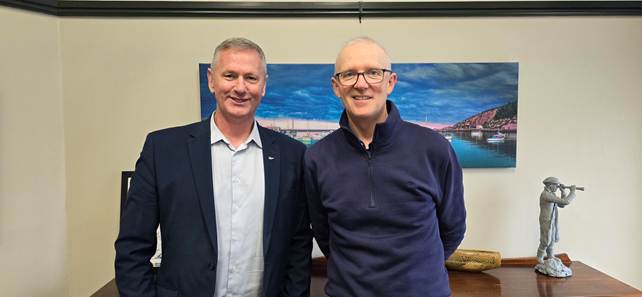
Greg
Pestell, MTFJ Employment Coordinator
Hato Hone St John Patient Shuttle
Update
I recently met with Julie Taverner and representatives of
Hato Hone St John, including the Chair of the local committee, to discuss
progress on establishing a patient shuttle service for our community.
Encouragingly, the service is already attracting strong
volunteer interest. At a recent meeting, organisers had expected 6–8
attendees, but 18 volunteers came forward. Hato Hone anticipates that even more
will join as the shuttle service becomes established. The diversity of age and
background among those who attended was also noted as a very positive sign.
The intention is to have the shuttle delivered to Waitaki
within the next few weeks. Once volunteers have completed their training, there
will be a “soft start,” with volunteers gradually building up the
service. It’s important to once again recognise the important service
that is currently provided by Trevor Goodin, ensuring that people had an
affordable option for getting to Dunedin (and sometimes to Timaru &
Christchurch!) for their hospital appointments.
In terms of funding, our Waitaki District Services Trust
has committed to providing the first three years of operational funding for the
St John service. Although there isn’t a confirmed start date for the
service, it is definitely getting close!
Overall, the meeting with Julie and her team highlighted
the strong community backing for the shuttle service and the willingness of
volunteers and organisations to work together to ensure its success. While I
had hoped to have the service commence while I was still in office, I am
pleased to have been able to play a part in ensuring it will be operating this
year.
New Dunedin Hospital Update
The Out-Patient Building - The New Patient Building: A Practical
Overview
Dunedin’s new out-patient building represents a significant
advancement in regional healthcare infrastructure. The facility, set to open in
October next year, is designed to address critical challenges in current
healthcare delivery by creating a dedicated space for ambulatory and outpatient
services.
The building's primary innovation lies in its separation of acute
and planned care streams. Where the existing hospital currently struggles with
mixed patient flows, this new facility provides distinct spaces for different
types of medical services. It features four-day surgery theatres and four
procedure rooms, effectively quadrupling the current capacity for planned
interventions.
Digital systems play a crucial role in the building's functionality.
A digital front desk will allow patients to self-check-in, reducing
administrative bottlenecks and potential waiting times. The facility
incorporates location-grade Wi-Fi that enables real-time tracking of medical
equipment, allowing staff to quickly locate resources across the building.
The technological infrastructure goes beyond simple convenience.
Integrated scheduling systems will coordinate multi-specialty appointments,
reducing the complexity of patient referrals and follow-ups. Automated
medication dispensing systems will improve patient safety, representing the
first such implementation in the South Island.
Communication technologies will support patient journeys before,
during, and after visits. SMS and email notification systems will provide
timely updates, while digital record-keeping will improve information sharing
between healthcare providers.
The building's design considers patient experience carefully. Wide
corridors, intuitive way-finding systems, and a focus on accessibility aim to
reduce the traditional anxiety associated with healthcare environments. The
space is specifically configured to support efficient patient flow, with
dedicated areas for different medical services.
For healthcare staff, the building offers more than just new rooms.
The digital and physical infrastructure is designed to reduce administrative
burden, allowing medical professionals to focus more directly on patient care.
Coordinated clinic systems and improved room scheduling will help optimise
resource utilisation.
Project leaders acknowledge that the building represents a
significant technological leap. They're approaching the implementation with a
"learner's license" mentality, recognising that staff and patients
will need support to fully utilise the new systems and spaces.
While the building offers expanded capacity and advanced
technologies, the core focus remains on delivering high-quality,
patient-centred healthcare. It represents a strategic investment in the
region's healthcare infrastructure, designed to improve both patient outcomes
and staff efficiency.
Stand Tū Māia hui
Last week I attended an event
hosted by Stand Tū Māia in Dunedin and was reminded
of the hugely important work they do for tamariki and whānau across
Aotearoa. Stand grew out of the former health camps in the early 2000s and has
since developed into a national service providing intensive, trauma-informed,
wrap-around support for families.
Their model combines long-term therapeutic work with
practical help in the home, school and wider community. Stand staff partner
closely with Oranga Tamariki, health, education, iwi and other agencies, and in
some cases make use of short residential stays to stabilise families. The
emphasis is always on healing trauma, restoring healthy relationships, and
keeping families together where possible.
The opportunity to see first-hand the type of work was not
only interesting, but it was also pleasing to see the range of services
available to those who need it in our community. Like many such services, there
are waiting lists for most of the regions they serve. They are seeking more
sustainable contracts from the government, which is a common refrain in these
days of austerity measures.
For us in Waitaki, Stand’s Southern team in Dunedin
is a vital resource. It means local families facing serious challenges have
access to specialist, kaupapa-grounded support without having to leave our
region. The difference Stand makes for children’s wellbeing and for
whānau resilience is clear, and their work is deeply valued in our
communities.


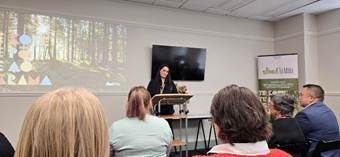
Stand
Tū Mia staff presenting the tools of their work.
Otago Polytechnic
Over the years I have often reflected on how easy it was
for Otago Polytechnic to succeed while stepping back from areas like Waitaki.
When they reduced services in Ōamaru, responsibility was passed to Aoraki
Polytechnic, and after Aoraki was absorbed into Ara, local provision declined
even further.
The creation of Te Pūkenga promised a chance to
rebuild services across the country and reduce duplication. I had hoped this
would open the door for stronger provision in Waitaki, but the reforms have
since been reversed and the focus is now back on regional institutions.
With Otago Polytechnic once again standing on its own, I
saw an opportunity to reopen the conversation about how they can serve the
whole of Otago, including our district. I recently met with Megan
Pōtiki (Executive Director) and Max Sims (Deputy
Executive Director: Operations) to begin that discussion.
It is early days, but my message was clear: our community
deserves equitable access to vocational training and education. The sooner
services are restored in Waitaki, the stronger our local economy and
opportunities for our people will be. Local access to courses in areas
like the trades, health and social care, and agribusiness would
give our young people pathways into work, help employers fill skill shortages,
and allow more of our residents to train closer to home.
This is a conversation we will continue, and one we must
keep insisting on.
Weston Fire Brigade 50th
Anniversary
I have appreciated my association with our local fire brigades over
the years, especially as Mayor. They are amazing organisations, driven by the
passion of volunteers and their willingness to serve their communities and
people in need. Over the past twelve years, we have gone from having rural fire
fighting as part of our Council to have them become part of the Otago Rural
Fire Authority in 2014, then the eventual amalgamation with the fire service to
become Fire & Emergency New Zealand in 2017.
The changes to the organisations have been major but that passion
hasn’t changed. So, it was another special evening when Kerry & I
joined the Weston Fire Brigade for their 50th Anniversary this
month. It was an opportunity to reflect on the events of the past 50 years, on
the characters involved along the way and the many humorous anecdotes that were
mentioned during the evening.
Congratulations to the brigade, to all those who have served over that time,
and best wishes for the future!

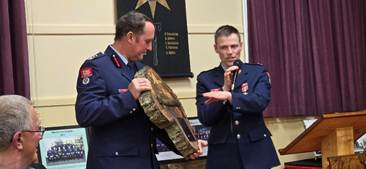
Josh
Lee presents his Weston Fire Brigade 50th Anniversary plaque to current Brigade
Chief, Richard Cranston
Oamaru/Waitaki Library 50th
Anniversary
It is also the 50th anniversary of the Ōamaru
Library! I have vague memories of going to the library when it was in the
neighbouring Athenaeum building (now the Waitaki Museum & Archive). I
don’t recall if I went to the small museum on top of a slight mound next
door, but I do recall it being demolished and the mound levelled to become the
site of the current library.
A lot of books have gone through the doors in the past 50 years, and
activities have changed significantly over that time. The library is no longer
just a place to loan books from, and the expectation they would become the
community’s “living room” has been surpassed. Our library
still delivers those services, but they are also places of education, cultural
exploration and so much more.
We are very fortunate to have the number of libraries we do
throughout the Waitaki district, and we are blessed with the dedication of the
staff who provide many of the services people value and trust.
Congratulations on the 50th anniversary, and best wishes
for many, many more!
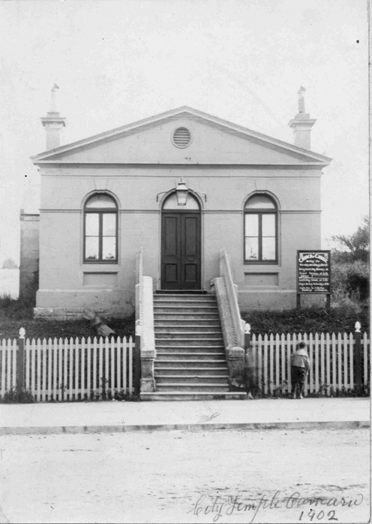
Site
of the current Ōamaru Public Library

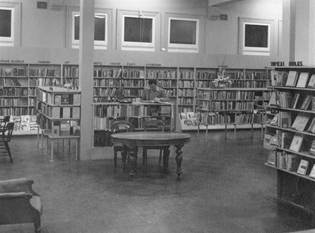
Scenes
from the previous library in the Athenaeum Building
The Oamaru Blue Penguin Colony
becomes Ōamaru Penguins
The Oamaru Blue Penguin Colony has entered an exciting new
chapter with its relaunch as Ōamaru Penguins. The refreshed
attraction tells a much broader story, from the prehistoric origins of penguins
to the present day and now weaves in the unique geological narratives of the
Waitaki Whitestone Geopark. This creates a world-class experience for visitors
while deepening the connection between our natural heritage and our community.
It is remarkable to think how far the colony has come. What
began as a group of dedicated volunteers protecting penguins once considered a
pest has become one of Ōamaru’s most loved and successful visitor
attractions. Their efforts not only safeguarded the kororā (little blue
penguin) but also shifted attitudes, helping the community recognise the
species as a taonga and a very tangible tourism and ecological asset.
Over time, the colony has grown into an internationally
recognised tourism experience, attracting tens of thousands of visitors each
year and contributing significantly to the Waitaki economy. The relaunch as
Ōamaru Penguins builds on that legacy, offering a richer visitor journey
and ensuring that both locals and visitors can better understand and appreciate
the unique place penguins hold in our story.
This development reflects the vision and hard work of many
people over the years, from the original volunteers to today’s
professional team, and stands as an excellent example of how conservation,
education, and tourism can work hand in hand. Ōamaru Penguins is not just
about watching penguins; it is about celebrating who we are as a community, the
environment we share, and the stories that make Waitaki unique.
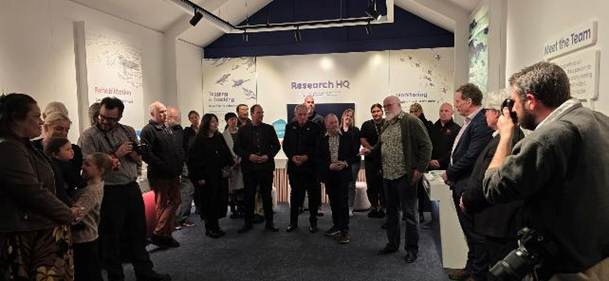
Te
Rūnanga o Moeraki's CEO, Trevor McGlinchey, welcomes us to the revamped
Ōamaru Penguins experience
Working with Mana Whenua in a true
partnership
Over my time as Mayor, one of the most significant and
rewarding shifts has been the strengthening of our relationship with mana
whenua. What began as occasional engagement has grown closer to a genuine
partnership.
This has not always been a straightforward journey.
Building understanding takes time, patience, and commitment on both sides. But
the progress has been clear to see. We now have stronger connections with
Moeraki and other rūnaka, and their perspectives are increasingly woven
into the way we approach issues, whether in planning, environmental
stewardship, or community wellbeing.
The benefits of this collaboration are real and
wide-ranging. Culturally, it helps us honour Te Tiriti o Waitangi and ensures
that local Māori voices are heard and respected. Socially, it strengthens
community cohesion. Environmentally, it supports approaches that value
kaitiakitanga – caring for the land, water, and ecosystems we all depend
on. Economically, it opens new opportunities through shared projects and
partnerships.
I am also aware that challenges remain. Racism,
misunderstanding, and fear can still emerge in our community, and it is our
responsibility as leaders to call that out, to educate, and to encourage
dialogue grounded in respect. True partnership means walking forward together,
even when the path is not always smooth.
As I reflect on the past 12 years, I am proud of how far we
have come, but even more hopeful about what lies ahead. The relationship
between mana whenua and the Council is stronger than ever, and I believe it
will continue to grow in a way that benefits not just Māori, but all of
Waitaki.
Toitū te whenua, toitū te mana, toitū te
tangata.
If the land is well, if the mana is upheld, the people will thrive.
Exploring Future-fit Local Government in
Canterbury
Reform of local government is once again a live issue, with
Environment Canterbury (ECan) leading work in recent months to explore whether
our current local government structures are well placed to meet the challenges
of the future. This has included looking at possible “future-fit”
models for Canterbury, with findings now shared for discussion with territorial
authorities, including Waitaki.
Why this
work is underway
Since the last major reforms in 1989, local government has
faced many incremental changes, but long-standing issues remain:
· Increasing
responsibilities and unfunded mandates from central government.
· A
heavy reliance on rates, creating affordability challenges alongside major
infrastructure demands.
· Declining
trust and participation in local democracy.
· Inconsistent
approaches to partnership with mana whenua.
· Strained
relationships between local and central government.
· In
Canterbury, these issues are heightened by unique factors:
· Environmental
pressures on rivers, groundwater, and coastal areas.
· A mix
of urban, provincial, and rural councils across large land areas.
· Population
change – strong growth in some areas and decline in others.
· The
need to invest heavily in climate resilience and transport.
Strategic
direction
ECan
has developed position statements to guide its leadership. These emphasise:
· A maturing partnership with Ngāi Tahu as a critical
partner across Waitaha Canterbury.
· Stronger, regionally informed environmental management to
complement national standards.
· Supporting economic prosperity through sustainable resource
use and innovation.
· Recognition that current structures and funding
arrangements are unsustainable.
Models
under consideration
To stimulate debate, four broad models have been outlined:
Combined Council –
Mayors and mana whenua representatives form a regional body, while local
councils continue to deliver services.
Unitary Council(s) –
Regional and local government functions are merged, either into a single
authority or several smaller unitary councils.
Regional Environmental Leadership
Body – A dedicated regional entity manages environmental functions,
with local councils focusing on place-based services.
Canterbury Assembly – A
directly elected regional mayor chairs an assembly of local representatives and
mana whenua, with hyper-local councils advocating for communities.
Each model has different strengths and weaknesses in terms
of scale, financial sustainability, strategic capacity, and responsiveness to
communities.
Next
steps
This is not about choosing a single model now, but about
creating the space for Canterbury’s councils, Ngāi Tahu
rūnanga, and central government to continue the conversation. The
Canterbury Mayoral Forum and other partners will have an important role in
shaping that work.
Reflection
for Waitaki
For Waitaki, the question is particularly relevant as
around 8% of our population and almost 60% of our land area lies within
Canterbury. Any changes to regional or local structures will need to carefully
address our cross-boundary situation to ensure our communities on both sides of
the Waitaki River are fairly represented and well served.
As Mayor, I am open to exploring change where it will
deliver real benefits for our ratepayers and strengthen services. At the same
time, I know our residents place high value on local representation –
they like to know who they are voting for and who will speak for them. This is
always a challenge in large regions with relatively small and dispersed
populations, such as Canterbury and Otago. However, as I am on my final weeks
in the role, it will be up to the next Mayor to decide whether to pick up this
work and progress it in any particular direction. That will be their decision
and the decision of the next Council.
My overarching view is that striking the right balance
between efficiency, affordability, and genuine local democracy will be central
to any model that is put forward.
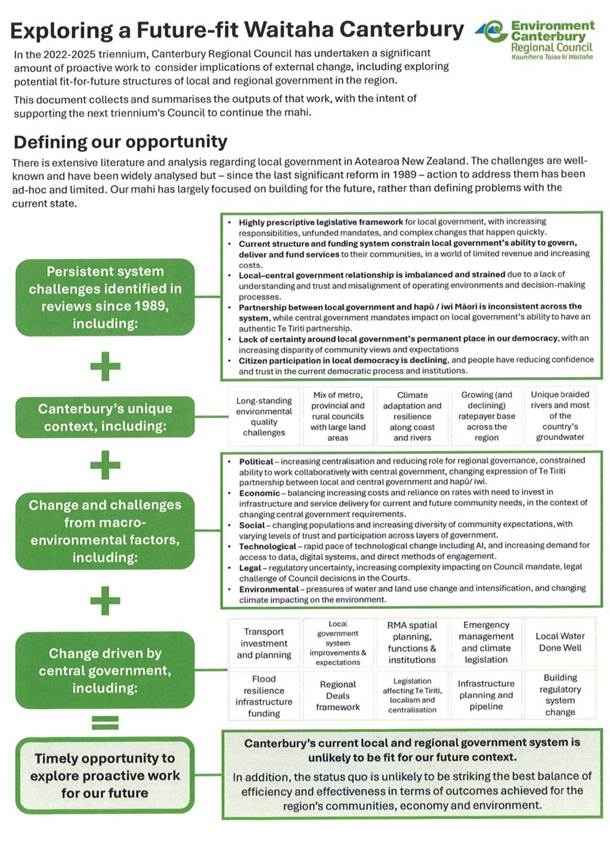
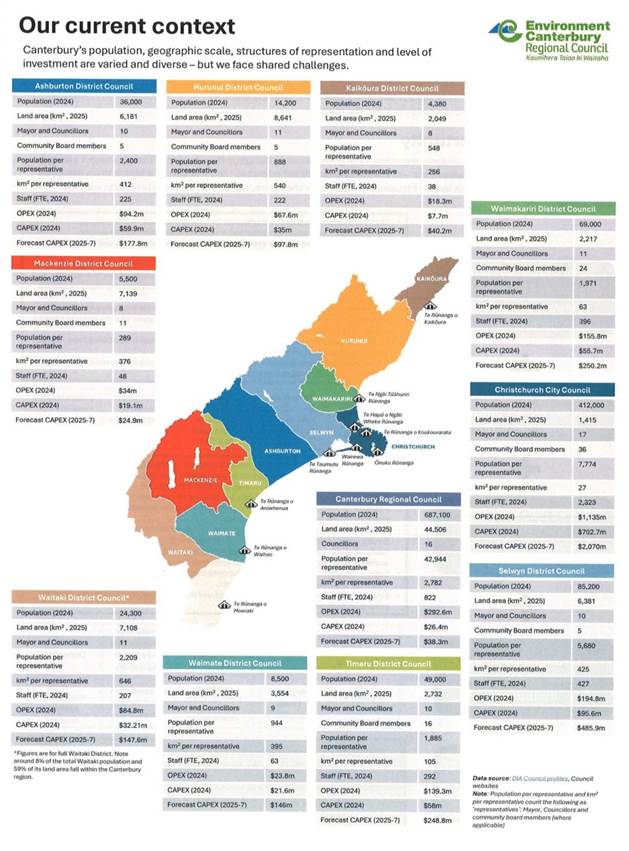
Some
of the work and thinking that has gone into the potential reorganisation of
local government in Canterbury
The Past Twelve Years
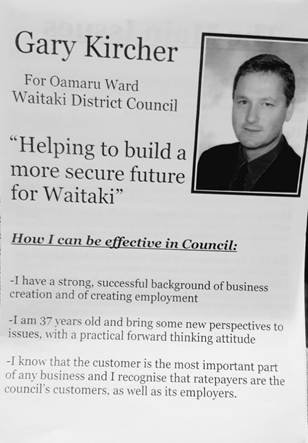
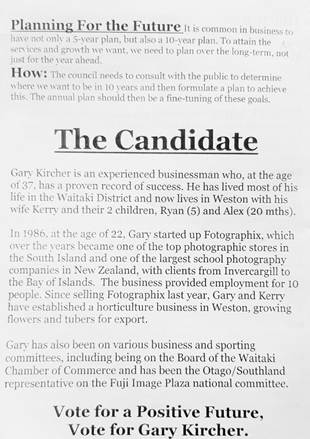
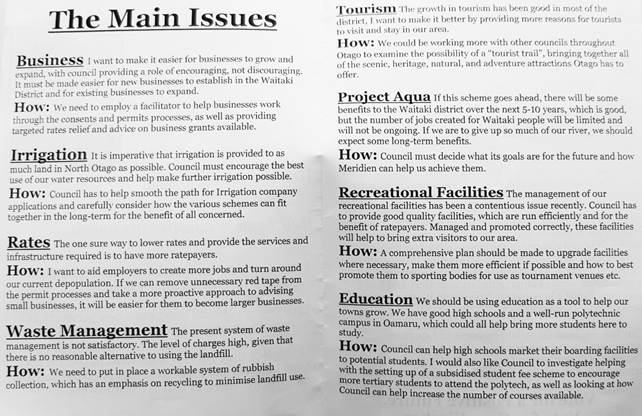
Having
served our community for 21 of the past 24 years, I thought it would be
interesting to look at my original, rather rudimentary candidate brochure I
photocopied off and delivered to homes around the Oamaru Ward. A long time
ago...
I won’t get too carried away here as we also have valedictory
speeches scheduled for this meeting for those of us who have decided to not
stand in this year’s election. In fact, I will simply sign off with the
words I used in my Ōamaru Mail column a couple of weeks ago:
This is my final column as Mayor of Waitaki. Over the
years, this space has given me the chance to share updates, reflections, and
sometimes challenges. Today, though, I want to use it to simply say thank you.
First, my thanks go to Allied Press and the Oamaru Mail
team. A local paper is so much more than headlines – it’s a
reflection of its community, telling our stories in our own voice. I’m
grateful that they’ve provided space for elected members, including
myself and our Councillors, to speak directly with you, the people we serve.
I also acknowledge the important volunteers who give so
much of themselves to make Waitaki a better place. Their contributions span
every part of our community, from sport, culture, and the arts, to supporting
health and wellbeing, to stepping up in our times of greatest need. Whether
it’s firefighters racing to a callout, St John volunteers offering care,
our churches operating foodbanks, or Victim Support lending comfort, these
people are the glue that holds communities together. True wealth isn’t
always measured in dollars – it’s often found in the connections
between people, and volunteers create so many of those connections. They have
been a constant source of inspiration to me throughout my time as Mayor.
To my fellow elected members – Councillors and
Community Board members, past and present – I thank you. Every person who
has put their name forward has done so to try to make our district stronger.
It’s not about status; it’s about service. The work is not always
easy, but the intent is always about helping our community.
Equally important are the many staff who serve our district
through their work at Council. I have been privileged to see first-hand the
dedication they bring to their roles. Many of them put in long hours, they
carry the weight of responsibility, and yes, sometimes they endure criticism
that can be unfair. They, too, want the best for our district, and they deserve
our respect. None of us – staff, Councillors, or Mayor – are
perfect, and in a diverse community, what seems “right” to one
person will often be seen very differently by another. But what unites us is
the effort to do what we can, as best we can.
I also want to acknowledge mana whenua and the four
papatipu rūnanga of Ngāi Tahu with strong and enduring interests in
Waitaki – Moeraki, Puketeraki, Waihao, and Arowhenua. Their presence here
is not only part of our past, but a vital part of our present and our future. I
have valued the wisdom they bring, especially the long-term perspective that is
so deeply embedded in te ao Māori. The concept of kaitiakitanga –
guardianship of people, land, and resources – is a reminder to all of us
who hold elected office that our decisions are not just about the here and now,
but about the generations who will follow us. That kind of thinking is
something our community and our leaders must continue to embrace if Waitaki is
to thrive into the future.
On a personal note, I want to acknowledge those who have
been especially important to me. The many community members who have offered
encouragement along the way. Whether through support, or by being honest, but
kind when they thought I could do better, you have all helped me to grow in
this role. And most of all, my family. To Kerry, my children, my siblings, and
my mum and my late father, and our wider whānau, your support has been my
foundation - you have each played a part in allowing me to serve in this way.
You have been part of my journey, and you have also felt the weight of
criticism along the way. Your support has been significant, and I
wouldn’t have coped without you.
Finally, to you – the people of Waitaki. I would
never have been able to serve as your Mayor without your trust. Whether you
agreed with me or disagreed, I have always worked to do my best for our
district, not just for today but for tomorrow.
If I could hope for any legacy, it would not be bricks and
mortar but opportunities: opportunities built on resilient infrastructure, on
cultural and sporting chances for people to thrive, on jobs that allow our
rangatahi to build full lives, and on a district that leverages its strengths
to be the best place possible for all of us.
Thank you, Waitaki, for the privilege of serving you.
Mō tātou, ā, mō kā uri ā muri
ake nei.
For us, and for our children after us.
Best wishes,
Gary
Kircher
Mayor
for Waitaki
|
Council
Meeting Agenda
|
30 September 2025
|
5 Memorandum
Reports
5.1 Project
Reclaim Final Report
Author: Steve
Clarke, Solid Waste Specialist
Authoriser: Roger
Cook, Director Natural and Built Environment
|
Recommendation
That Council receives and notes the report.
|
Purpose
To provide elected members with a final report in relation
to Project Reclaim.
1. Executive Summary
Project Reclaim was initiated in
response to an urgent environmental threat posed by three historic coastal
waste sites in the Waitaki District — the Hampden closed landfill and two
uncontrolled fill areas along Beach Road. Accelerating coastal erosion,
worsened by climate change, had begun to expose buried waste in this
ecologically and recreationally sensitive area, with NIWA data indicating
erosion rates of up to one metre per year.
Council, in partnership with iwi,
central government, stakeholders, and the local community, implemented a
sustainable and cost-effective solution: the full removal and relocation of
approximately 69,000 tonnes of legacy waste to a newly developed Class 1
engineered cell at the Palmerston Landfill.
2. Objectives and Strategic Outcomes
· Eliminate the
environmental and public health risks posed by coastal landfill exposure
· Align with climate
adaptation and managed retreat principles
· Remove contaminated
material to a safe, consented landfill facility
· Engage transparently with
iwi, community, and stakeholders
· Minimise costs through
leveraging off central government funding and putting a case for waste related
levy exemptions.
3. Timeline of Key Milestones AND COUNCILOR
UPDATES
|
Date
|
Milestone
|
|
February 2021
|
WSP completes Detailed Site Investigation (DSI) for Beach
Road sites. DSI recommends a Remedial Options Assessment (ROA) to manage site
risks.
|
|
November 2021
|
Morrison Low (ML) awarded Contract 841 to complete a
Feasibility Study and Business Case for remediation of Hampden and Beach Road
landfills, and redevelopment of Palmerston Landfill.
|
|
February 2022
|
Feasibility Study and Business Case completed.
|
|
1st March 2022
|
Workshop held with Councillors to present Feasibility
Study and Business Case findings.
|
|
June 2022
|
Project adopted into the 2022/23 Annual Plan.
|
|
10th November 2022
|
ML awarded Project 2428 to consult and lead procurement of
remediation and landfill development contracts.
|
|
20th December 2023
|
Project Reclaim update via Council Activity Update report
|
|
8th February 2023
|
Progress workshop held with Councillors regarding
procurement activities.
|
|
21st March 2023
|
Project Reclaim update via Council Activity Update report
|
|
22nd May 2023
|
Skevingtons awarded contract for Falcon Street Sewer Pipe
installation.
|
|
20th June 2023
|
Project Reclaim update via Council Activity Update report
|
|
27th June 2023
|
Council meeting: Council approved Contract 901 be awarded
to Fulton Hogan; Contract 919 be awarded to Waste Management.
|
|
19th September 2023
|
Project Reclaim update via Council Activity Update report
|
|
1st October 2023
|
Improvement works begin at Palmerston Landfill, including
new lined cell development.
|
|
5th December 2023
|
Project Reclaim update via Council Activity Update report
|
|
20th December
|
Governance Team site visit Palmerston Landfill
|
|
12th March 2024
|
Project Reclaim update via Council Activity Update report
|
|
11th June 2024
|
Project Reclaim update via Council Activity Update report
|
|
June 2024
|
Excavation work begins at Hampden landfill.
|
|
1st August 2024
|
Excavation work begins at Beach Road landfill sites.
|
|
10th September 2024
|
Project Reclaim update via Council Activity Update report
|
|
12th November 2024
|
Councillor site visit Beach Rd
|
|
30th November 2024
|
Excavation works completed at all sites.
|
|
3rd December 2024
|
Project Reclaim update via Council Activity Update report
|
|
13th December 2024
|
Intermediate landfill cap installation completed at
Palmerston Landfill.
|
4. Budget and Funding Summary
Total Project Budget:
$18.5 million
Total Project Cost: $9.95
million
*Project completed under budget despite increased volume of waste.
|
Funding Source
|
Contribution
|
|
Waitaki District Council
|
$9.95 million
|
|
Ministry for the Environment - Waste Levy Rebate
|
$4.05 million
|
|
Environmental Protection Agency – Emissions Trading
Scheme Exemption
|
$1.5 million
|
|
Ministry for the Environment – Contaminate Sites and
Vulnerable Landfills Fund
|
$3 million
|
Budgets were reviewed monthly with Project Manager
keeping GM HER Group (Project Sponsor) updated.
Budgets reviewed regularly by the Performance, Audit and Risk
committee.
5. Project Delivery Approach
· Contracting Model:
NZS3916 design-build
· Delivery Team: Fulton
Hogan, Waste Management NZ, Tonkin + Taylor
· Design Expertise: Tonkin
+ Taylor
· Engineer to Contract:
Morrison Low
· Procurement Method: Early
contractor engagement, collaborative bidding model
This collaborative model
streamlined complex technical delivery, fast-tracked consenting, and enabled
agile response to environmental conditions and scope growth.
6. Key Outcomes
· 69,000 tonnes of legacy
waste removed from erosion-prone coastal landfills
· New Class 1 engineered
landfill cell developed at Palmerston Landfill, compliant with leachate
management standards
· Installation of improved
leachate collection and stormwater separation systems at Palmerston Landfill
· Protection of marine
ecosystems and culturally significant environments.
· Operating within the
coastal and tidal zones with strict erosion and sediment controls
· Protecting local
wildlife, including native lizards relocated from Hampden to Moeraki in
partnership with DOC and Iwi.
· Mitigating impacts on
penguin nesting sites by scheduling works outside breeding seasons
· Preserving cultural and
archaeological sites of significance through early engagement with iwi
· Reinforced
Council’s position as a leader in climate resilience and asset management
7. Environmental Enhancements at Palmerston
Landfill
· Constructed new lined
Class 1 cell with long-term containment
· Installed new sewer
pipeline in Falcon St, Palmerston to connect the Palmerston Landfill to the
Palmerston Waste Water Treatment Plant for the discharge of landfill leachate.
· Removed evaporation pond
and remediated damaged stormwater line
· Ensured complete
separation of leachate and stormwater
· Capped existing cells and
enhanced environmental monitoring systems
· Temporarily closed
landfill and retain future airspace capacity for strategic use prior to August
2027 consent expiry
8. Community and Stakeholder Engagement
· Ongoing engagement with
local iwi, residents, schools, and interest groups
· Multiple community site
visits, regular media updates, and a dedicated project website
· Strong support from
stakeholders, including the Department of Conservation, Otago Regional Council,
Iwi and residents
9. Cultural and Environmental Significance
· Honoured Te Ao Māori
values, particularly kaitiakitanga (guardianship) of the marine environment
· Directly addressed the
risk of landfill waste impacting penguin colonies and coastal habitats
10. Asset Management (AM) and Strategic
Learnings
· Demonstrated
best-practice alignment with Better Business Case (BBC) methodology
· Reflected core AM
principles:
o Sustainable use of resources
o Risk management and asset resilience
o Long-term cost-effectiveness
o Protection of natural and community values
· Prompted internal
discussion around climate-related asset retreat, especially for roads and Three
Waters networks
· Illustrates the need for
future managed retreat and infrastructure realignment strategies
11. Awards and Recognition
· Winner – 2025
Āpōpō Excellence Awards
· Finalist – 2025
WasteMinz Excellence Awards
· Case Study – MfE
Coastal Risk Framework and Tonkin + Taylor Knowledge Hub
12. Conclusion
Project Reclaim was a complex,
high-risk, and highly visible initiative successfully delivered by Waitaki
District Council and its partners. It addressed a critical environmental
challenge, protected marine and coastal ecosystems, and provided valuable long-term
infrastructure and learnings for the region.
By acting early and
collaboratively, Council avoided significantly higher future costs and
established a new benchmark for integrated environmental and infrastructure
decision-making.
Project Reclaim is an exemplar of
sustainable environmental remediation, addressing the pressing risk of legacy
waste contaminating the marine environment due to coastal erosion. The project
recognised that historical landfill practices were no longer aligned with
current expectations of environmental stewardship, especially among iwi and the
wider community.
The project successfully removed
approximately 69,000 tonnes of waste and contaminated material from
erosion-prone coastal landfills and relocated it to a newly constructed Class 1
lined cell at Palmerston Landfill. This solution eliminated the long-term
environmental risk, avoided future contamination events, and maximised the use
of an existing Council-owned and consented landfill. By keeping waste disposal
within the district, the project significantly reduced transport-related
emissions and costs.
Broader Environmental Enhancements
The project delivered substantial environmental improvements
at Palmerston Landfill, including:
· Construction of a new
Class 1 HDPE-lined cell
· Decommissioning of the
evaporation pond
· Installation of a
dedicated leachate pipeline to the wastewater treatment plant
· Separation and
remediation of stormwater systems to prevent cross-contamination
Strategic Asset Management Lessons
Project Reclaim also prompted
broader consideration within Council of how to manage infrastructure affected
by climate change, including the viability of long-term maintenance for roads
like Beach Road. This reflective approach illustrates a responsible asset
management strategy that integrates environmental risk, long-term cost, and
community values.
Ultimately, Project Reclaim
achieved its objective: removing significant environmental risk while
demonstrating best-practice environmental, cultural, and financial stewardship
in the face of climate change.
|
Council
Meeting Agenda
|
30 September 2025
|
6 Decision
Reports
6.1 The
Future Status of Beach Road North
Author: Paul
Hayes, Assets Planning Manager
Authoriser: Roger
Cook, Natural and Built Environment
Attachments: 1. Feedback
from Long Term Plan Consultation ⇩ 
2. Costs
of options for Beach Road North ⇩
|
Recommendation
That Council resolves to permanently close Beach Road
North and instructs officers to pursue low-cost options to maintain and
enhance public access for as long as erosion allows.
|
Decision Objective
To seek a decision from Council as to the future status of Beach Road
North following the conclusion of Project Reclaim and taking into account
public feedback through the 2025-34 Long Term Plan consultation.
Summary
Beach Road North has been closed
since mid-2024 due to excavations to remove fly-tipped material during Project
Reclaim. Public feedback on the future of the road was sought during
consultation for the 2025-34 Long Term Plan and, while the aesthetic, recreational
and cultural value of the coastal road was widely recognised, the largest
number of respondents felt that the high costs and uncertainty associated with
reopening the road made permanent closure a more prudent option.
Officers have assessed a range of
reopening and closure options and considered whole of life costs over a 40 year
period, including factors such as the placement and maintenance of rock
protection, realignment of the road around the excavations and areas of land
movement, maintenance of the road surface, widening of alternative transport
routes, realignment of water infrastructure and eventual removal of roading
assets at end of life.
|
Description of options
|
Cost over 40 years
|
NPV over 40 years
|
|
A: Realign and reopen Beach
Road North
|
|
|
|
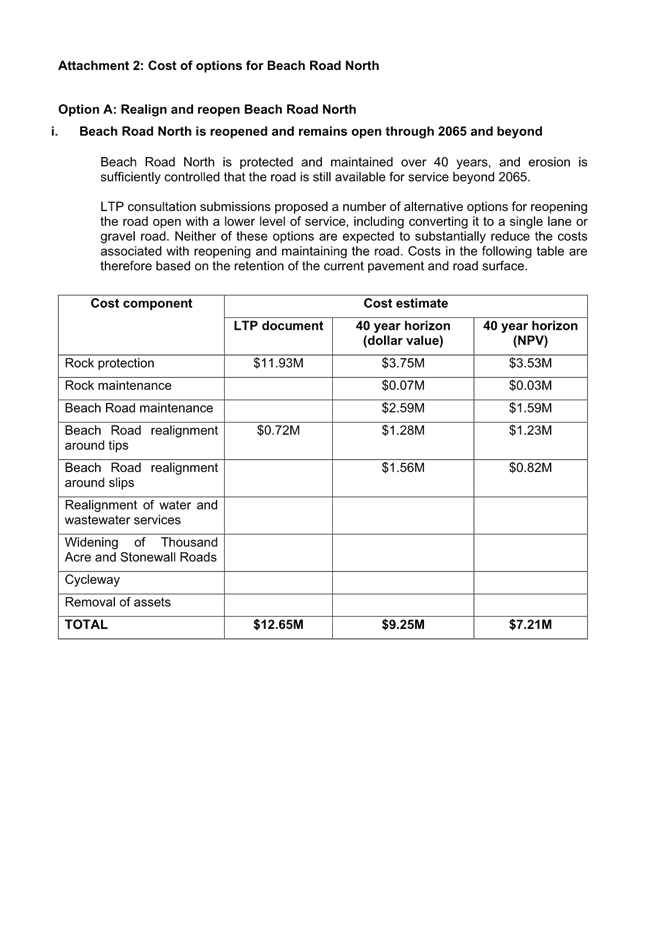
i. Beach Road North is
reopened and remains open through 2065 and beyond
|
$9.25M
|
$7.21M
|
|
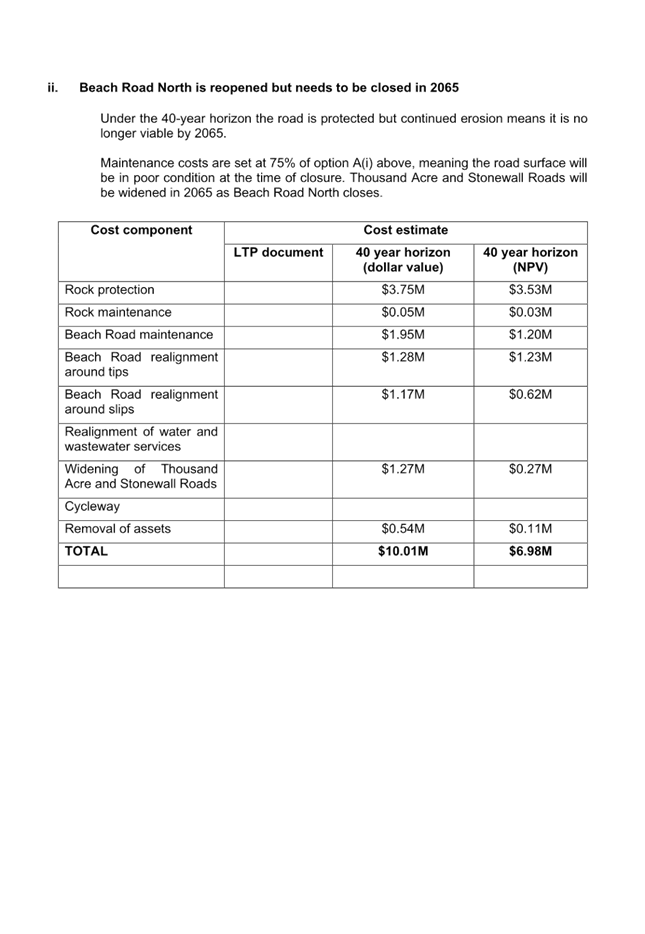
ii. Beach Road North is reopened
but needs to be closed in 2065
|
$10.01M
|
$6.98M
|
|
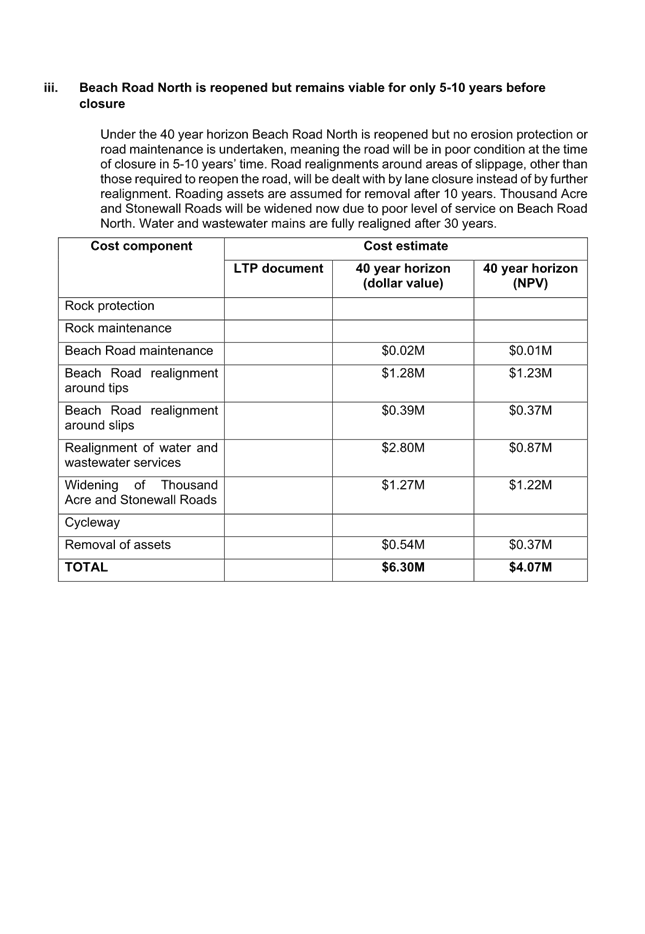
iii. Beach Road North is reopened but
remains viable for only 5-10 years with a low level of service before
closure
|
$6.30M
|
$4.07M
|
|
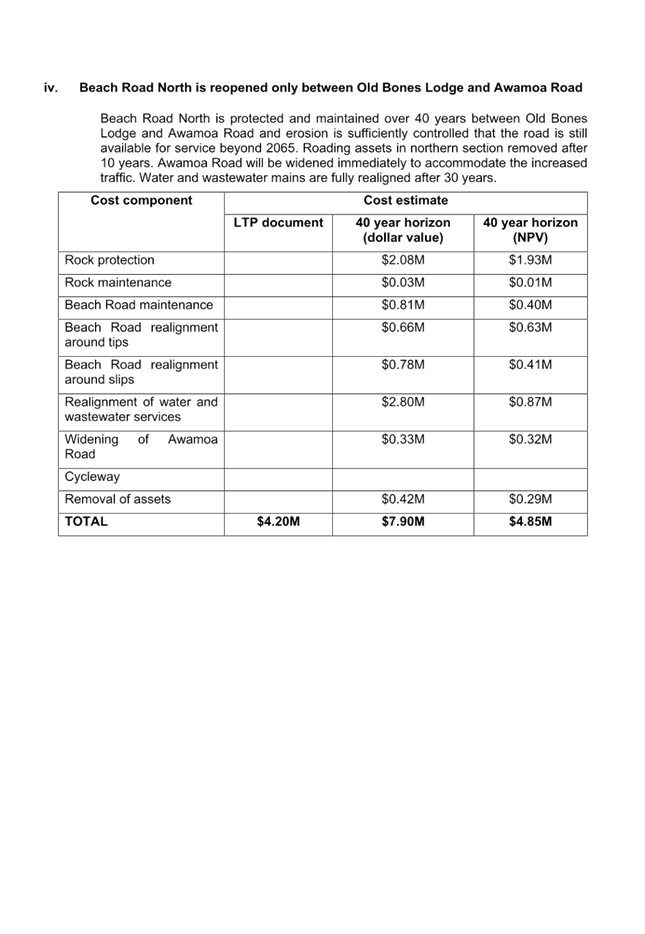
iv. Beach Road North is reopened only
between Old Bones Lodge and Awamoa Road
|
$7.90M
|
$4.86M
|
|
B: Confirm closure of Beach Road North
|
|
|
|
i. Assume road is permanently
closed and all assets are removed now
|
$4.61M
|
$2.63M
|
|
ii. Assume road is permanently
closed but is used as a cycleway through to 2065
|
$4.88M
|
$2.51M
|
context, analysis and advice
Background
and Current Situation
(i) Project
Reclaim
Through
Project Reclaim, Council committed to undertaking the remediation of historic
fly-tipping and landfill sites that were at risk of exposure due to coastal
erosion. An environmental pollution incident was highly likely if Council had
not committed to the remediation of the sites. Beach Road North was closed in
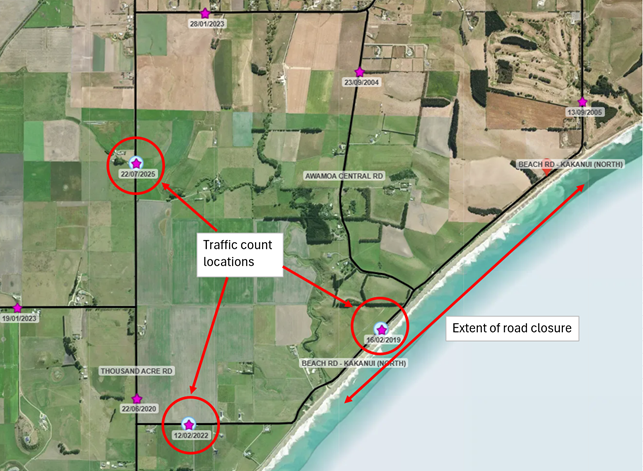
mid-August 2024 between Old Bones Lodge to the corner just before the North
Otago Golf Course to allow the excavation to occur.
It was known
that one of the sites on Beach Road North extended under the road and would
necessitate investment in reopening the road. However, whilst undertaking the
work at the two sites located at Beach Road North, 58% more fly-tipped material
was required to be removed than expected, with deposits and the resultant
excavations extending further back under the road, severing the road in two
locations.
(ii) Coastal
Hazard Strategy
Council
commissioned Beca in 2024 to assess coastal hazards along the North Otago coast
and develop potential shoreline management options for 12 of the highest risk
locations, including Beach Road North. The multi-criteria analysis outlined in
Beca’s Waitaki Coastal Hazard Strategy - High Risk Sites Options
Assessment Report (5/11/24) identifies managed retreat through the
closure of Beach Road North as the highest scoring option.
(iii) 2025-2034
Long Term Plan Consultation on Beach Road North
At the
Council Meeting held on 26 November 2024, Council agreed to consult with the
community about whether to reopen Beach Road North as part of the 2025-34 Long
Term Plan and that Beach Road North would remain closed until a decision to
reopen it occurs. Three options with indicative costings were presented for the
Long Term Plan consultation:
Option A: Realign the Road - Realign the road in a new position
around the holes and install 42,000m3 of rocks to protect the 2.8km stretch of
coastline.
Cost estimate: $12,650,000 (debt funded over 30 years), made up of Road
Cost $720,000 + Rock Armouring $11,930,000.
Option B: Managed Retreat – Road Closure – Our
preferred option - The road will close permanently to vehicular traffic.
Cost estimate: $50,000 (debt funded over 10 years) in 2025/26 for
establishment of a walking/cycling track and beautification.
Option C: Close Beach Road North to Awamoa Road - Close a section
of Beach Road North. Realign the road, reinstating the connection between
Kakanui Beach Reserve and Awamoa Road.
Cost
estimate: $4,200,000 (debt funded over 30 years)
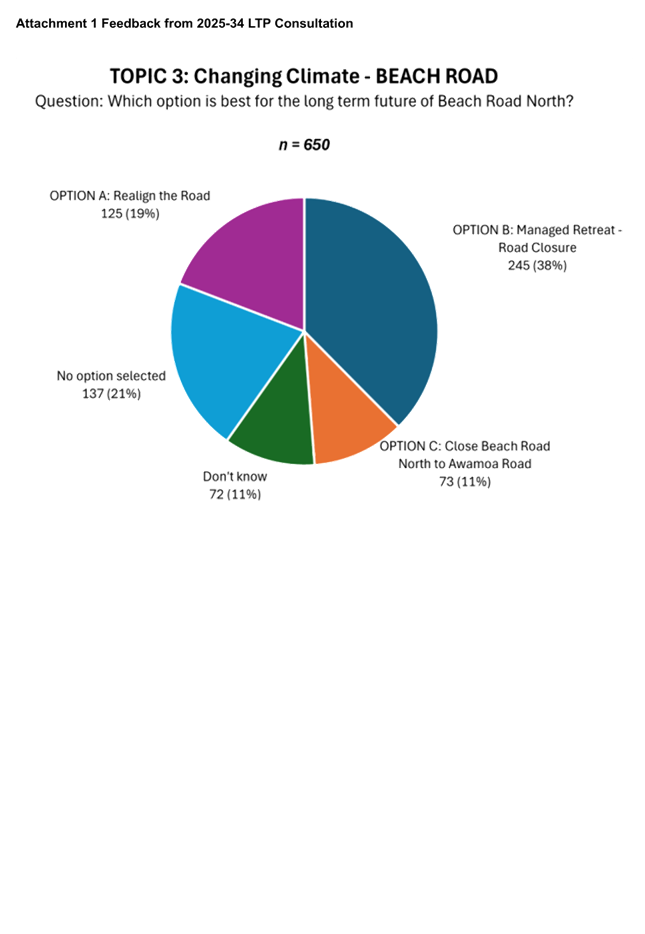
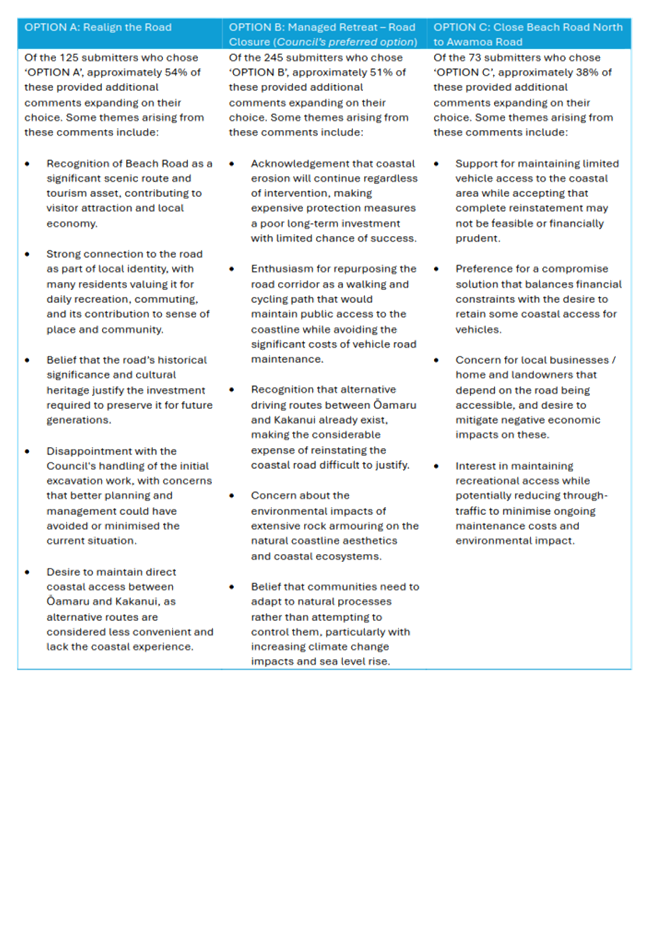
A summary of
public feedback on Beach Road North is provided as Attachment 1. The largest
number of submissions (38%) recognised the high costs and uncertainty of
erosion control efforts and were in favour of the option of managed retreat and
road closure (Option B). This was roughly twice the number who favoured
re-opening the road based on its scenic nature, cultural, tourism and
recreational value, and the convenience of a coastal connection between Kakanui
and Ōamaru.
Through the
community engagement some additional options for the future of Beach Road North
were suggested. These included turning it into a single lane road and/or an
unsealed/gravel road, providing carparks for continued beach access, and
creating a cycling track that links into town.
(iv) Council
assets
Council
assets that are affected by any decision to re-open or formally close Beach
Road North are summarised below:
· 2.8km
of road surface, including culverts and the bridge over Awamoa Creek. These
assets have a combined value of $1.6 million.
· 2.5km
of water main and wastewater main between Awamoa Creek and North Otago Golf
Course were constructed in 2014 and have a combined book value of $1.5 million.
Any rupture to these lines would cut the supply of water to Kakanui (North to
South) and the conveyance of wastewater from Kakanui (South to North). The
mains are located 10 to 20m to the west of Beach Road North.
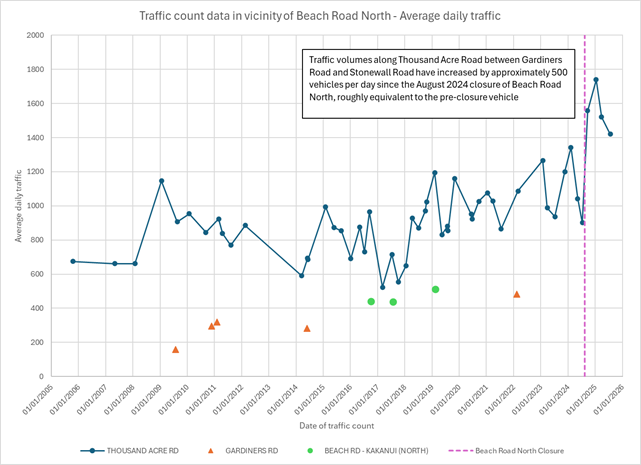
Beach Road
North carried around 500 vehicles per day before the August 2024 road closure.
Traffic monitoring shows that most of these movements are now along Thousand
Acre Road which now has average daily traffic of around 1,600 vehicles.
Priority and
Strategic Context
A decision around the future status
of Beach Road North is important from a public interest viewpoint, but less so
from a roading perspective given the proven viability of an alternative traffic
route along Thousand Acre and Stonewall Roads. There is, however, some urgency
around decision making given the continued coastal erosion that is making a
reopening decision progressively more challenging and expensive.
Decision making should take into
account the wider context of coastal erosion in North Otago and the need for a
consistent and strategic approach.
Analysis
and Discussion
As requested by Council, Officers
have reviewed the issues associated with re-opening and formally closing Beach
Road North between Old Bones Lodge and North Otago Golf Course. Costs have been
estimated over a 40 year horizon through to 2065 and calculated in terms of raw
expenditure and net present value[1]
(NPV) applying a discount rate of 4% as used by Waka Kotahi NZTA.
Officers have taken a wider view of
the cost components that are considered for the two options than was taken in
the LTP document. These include:
· Rock protection
– The LTP road realignment option was based on the Beca report which
allowed for 42,000m3 of rock and turf reinforcement matting over
2.8km of coastline. Beca considered that this extensive protection “would
provide adequate protection to avoid the relocation of the services”
(page 50). Compared with this advice, a lesser degree of rock protection is
considered to be more realistic and in line with measures undertaken with some
success along other parts of the coastline. An allowance should be made for
maintenance of the rock protection over its lifespan. It should be recognised
that it would provide a lower level of protection than the full revetment
recommended by Beca.
· Realignment
around the dump sites – The excavations to remove fly-tipped material
have cut the road in two locations, and localised realignments are required to
reopen the road.
· Realignment
around additional slips – Since Beach Road North was closed, two
areas of additional slippage have advanced to the point that localised road
realignments are now required. An allowance should be made for ongoing
localised areas of slippage if anything less than Beca’s full revetment
construction is constructed.
· Maintenance of
Beach Road North – If Beach Road North is reopened, ongoing road
maintenance will be required, including annual maintenance, periodic resealing
and rehabilitation of the road surface, and renewal of culverts, signage, etc.
· Widening of
Thousand Acre and Stonewall Roads – The analysis assumes that the
additional vehicle movements shifted from Beach Road North to Thousand Acre and
Stonewall Roads aren’t significant enough to have a noticeable impact on
the maintenance and renewals regimes of these roads. It is assumed, however,
that increased traffic volumes would trigger road widening (1m width per lane
over 4.2km) as soon as a formal decision was made to close Beach Road North.
· Realignment of
water and wastewater services – The water and wastewater mains
running parallel to the closed section of Beach Road are only ten years old.
Irrespective of any decision on Beach Road North, Council would aim to maintain
these services in place for as long as possible to extract maximum value from
this sunk cost. The pipes are set back 10 to 20m beyond the landward edge of
the road and, even without any protection, could be expected to be safe from
erosion for several decades. Even once threatened by erosion, it is probable
that localised realignments could be employed in the first instance to maximise
the life of the assets. For the purposes of this analysis, it is assumed that
full realignment would be undertaken after 30 years if Beach Road North is
permanently closed. The water main would be connected to the Hamnak Line at the
junction of Thousand Acre and Stonewall Roads, whilst the wastewater main would
continue along Stonewall Road to connect at the top of the sewer network on
Awamoa Road.
· Cycleway
– Public consultation clearly demonstrated a desire to maintain access
for pedestrians and cyclists along Beach Road North in the event of its
closure. Signage, protective barriers and periodic localised realignment around
areas of slippage would be required, but no investment is allowed for in terms
of erosion protection or road maintenance outside the bridge over Awamoa Creek.
· Removal of
assets – It is assumed that infrastructure assets would be removed
before they are undermined by erosion and fall into the sea.
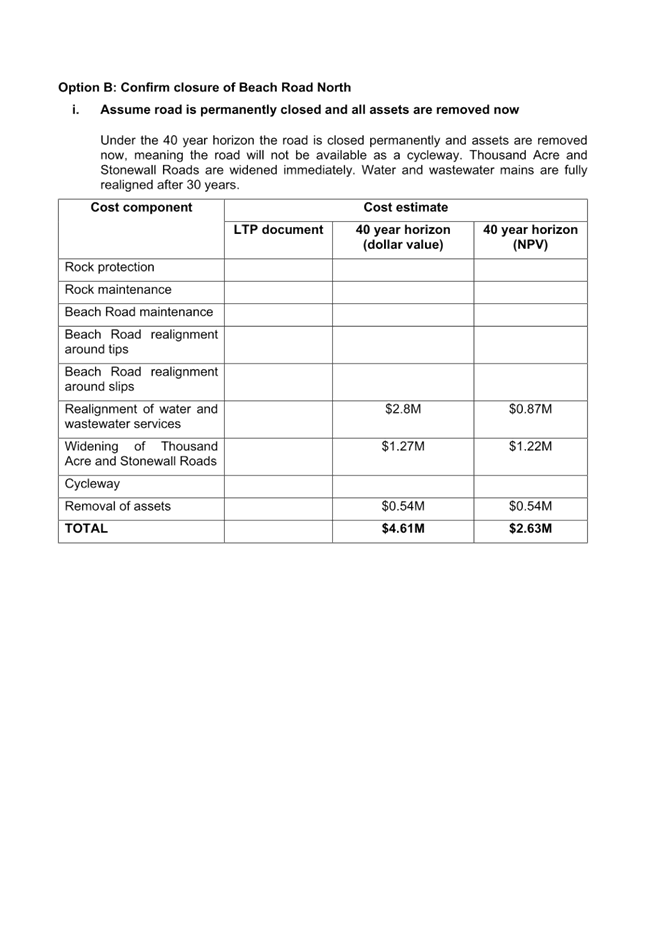
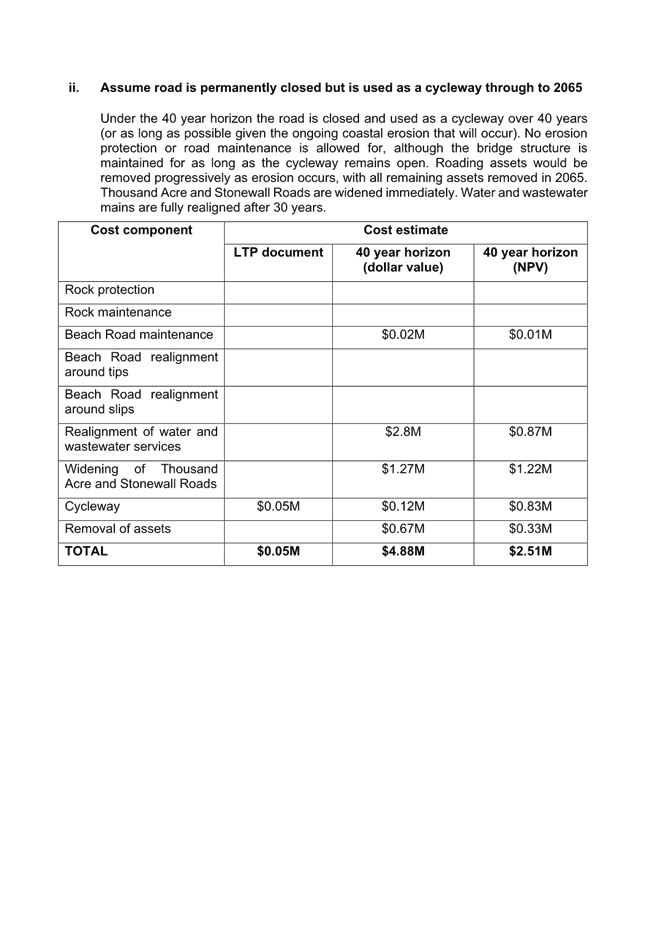
The cost of options for Beach Road
North are summarised below, with more detail provided in Attachment 2.
|
Council
Meeting Agenda
|
30 September 2025
|
|
Description of
options
|
Cost over 40 years
|
NPV over 40 years
|
|
A: Realign and reopen Beach Road North
|
|
|
|
i. Beach
Road North is reopened and remains open through 2065 and beyond
Beach Road North is protected and maintained over 40 years and erosion
is sufficiently controlled that the road is still available for service
beyond 2065. LTP consultation submissions proposed a number of alternative
options for reopening the road open with a lower level of service, including
converting it to a single lane or gravel road. Neither of these options are
expected to substantially reduce the costs associated with reopening and
maintaining the road. Costs in the following table are therefore based on the
retention of the current pavement and road surface.
|
$9.25M
|
$7.21M
|
|
ii. Beach
Road North is reopened but needs to be closed in 2065
Under the 40 year horizon the road is protected but continued erosion
means it is no longer viable by 2065. Maintenance costs are set at 75% of
option A(i) above, meaning the road surface will be in poor condition at the
time of closure. Thousand Acre and Stonewall Roads will be widened in 2065 as
Beach Road North closes.
|
$10.01M
|
$6.98M
|
|
iii. Beach
Road North is reopened but remains viable for only 5-10 years before closure
Under the 40 year horizon Beach Road North is reopened but no erosion
protection or road maintenance is undertaken, meaning the road will be in
poor condition at the time of closure in 5-10 years’ time. Road
realignments around areas of slippage, other than those required to reopen
the road, will be dealt with by lane closure instead of by further
realignment. Roading assets are assumed for removal after 10 years. Thousand
Acre and Stonewall Roads will be widened now due to poor level of service on
Beach Road North. Water and wastewater mains are fully realigned after 30
years.
|
$6.30M
|
$4.07M
|
|
iv. Beach Road
North is reopened only between Old Bones Lodge and Awamoa Road
Beach Road North is protected and maintained over 40 years between Old
Bones Lodge and Awamoa Road and erosion is sufficiently controlled that the
road is still available for service beyond 2065. Roading assets in northern
section removed after 10 years. Awamoa Road will be widened immediately to
accommodate the increased traffic. Water and wastewater mains are fully
realigned after 30 years.
|
$7.90M
|
$4.85M
|
|
B:
Confirm closure of Beach Road North
|
|
|
|
i. Assume
road is permanently closed and all assets are removed now
Under the 40 year horizon the road is closed permanently and assets
are removed now, meaning the road will not be available as a cycleway.
Thousand Acre and Stonewall Roads are widened immediately. Water and
wastewater mains are fully realigned after 30 years.
|
$4.61M
|
$2.63M
|
|
ii. Assume
road is permanently closed but is used as a cycleway through to 2065
Under the 40 year horizon the road is closed and used as a cycleway
over 40 years (or as long as possible given the ongoing coastal erosion that
will occur). No erosion protection or road maintenance is allowed for,
although the bridge structure is maintained for as long as the cycleway
remains open. Roading assets would be removed progressively as erosion
occurs, with all remaining assets removed in 2065. Thousand Acre and
Stonewall Roads are widened immediately. Water and wastewater mains are fully
realigned after 30 years.
|
$4.88M
|
$2.51M
|
Financial Considerations
The 40 year horizon cost estimates
are based on various assumptions and are made without detailed engineering
design, so should be considered as indicative only. Notwithstanding this, it is
clear that reopening Beach Road North is approximately double the cost of
permanent closure and is not recommended from a purely financial
perspective.
It is important to note that the
analysis does not attempt to monetise any of the non-cost benefits identified
through the Long Term Plan consultation process (aesthetics, recreation,
tourism, convenience, etc.). What it does though, is give some idea of the
dollar value that Council would need to be assign to the non-cost benefits for
reopening to stack up financially.
Project Reclaim was Loan funded and
although the final cost was under budget this only resulted in reduced
borrowing. Any money spent on Beach Road North will have to be loan funded and
the full debt servicing cost funded by Rates.
Additional
Considerations
While the latest analysis has
expanded the area of interest to include Thousand Acre, Stonewall and Awamoa
Roads, the area of consideration is still too limited.
Beach Road South between Thousand
Acre Road and Kakanui is also highly vulnerable to coastal erosion and is
likely to be cut in the short to medium term without comprehensive rock
protection. The Beca report has estimated the upfront cost of this protection
at more than $17 million and recommended that a managed retreat approach would
be the most appropriate strategy to pursue.
The ongoing coastal resilience
project (IBIS 4440 Coastal Resilience) allocates $2.05 million
from 2025-2027 to target 10 erosion hotspots along the coastline to the north
and south of Kakanui. The rock protection is intended to slow erosion to buy
some time to finalise and implement plans for permanent protection or managed
retreat, not to guarantee the future of the road in its current position. In
terms of Beach Road South, Council will need to consider options related to (i)
permanent protection of the coastline, (ii) realignment of the road behind
erosion lines, or (iii) closure of the road and upgrade of alternative routes
(probably Fortification Road) which will receive diverted traffic. Any
decision to reopen Beach Road North should not be made without full consideration
of the long term status of Beach Road South.
Risks
The key risk with reopening the
road is that the rate of coastal erosion (with or without full rock protection)
is greater than that assumed and that the cost to maintain the road is greater
than assumed and/or the useful life of the road is less than assumed. There are
also risks to public safety if Beach Road North is reopened to traffic without
adequate coastal protection and its condition is allowed to deteriorate.
The key risk with permanent closure
of the road relates to the potential health and safety implications of
maintaining pedestrian and cycle access (if this option is selected) to a
dynamic coastal cliff environment with significant fall heights to the beach
below. This risk would need to be managed through an appropriate level of
signage and/or barriers that were monitored and adjusted in response to
continued erosion.
Significance
and Engagement
Officers recognise the significant
public interest currently being expressed in the future of Beach Road North and
acknowledge that any final decision by Council at the end of the Triennium may
prompt further debate in the community and could be requested to be revisited
in the future.
Summary
of Options Considered
Option 1
– Council agrees to formalise the closure of Beach Road North (B.i &
B.ii) – The road is permanently closed between Old Bones Lodge
and North Otago Golf Course and Officers are instructed to pursue low-cost
options to maintain and enhance public access for as long as erosion allows.
The approval for these measures would be the subject of a separate Council
decision paper.
This is the
preferred option.
Option 2
– Council agrees to permanently reopen Beach Road North (A.i & A.ii) –
The road is realigned around the tips and areas of slippage,
protected and maintained for as long as possible. Officers are instructed to
proceed with design and costing for comprehensive and targeted erosion
protection options.
This option is
not recommended due to its high lifetime cost and failure to incorporate
considerations relating to the future of Beach Road South.
Option 3 –
Council agrees to temporarily reopen Beach Road North (A.iii) – The
road is realigned around the tips and areas of land movement but no further
erosion protection or road maintenance is to be undertaken.
This option is
not recommended due to its high lifetime cost and progressively poor level of
service.
Option 4 –
Council agrees to permanently reopen Beach Road North between Old Bones Lodge
and Awamoa Road (A.iv) – The road is realigned around the tip
and areas of slippage, but no further erosion protection or road maintenance is
to be undertaken north of Awamoa Road.
This option is
not recommended due to its high lifetime cost and the comparatively poor
alternative transport route offered by Awamoa Road.
Option 5 –
Council recommends the permanent closure of Beach Road North but defers the
decision to the incoming Council as part of the Long Term Plan amendment.
Option 6 –
Council recommends the reopening of Beach Road North but defers the decision to
the incoming Council as part of the Long Term Plan amendment.
Assessment
of Preferred Option
The permanent closure of Beach Road
North is preferred due to:
· Its
lower initial and whole of life cost relative to reopening options.
· Its
lower risk and uncertainty relating to the extent and speed of coastal erosion.
· It
reflecting the largest amount of Long Term Plan consultation feedback.
· The
proven viability of the alternative route along Thousand Acre and Stonewall
Roads.
· The potential to
maintain public access to the closed road corridor for pedestrians and
cyclists.
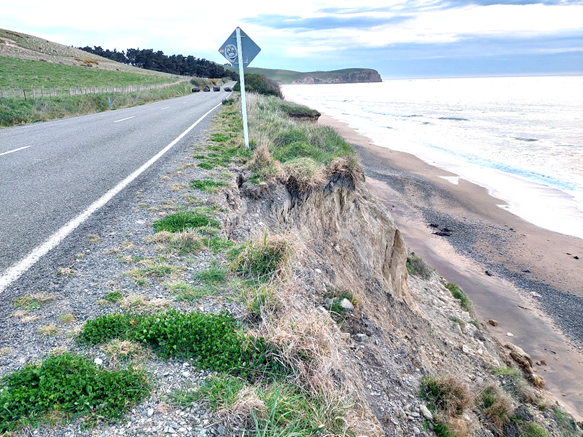
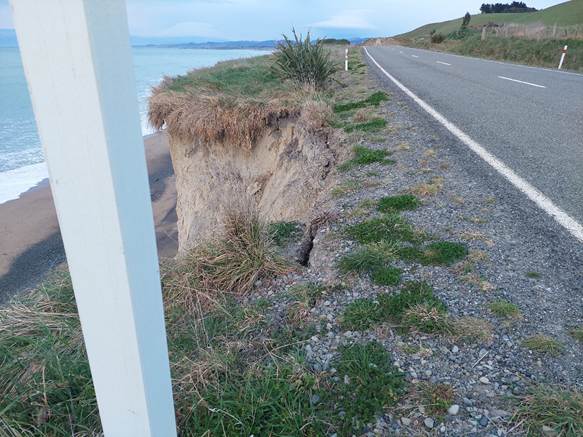
Photographs Showing
Erosion at Beach Road
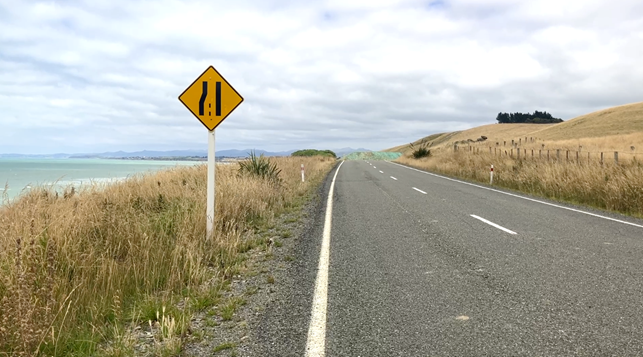
Above – January, 2025.
Below – September, 2025.

|
Council
Meeting Agenda
|
30 September 2025
|
|
Council
Meeting Agenda
|
30 September 2025
|
|
Council
Meeting Agenda
|
30 September 2025
|
6.2 Chief
Executive and Corporate KPIs
Author: Alex
Parmley, Chief Executive
|
Recommendation
That Council:
1. Adopts
the Key Performance Indicators for the Chief Executive for the year ending 30
June 2026 (to be circulated as Attachment 1).
|
Decision Objective
To adopt the Chief Executive and
Corporate Key Performance Indicators (KPIs) for the year ending 30 June 2026.
Summary
This report provides the proposed
Chief Executive and Corporate Key Performance Indicators (KPIs) for the year
ending 30 June 2026. These KPIs have been discussed informally with the
Mayor and Councillors.
Background
The Chief
Executive is responsible for advising Council, implementing policy, and
delivering the services and development according to Council’s Long-Term
Plan (LTP) and Annual Plan.
The Chief
Executive is the Council’s only employee and is expected to work
according to the role and leadership behaviour set out
in the Local Government Act (LGA) and the relevant Position Description. The
Council and the Chief Executive are expected to agree on key areas of
performance each year. These in turn reflect the priorities for what the
organisation overall, delivers through its staff, contractors and partnerships.
The Chief Executive and Corporate KPIs and the Councils
Strategic Framework are important tools by which the Council sets the
priorities and objectives to be delivered by the organisation, and key
performance indicators for the organisation, with the CE being accountable for
ensuring organisational delivery.
The proposed CE and Corporate KPIs sets out
two distinct areas:
1. The Priority Outcomes –
these are the key outcomes/objectives that the CE and staff will work to
deliver with the Governance Team and partners over the next one to two years.
2. Organisational (CE) Key
Performance Indicators – these are the key priority measures to assess
the health and performance of the organisation mapped to the Waitaki District
Council Strategic Framework pillars.
The Priority
Outcomes reflect a focus on the delivery of the Council’s Strategic
Framework together with associated strategies and plans agreed by Council. This
includes the continued change and continuous improvement of the organisation,
following the Transformation Programme, to ensure it delivers more effectively
and efficiently for the district and our communities; together with ensuring
continued progress in delivering ambitions and outcomes for
· Prosperous Place,
· Strong Communities, and
· Valued Environment.
The
KPIs do not attempt to list every item of work to be taken forward by the Chief
Executive and the staff team. Instead, they set out the focus and
priorities for the Chief Executive and the organisation to deliver the outcomes
the Council has identified.
DISCUSSION
The
Chief Executive’s and Corporate KPIs, as outlined in this report,
continue to enable Council to deliver the Community Outcomes identified by this
Council in the Strategic Framework and the associated strategies and
plans. They also serve to prioritise the work of the CE and the Council,
to ensure focus on the most important matters, given the range of competing
demands. The Priority Outcomes identified support the delivery of the four
Organisation Objectives in the Council’s Strategic Framework:
· Quality
Services: Deliver modern, effective customer services within a culture of
continuous improvement.
· Strong
Communities: Support and enable our communities to improve wellbeing.
· Prosperous
District: Develop and enable a thriving district economy, characterised by
sustainable and inclusive growth.
· Valued
Environment: Protect Waitaki’s natural and built environment for
present and future generations.
It is recommended that the Priority
Outcomes support the Strategic Framework and that KPIs are measures that will
support assessment of progress in delivering the Strategic Framework and the
Priority Outcomes. They provide a measurable framework for aligning the
performance of the Chief Executive and the organisation with the
Council’s outcomes and priorities. Adding other KPIs may dilute the
focus and accountability and create confusion or inconsistency in the reporting
and evaluation process.
If adopted, there will be further
discussion with the new Council following elections and induction on the KPIs
and if necessary, adjustments will be made to reflect the aspirations and
priorities of the new Council.
Summary of
Options Considered
Option 1 – Adopt the Chief Executive and Corporate
KPIs for the year ending 30 June 2026, as proposed (Recommended)
Option 2 – Adopt the KPIs for the Chief Executive for
the year ending 30 June 2026, with any amendments agreed at this meeting
Option 3 – Do not adopt the KPIs for the year ending
30 June 2026.
Assessment of
Preferred Option
Option 1 is the preferred option as
it represents an ambitious and substantial body of work to be taken forward
over the coming year. It has been carefully considered within the
Organisational Performance Management Framework developed for Council, with
defined outcomes and measures of success that will enable progress to be
clearly assessed and monitored. Adoption of the KPIs will enable clarity to be
given to the whole staff team of the work priorities and enable delivery to be
commenced.
Option 2 is not preferred, as
adding to or amending the KPIs may risk the KPIs not being able to be achieved
or not being measurable.
Option 3 is not a
desirable option. It is a legal requirement for KPIs to be in place to manage
the Chief Executive’s performance under the Local Government Act 2002. If
KPIs are not agreed, then the priorities and workplan for the Chief Executive and
the organisation will not be clear for the year ahead.
Conclusion
It is a legal
requirement for Council to agree with the Chief Executive key performance
indicators for the Chief Executive on an annual basis and to adopt these. The
proposed KPIs represent an ambitious programme of work to deliver the Strategic
Framework of Council, continue to progress the development of the organisation
and to deliver priority outcomes for the district and communities.
Additional Decision-Making Considerations
Waitaki District Council Strategic Framework
Outcomes
Community Outcomes
Prosperous District
· Attractive
to new opportunities
· Supporting
local businesses
· Fostering
a diverse and resilient economy
Strong Communities
· Enabling
safe, healthy communities
· Connected,
inclusive communities
· Promoting
a greater voice for Waitaki
· Celebrating
our community identity
Quality Services
· Robust
core infrastructure and services
· Community
facilities and services we are proud of
Valued Environment
· Protecting
our diverse landscapes and water bodies
· Meeting
environmental and climate change challenges
Legal
Considerations
Legal considerations are addressed in the body of this
report.
|
Council
Meeting Agenda
|
30 September 2025
|
6.3 Capital
Works Programme Approval
Author: Mark
Renalson, Project Management Office Manager
Authoriser: Paul
Hope, Director Support Services
Attachments: 1. Corriedale
Water Quality Upgrades presentation ⇩
|
Recommendation
That Council:
Approves project commencement for the
Corriedale Water Supply upgrades, which will likely impact rates for end
users.
Acknowledges that installation of
end-point treatment units as being the most likely compliance pathway under
the Acceptable Solutions framework.
|
Decision Objective
To seek Council
approval for the Corriedale Water Upgrade Project for potential end-point
treatment systems across the Corriedale mixed-use rural water schemes, in
alignment with legislative requirements and to ensure compliance with drinking
water standards.
Summary
End-point
water treatment units are being reviewed for potential use as an acceptable
solution to meet the Drinking Water Standards for New Zealand. A key
characteristic of this approach is that water is not treated through a
centralised system, but rather at the point of use, specifically at each
dwelling or property, where dedicated residential treatment equipment would be
installed.
The Corriedale
supply is classified as a mixed-use rural scheme, where at least 50% of the
water is used for agricultural purposes. The proposed treatment units will
require ongoing operational support, including the replacement of consumables
(such as filters and UV bulbs), water quality testing, as well as associated
administrative oversight. As these ongoing operational costs will likely
increase targeted rates for this area, a previous Council resolution requires
Council approval to continue.
decision-making expectations
|
Governance
Decision-Making:
|
Although
funding for the project has already been approved through the Long Term Plan
and initial work has commenced, early financial modelling has identified a
likely increase to targeted rates. In accordance with a previous Council
resolution, any project with potential rating impacts must return to Council
for formal approval before proceeding further.
|
|
Operational
Decision-Making:
|
The Project
Management Office (PMO), in collaboration with Infrastructure and CWML, will
manage solution development and approval, the procurement process, contractor
engagement, installation of treatment units and coordination of ongoing
operational support. Operational teams will also oversee consumables
replacement, water quality testing and asset updates.
|
|
Communications
|
Media Releases – contributed to by officers and
Elected Members
Media/public enquiries regarding governance
decision-making topics above can be addressed by governance
Media/public enquiries regarding operational
decision-making topics above can be addressed by officers
|
Summary of Decision-Making Criteria
|
|
No/Moderate/Key
|
|
No/Moderate/Key
|
|
Policy/Plan
|
Moderate
|
Environmental
Considerations
|
Moderate
|
|
Legal
|
Moderate
|
Cultural Considerations
|
Moderate
|
|
Significance
|
Key
|
Social Considerations
|
Moderate
|
|
Financial Criteria
|
Key
|
Economic Considerations
|
Moderate
|
|
Community Views
|
Moderate
|
Community Board Views
|
No
|
|
Consultation
|
Moderate
|
Publicity and
Communication
|
Moderate
|
Background
The Corriedale Water Quality Upgrade project
consolidates upgrades four rural schemes: Awamoko, Kauru Hill, Windsor and
Tokarahi. These schemes are currently non-compliant with Taumata Arowai
drinking water standards due to current treatment methods currently being below
that which is stipulated in the Drinking Water Quality Assurance Rules set down
under section 49(1)(a) of the Water Services Act 2021.
The Rules focus upon larger schemes for which
centralised treatment is usually the most viable option from a cost
perspective. For smaller schemes, where there is less than 500 people, or where
at least half of the water is used for agricultural purposes, centralised
treatment usually becomes cost ineffective, and a Taumata Arowai Acceptable
Solution may instead be used.
Taumata Arowai under section 50 of the Water Services
Act 2021, have issued by way of Notice, the Water Services (Mixed-use Rural)
Drinking Water Acceptable Solution 2025. This Solution allows for the use of
end-point treatment systems that are installed on residential properties and
treat the water as it enters the residence. This is the solution that is
currently being explored and confirmed for the Corriedale schemes.
Following
site visits and preliminary discussions with CWML, and once Council approval to
proceed is obtained, Fluent Consultants will be engaged to produce a Solution
Report, so that this matter can proceed in an expedited manner. The report will
recommend the most appropriate solution available and early indications have
been that end-point treatment is the most viable option within the available
budget. The total budget is $4.4 million, with $400,000 allocated for
contingency, professional services and potentially contingency consumable
stock. The remaining funds will be used for supply and installation of
treatment units.
Summary of Options Considered
Option 1 – Council supplies and installs
end-point treatment units via contract, with ongoing consumables provided
through CWML Contract (Preferred Option)
Under this model, Council would procure and install
end-point treatment units at each dwelling through a centralised contract. The
units would be standardised across all four schemes (Awamoko, Kauru Hill,
Tokarahi and Windsor) and include multi-stage filtration, UV disinfection and
backflow prevention. Ongoing supply of consumables (filters, UV bulbs) would be
managed through CWML or a nominated contractor, with costs recovered via
targeted rates.
Advantages:
· Ensures full
compliance with Taumata Arowai’s Acceptable Solutions framework.
· Enables
standardisation of equipment, simplifying maintenance and monitoring.
· Leverages
Council’s bulk purchasing power to reduce unit and consumables costs.
· Allows for
verifiable installation and scheduled replacement of consumables.
· Minimises
administrative burden on ratepayers and ensures equity of service.
Challenges:
· Requires
upfront capital investment and ongoing operational funding.
· Council
retains responsibility for ensuring ongoing compliance and performance.
· Will
require long term support for consumables CWML.
Option 2 - Require users to
purchase, install, and maintain units independently, with Council verifying
compliance.
This option would shift responsibility to individual
property owners to purchase, install and maintain their own end-point treatment
units. Council would still be legally responsible for ensuring compliance,
meaning it would need to verify that each unit is correctly installed,
maintained and functioning as intended. This option was considered but
ultimately not recommended due to the high compliance risk and administrative
complexity.
Advantages:
· Reduces initial
capital outlay for Council.
· Empowers property
owners to manage their own systems.
Challenges:
· Council remains
legally accountable under the Water Services Act
· Requires significant
administrative oversight to verify compliance
· Risk of inconsistent
installation, non-standard equipment and non-compliance
· Loss of bulk purchasing
power increases cost per unit
· Likely to require
additional FTEs to manage verification and enforcement
· Difficult to ensure
equity across the community
· Not a cost effective as
a standardised unit installed by Council (i.e. Option 1)
Option 3 – Centralised treatment system (ruled
out due to cost and feasibility).
This option would involve
constructing a centralised water treatment facility for each scheme. While this
approach aligns with traditional water supply models, it was ruled out early
due to cost, complexity and feasibility constraints.
Advantages:
· Centralised control
and monitoring of water quality.
· Familiar model for
water treatment and asset management.
Challenges:
· Significantly higher
capital and operational costs (well beyond the $4.4M budget/quotes received at
$12m).
· May require land
acquisition, consenting and complex infrastructure upgrades.
· Longer delivery
timeframe and higher risk of delays.
· Not viable for
dispersed rural populations with mixed-use supply.
Assessment of
Preferred Option
The preferred option, Council-led supply and
installation of end-point treatment units via contract, offers the most
effective, equitable and compliant pathway for addressing water quality issues
across the Corriedale schemes. This approach ensures standardisation of
equipment, simplifies procurement and enables bulk purchasing efficiencies. It
also allows Council to maintain oversight of installation quality, consumables
replacement and ongoing compliance with Taumata Arowai’s Acceptable
Solutions framework.
Alternative options, such as user-led installation
and centralised treatment, were assessed but found to be either
administratively burdensome or financially unviable. User-led models would
ultimately be more expensive due to the lack of bulk purchasing, require
significant Council resources to verify compliance and would introduce risks
related to inconsistent installation and maintenance. Centralised treatment
systems were ruled out due to high capital costs, complex infrastructure
requirements and incompatibility with the mixed-use rural supply model.
The preferred option aligns with Council’s
strategic priorities, supports public health outcomes, is the most
cost-effective option for Council / users and will facilitate an expedited
return to compliance.
Conclusion
The Corriedale Water Quality Upgrade is a
strategically important and legislatively mandated initiative that addresses
non-compliance across four rural water schemes. The recommended delivery model,
Council-led supply and installation of end-point treatment units, is fiscally
prudent, and ensures regulatory compliance and operational
sustainability.
Council approval is now sought to proceed with
implementation, acknowledging the financial impact on targeted rates and the legal
obligation to act. This decision will enable the project to move forward
with solution design, procurement, community engagement and installation,
ensuring safe and reliable drinking water for affected residents.
It is important to note that this is notification only of
the potential impact on rates and charges. A decision on the funding mix
and approach will be made in later report.
Additional Decision-Making Considerations
Waitaki District Council Strategic Framework
Outcomes
Community Outcomes
Prosperous District
· Attractive to new
opportunities
· Supporting local
businesses
· Fostering a
diverse and resilient economy
Strong Communities
· Enabling safe,
healthy communities
· Connected,
inclusive communities
· Promoting a
greater voice for Waitaki
· Celebrating our
community identity
Quality Services
· Robust core
infrastructure and services
· Community
facilities and services we are proud of
Valued Environment
· Protecting our
diverse landscapes and water bodies
· Meeting
environmental and climate change challenges
Policy
and Plan Considerations
The project
aligns with the Water Services Act 2021 and Taumata Arowai’s Acceptable
Solutions framework. It supports Council’s Long Term Plan objectives by
delivering safe, compliant drinking water infrastructure to rural communities.
Community
Views
Initial
engagement with CWML and Corriedale community representatives has highlighted
their strong commitment their schemes, infrastructure and water quality. A
targeted communications programme is planned to ensure transparency and gather
feedback prior to solution approval and implementation. Community
representatives are aware and understanding of the financial limitations that
will influence the chosen solution.
Financial
Considerations
The total approved budget for the Corriedale Water
Quality Upgrade is $4.4 million, funded through internal loans and depreciation
reserves. Approximately $400,000 is allocated for contingency and professional
services, with the remaining budget dedicated to the supply and installation of
end-point treatment units.
Ongoing operational costs are estimated at $230,000
per annum, primarily for consumables such as filters and UV bulbs. It is
currently intended that these costs will be recovered through targeted rates
applied to affected properties. Additional contractor administration costs for
consumables distribution are yet to be finalised.
Legal
Considerations
Council is legally obligated to ensure compliance
with the Water Services Act 2021 and Taumata Arowai’s Drinking Water
Quality Assurance Rules. The Corriedale schemes are currently non-compliant and
failure to act may result in enforcement action, reputational damage and
increased public health risk.
The Acceptable Solutions framework provides a legally
recognised compliance pathway for mixed-use rural supplies, allowing Council to
meet its obligations without preparing a full Drinking Water Safety Plan.
Adoption of this framework requires formal notification to Taumata Arowai and
implementation of end-point treatment systems that meet specified
standards.
Environmental
Considerations
The project directly contributes to improved
environmental outcomes by ensuring safe and compliant drinking water across
four rural schemes. It reduces reliance on untreated or inadequately treated
water sources, thereby lowering the risk of contamination to local water bodies
and ecosystems.
The use of end-point treatment systems also supports
decentralised infrastructure, which is more adaptable to rural landscapes and
less disruptive to natural environments. The project aligns with
Council’s strategic goal of meeting environmental and climate change
challenges through resilient infrastructure.
Publicity
and Community Considerations
A targeted communications programme will be delivered
in partnership with CWML to ensure affected residents are informed and engaged
throughout the project lifecycle. This includes direct communication regarding
installation timelines, operational impacts and changes to targeted rates.
Media releases will be coordinated with elected
members as necessary, and public enquiries will be managed by officers.
Community feedback will be incorporated into the final design and delivery
approach, ensuring transparency and building trust in Council’s water
services.
|
Council
Meeting Agenda
|
30 September 2025
|
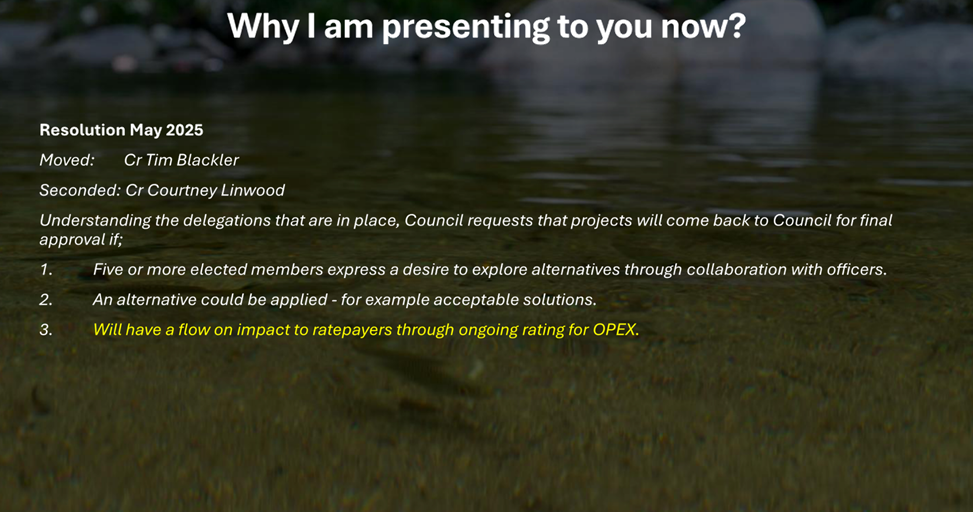
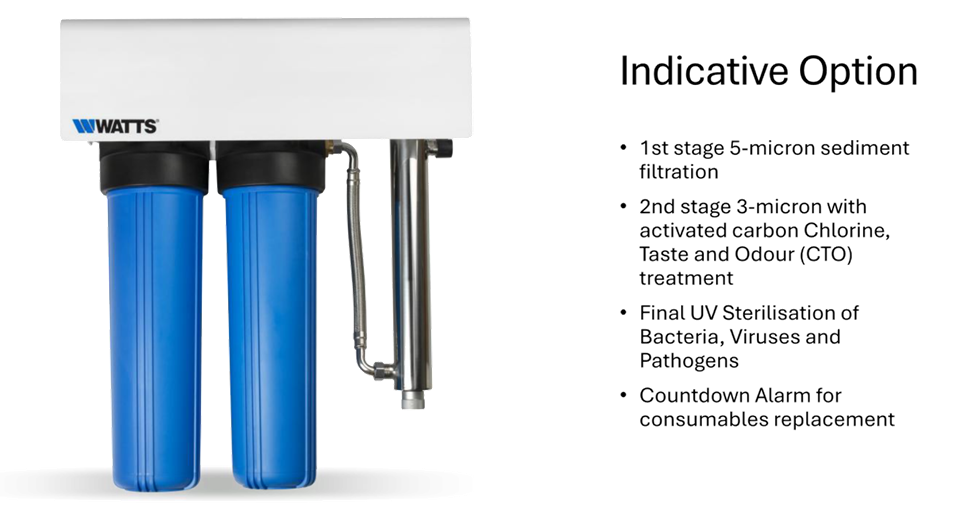
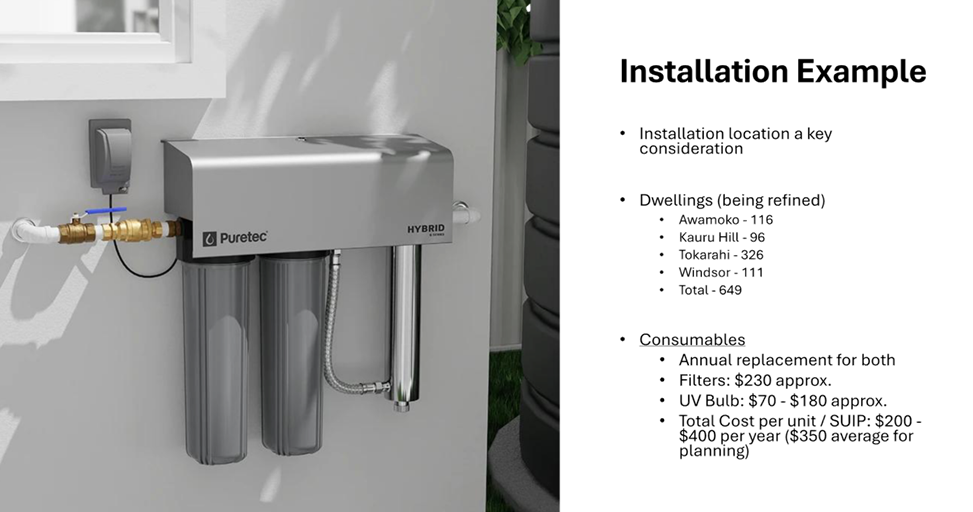
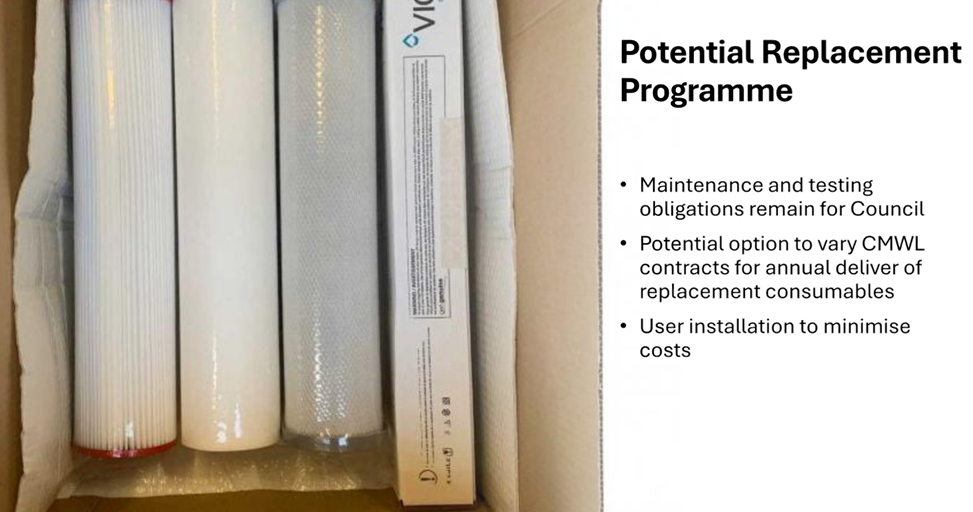
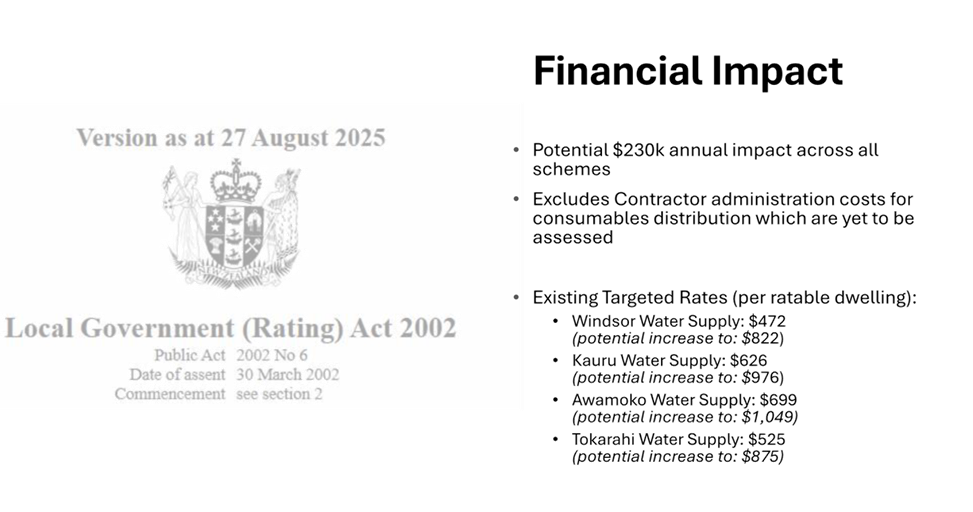
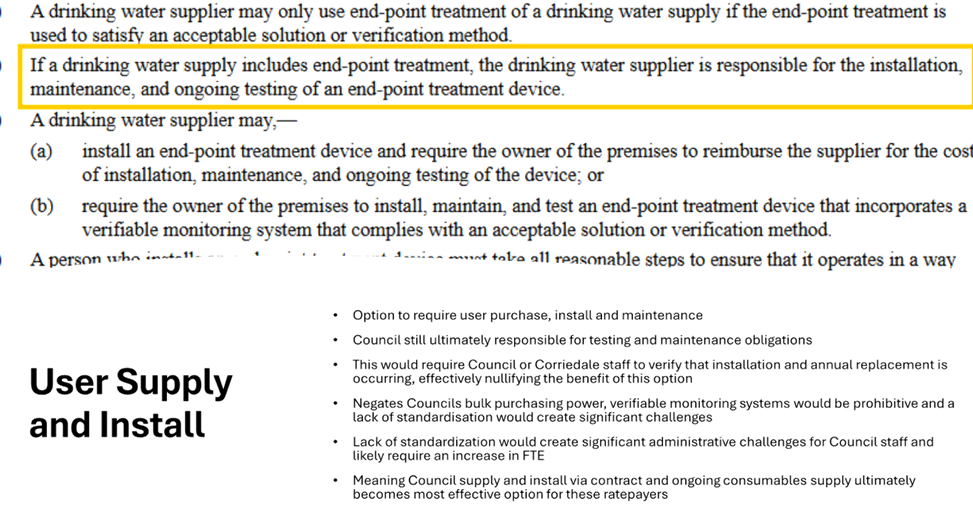
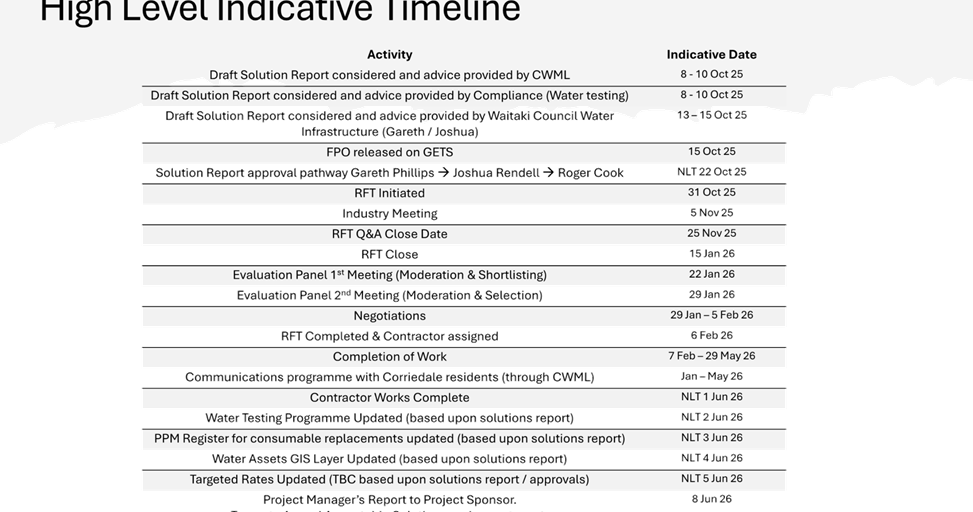
|
Council
Meeting Agenda
|
30 September 2025
|
6.4 Terms of
Reference - Future Water Services Advisory Group
Author: Arlene
Goss, Governance Services Lead
Authoriser: Paul
Hope, Director Support Services
Attachments: 1. 20250922
Draft Terms of Reference Future Water Advisory Group ⇩ 
|
Recommendation
That Council:
1. Approves
the attached Terms of Reference set out for the Future Water Services
Advisory Group.
2. Replaces
all prior references to Future Water Services Portfolio holder with
‘Elected Member Liaison’.
3. Appoints
Cr Tim Blackler as the Elected Member Liaison until the end of the triennium.
4. Recommends
to the incoming Mayor and Council that the Future Water Services Advisory
Group is not to be discharged following the election.
5. Sets a
member remuneration pool budget of $25,000 per annum, with the money coming
from the Better Off Funding grant.
|
Decision Objective
For Council to consider
and approve the Draft Terms of Reference for the new Future Water Services
Advisory Group, as proposed by Cr Blackler at the last council meeting.
Background
Cr Tim Blackler put a notice of motion to the council
meeting on August 26 asking for support to set up an advisory group to assist
the council with ongoing matters around the Local Water Done Well government
initiative.
At that meeting the following resolutions were passed:
Resolved
WDC 2025/001
Moved: Member
Tim Blackler
Seconded: Member
John McCone
That Council;
a. Requests the Chief Executive to establish a
Future Water Services Advisory Group.
b. Agrees that the remit of the Future Water
Services Advisory Group is to provide advice and support to Council and the CE
on:
i. Further development of the Water Services Delivery Plan
should this be required.
ii. The development of the Implementation Plan for delivering
water services in-house efficiently and effectively.
iii. engagement
with a Government Water Services Facilitator or Specialist should one be
appointed.
c. Appoints an Elected Member to the Future Water
Services Portfolio to work with the CE.
d. Requests the Chief Executive, working with the
Future Water Services Portfolio Holder, to appoint up to six members to the
advisory group with the required skills and attributes highlighted in this
report by mid-September.
e. Delegates to the Chief Executive working with
the Future Water Services Portfolio Holder the authority to establish any
necessary further expectations, scope or structure to enable meaningful input.
Carried
Following this meeting a councillor workshop was held to
discuss a Terms of Reference for the advisory group. A draft Terms of Reference
was then drafted by Cr Blackler and presented to the chief executive.
Further refinements of the Terms of Reference were made at a
meeting with Cr Blackler on September 12. Membership of the group was also
discussed, with Cr Blackler offering to approach suitable candidates
immediately.
Summary of Options Considered
Option 1 –
Adopt the Draft Terms of Reference with any changes requested by Council.
Option 2 –
Not adopt the Draft Terms of Reference.
Option 3 –
Pass a resolution to allow the Draft Terms of Reference to “lie on
the table” until the new Mayor and councillors meet on November 4, 2025.
Assessment of Preferred Option
Cr Blackler has expressed some concern about the time it has
taken to get to this point, and the looming election. His preferred option is
that Council adopts the attached Terms of Reference immediately to allow him to
set up the membership of the new group and get it established.
Conclusion
It is recommended that Council adopt the draft Terms of
Reference for the Future Water Services Advisory Group.
|
Council
Meeting Agenda
|
30 September 2025
|
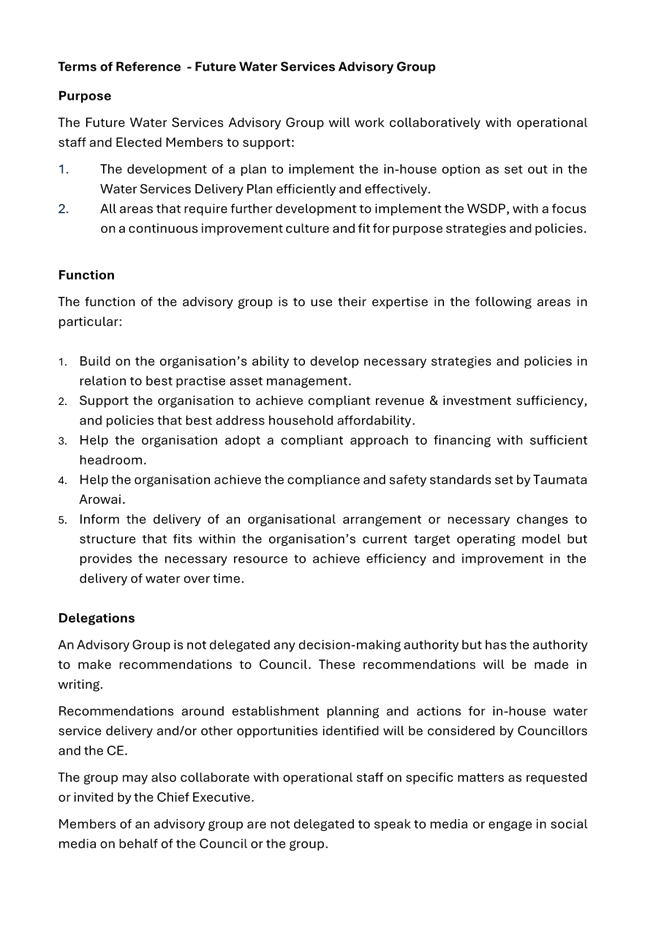
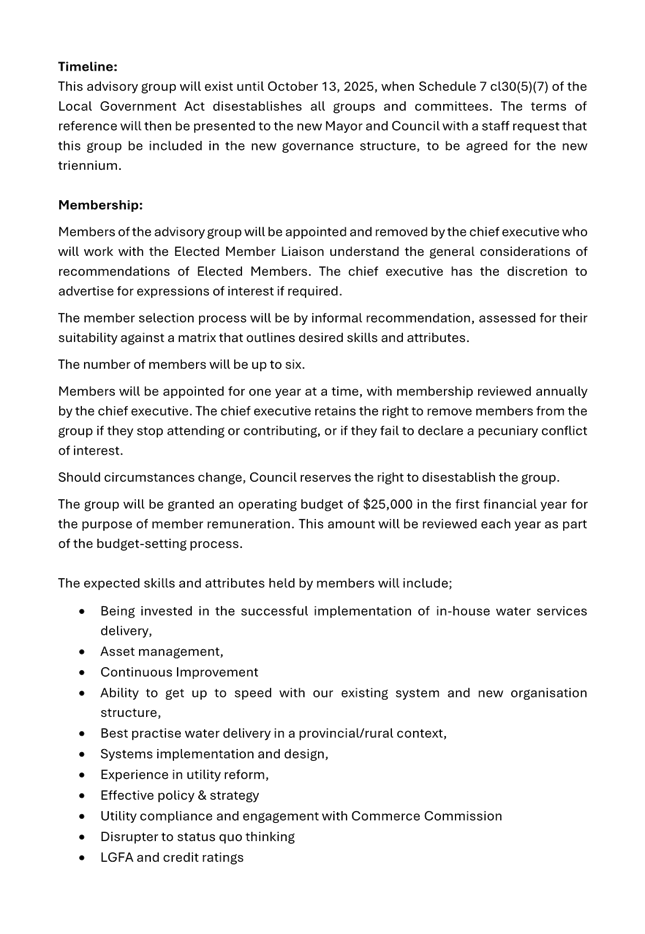
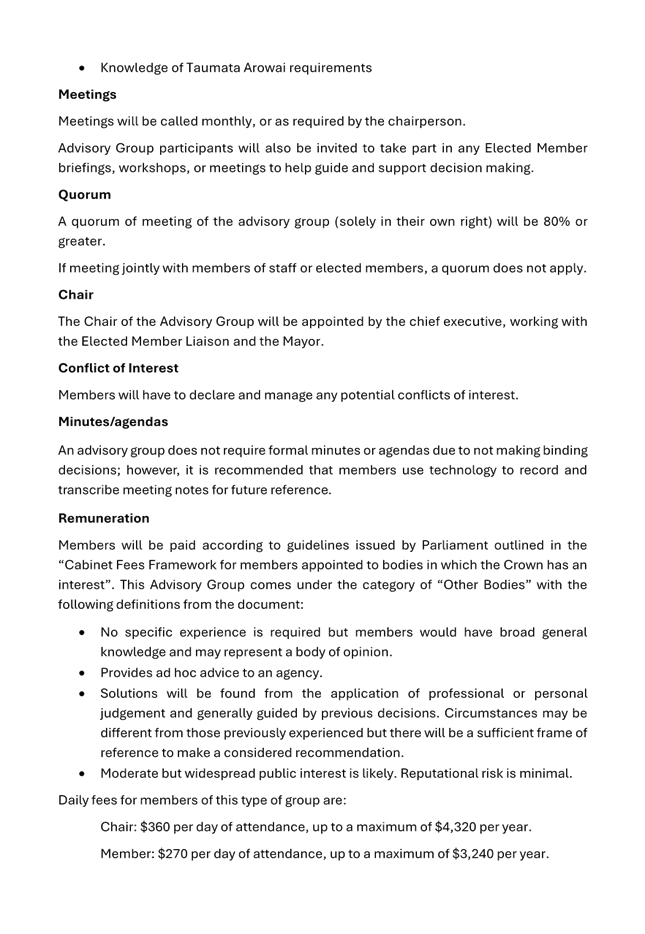
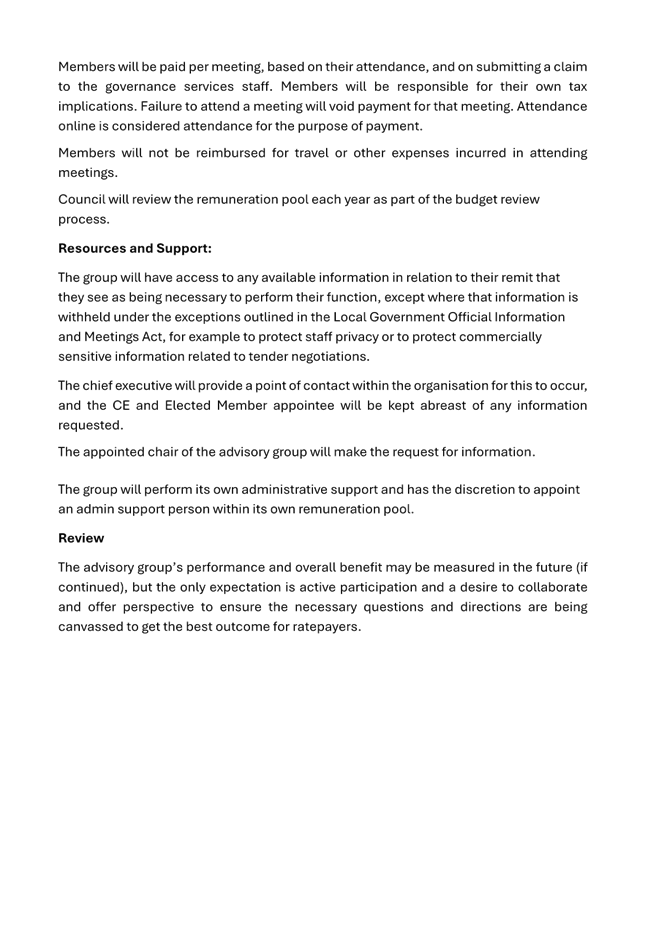
|
Council
Meeting Agenda
|
30 September 2025
|
6.5 Minor
Amendments to Roading Bylaw 2020
Author: Andrew
Bardsley, Regulatory & Compliance Manager
Authoriser: Roger
Cook, Director Natural and Built Environment
Attachments: 1. Roading
Bylaw 2020 - Parking machine changes ⇩
|
Recommendation
That Council:
1. Approves
minor amendments to the Roading Bylaw 2020 – Parking, and that any
amendments will apply from the time the replacement parking machines become
operational.
|
Decision
Objective
For Council to approve minor administrative amendments to
the Roading Bylaw 2020 – Parking (refer Attachment 1)
Summary
The Roading Bylaw 2020 – Parking, is Councils
mechanism for controlling metered parking zones, outlining approved payment
methods and the conditions of use.
The replacement of the current Pay and Display parking
machines with Pay by Plate machines will require minor changes to the Roading
Bylaw 2020 to ensure Council modifies the information provided to the public on
the changes to the operation of parking machines and accepted payment methods.
decision-making
expectations
|
Governance
Decision-Making:
|
To determine parking
policy
|
|
Operational Decision-Making:
|
To implement changes to
parking policy
|
|
Communications
|
Media Releases –
contributed to by officers and Elected Members
Media/public enquiries
regarding governance decision-making topics above can be addressed by
governance
Media/public enquiries
regarding operational decision-making topics above can be addressed by
officers
|
Summary
of Decision-Making Criteria
|
|
No/Moderate/Key
|
|
No/Moderate/Key
|
|
Policy/Plan
|
Key
|
Environmental Considerations
|
No
|
|
Legal
|
Key
|
Cultural Considerations
|
No
|
|
Significance
|
Moderate
|
Social Considerations
|
No
|
|
Financial Criteria
|
No
|
Economic Considerations
|
Moderate
|
|
Community Views
|
No
|
Community Board Views
|
No
|
|
Consultation
|
No
|
Publicity and Communication
|
Key
|
Background
A Council resolution on 27 May 2025 approved the replacement
of the current parking machines with Pay by Plate cashless models.
The machines being replaced are Pay and Display models
requiring the user to display a paper receipt in their vehicle upon payment by
card, app or coins.
The new machines are paperless and require the user to only
enter their vehicle registration number and payment is made via card, app or QR
code. There is no requirement to display a receipt.
The Councils current Roading Bylaw 2020 - Parking refers to
users displaying a receipt and using coins as a means of payment. This
information is no longer relevant and is required to be updated in line with
the guidelines for usage of the new machines.
The changes requested are addressed on Page 11 Part 5.4,
Page 13 Part 9.1 and Pages 14, 15 Part 10.3 to 10.9 of the attached Roading
Bylaw 2020 – Parking. (refer Attachment 1)
Summary of
Options Considered
Option 1 –
Adopt minor changes to the Roading Bylaw 2020 – Parking (Recommended)
This option will remove any
inconsistencies between the current Roading Bylaw for parking and the
operational requirements of the
replacement parking machines.
Option 2 –
Does not adopt minor changes to the Roading Bylaw 2020 – Parking
This option will render the current
Roading Bylaw unenforceable in relation to the parking related
compliance guidelines for the replacement
parking machines.
Assessment of
Preferred Option
Making the requested minor changes to the Roading Bylaw is
required to align it with changes to the operational requirements of the
replacement machines. These include a change from Pay and Display to Pay by
Plate and payment methods. Without these changes officers will be unable to
carry out enforcement for non-compliance relating to parking behaviour in our
metered parking areas.
Conclusion
The recent Council decision to replace our parking machines
was required to address their outdated technology and increasing maintenance
issues. The new models improved operational reliability, and technology has
necessitated changes to the Roading Bylaw to align with the operational changes
for using the new machines.
Additional
Decision-Making Considerations
Waitaki District Council Strategic Framework
Outcomes
Community Outcomes
Prosperous District
· Attractive
to new opportunities
· Supporting
local businesses
· Fostering
a diverse and resilient economy
Strong Communities
· Enabling
safe, healthy communities
· Connected,
inclusive communities
· Promoting
a greater voice for Waitaki
· Celebrating
our community identity
Quality Services
· Robust
core infrastructure and services
· Community
facilities and services we are proud of
Valued Environment
· Protecting
our diverse landscapes and water bodies
· Meeting
environmental and climate change challenges
Policy and
Plan Considerations
The required administrative amendments will ensure the
Roading Bylaw 2020-Parking is fit for purpose to fairly inform the community
and to support the compliance and enforcement functions for paid parking
Community
Views
Consultation is not required; however these amendments will
inform the public of usage and payment requirements associated with the use of
the new parking infrastructure.
Financial
Considerations
Without the requested amendments the ability to collect the
current parking related fee and enforcement fines would be incompatible with
the bylaw.
Legal
Considerations
The amendments to the bylaw are required to allow WDC to
legally enforce the requirement to pay for parking.
Environmental
Considerations
There are no environmental considerations.
Publicity and
Community Considerations
The changes will be widely disseminated to the public via
our community engagement team. This will include information about the changes,
guidance on how to use machines and identifying any changes to the paid parking
requirements. Community feedback will be sought via our ‘Let’s
Talk’ website page.
|
Council
Meeting Agenda
|
30 September 2025
|
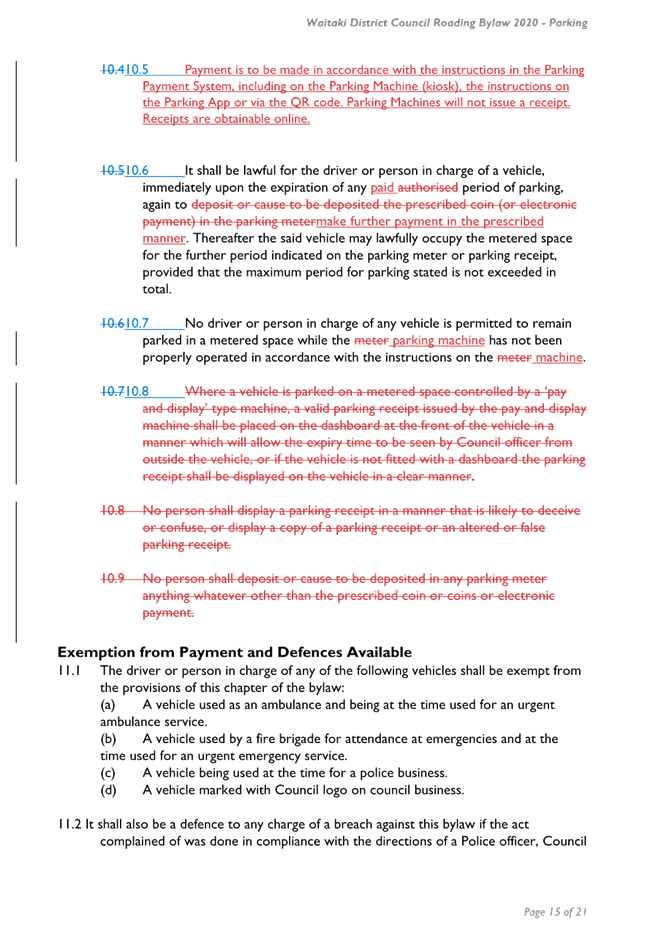
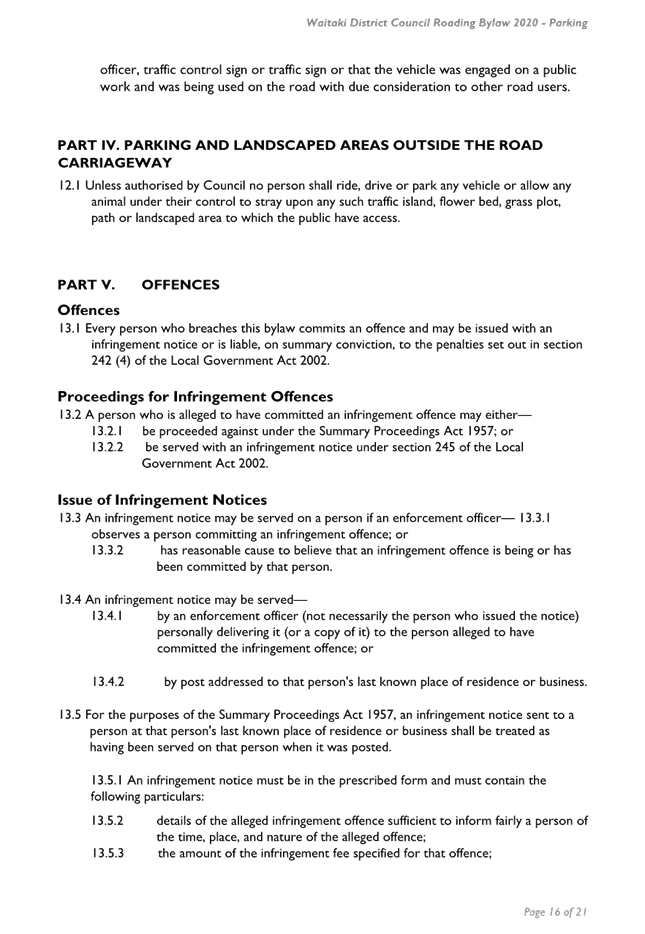




|
Council
Meeting Agenda
|
30 September 2025
|
6.6 Report to
Alcohol, Regulatory and Licensing Authority (ARLA)
Author: Andrew
Bardsley, Regulatory & Compliance Manager
Authoriser: Roger
Cook, Director Natural and Built Environment
Attachments: 1. Alcohol
Regulatory and Licensing Authority - Annual Report 2024 - 2025 ⇩ 
|
Recommendation
That Council:
1. Formally
receives the 2024/2025 Alcohol Regulatory and Licensing Annual Report, and
2. Acknowledges
that resolving point 1 above will also enable the Annual Report to be
publicly notified on Council’s website pursuant to legislative
requirements
|
Decision Objective
That Council formally receives the
2024/2025 Alcohol Regulatory and Licensing Authority (ARLA) annual report for
the Waitaki district (included as Attachment 1).
Summary
This annual report fulfils the
statutory requirements of Section 199 of the Sale and Supply of Alcohol Act
2012. It provides a comprehensive overview of alcohol licensing activities in
the Waitaki District for the reporting period, ensuring transparency,
accountability, and compliance with legislative obligations.
New Zealand Medical Journal data
suggests that more than half of physical and sexual assaults involve alcohol
consumption by the offender. Equally, national police data shows that almost
50% of family harm incidents involved either the offender or victim being
affected by alcohol.
Policy interventions, such as
limiting trading hours, appear to reduce assault-related harm, a tangible
indication of how alcohol availability impacts violence rates.
The steady state of alcohol
licensing activity and increased community engagement signal a positive trend
in public involvement and regulatory compliance. Continued focus on stakeholder
collaboration and public participation will further strengthen the Council's
ability to address alcohol-related issues effectively.
decision-making expectations
|
Governance
Decision-Making:
|
The report is approved,
and statutory reporting requirements are met
|
|
Operational Decision-Making:
|
None
|
|
Communications
|
Media Releases –
contributed to by officers and Elected Members
Media/public enquiries
regarding governance decision-making topics above can be addressed by
governance
Media/public enquiries
regarding operational decision-making topics above can be addressed by
officers
|
Summary of Decision-Making Criteria
|
|
No/Moderate/Key
|
|
No/Moderate/Key
|
|
Policy/Plan
|
Moderate
|
Environmental Considerations
|
No
|
|
Legal
|
Key
|
Cultural Considerations
|
No
|
|
Significance
|
Moderate
|
Social Considerations
|
Moderate
|
|
Financial Criteria
|
No
|
Economic Considerations
|
No
|
|
Community Views
|
Moderate
|
Community Board Views
|
No
|
|
Consultation
|
No
|
Publicity and Communication
|
Key
|
Background
The Alcohol Regulatory and
Licensing Authority (ARLA) is required to provide an annual report to the
Minister of Justice each year detailing alcohol licensing activities for each
district. To achieve this, the Waitaki District Licensing Committee (DLC) is
required to provide an annual report to ARLA detailing records of all licensing
application decisions.
Section 65(1) of the Sale and
Supply of Alcohol Act 2012 requires the Waitaki District Council to provide a
detailed list of names, addresses, and types of licensed premises currently
operating in our district and a breakdown showing revenue from licensing fees.
Council as the Licensing authority
is required to publicly notify the ARLA Annual report, to meet the requirements
of section 199(4)(5) Sale and Supply of Alcohol Act 2012. The report is a
public record and is required to be made available on an Internet site
maintained by or on behalf of the territorial authority for a period of no less
than 5 years.
Commentary on current
alcohol-related trends and issues is also provided by the Chair of the DLC on
pages 2 – 3 of the report.
Summary of Options Considered
Option 1 –
The 2024/2025 annual ARLA report is formally received by
Council (Recommended).
Option 2 –
The 2023/2024 annual ARLA report is not formally received by Council.
Assessment of Preferred Option
Option 1 is the recommended option. It will enable the
report to be publicly notified and made available to the public on
Council’s website, which is a requirement of section 199(5) of the Sale
and Supply of Alcohol Act 2012. This will promote transparency and
accountability of Council to its community.
Next Steps
The Regulatory & Compliance Manager will have the report
published on the WDC website.
Conclusion
District Licencing Committees are an important link between
communities, police and public health in considering licencing related matters
in the sale and supply of alcohol. It is important that communities have a
voice in this decision-making process supported by statistical and trend
analysis.
Additional Decision-Making Considerations
Waitaki District Council Strategic Framework
Outcomes
Community Outcomes
Prosperous District
· Attractive
to new opportunities
· Supporting
local businesses
· Fostering
a diverse and resilient economy
Strong Communities
· Enabling
safe, healthy communities
· Connected,
inclusive communities
· Promoting
a greater voice for Waitaki
· Celebrating
our community identity
Quality Services
· Robust
core infrastructure and services
· Community
facilities and services we are proud of
Valued Environment
· Protecting
our diverse landscapes and water bodies
· Meeting
environmental and climate change challenges
Policy
and Plan Considerations
Reporting on alcohol-related licensing activity is important
as it provides trend analysis, helping Council officers identify patterns and
trends in alcohol related licencing, allowing for more informed
decision-making. By understanding these trends, the Council can allocate
resources more effectively to areas that need the most attention.
Community
Views
Regular reporting ensures that the community is kept
informed about alcohol licensing matters, fostering trust and accountability.
It provides an opportunity for the community to engage with the Council on
these issues, ensuring that their concerns and suggestions are considered.
Financial
Considerations
Alcohol licencing fees are set within the Sale and Supply of
Alcohol Act 2012.
Legal
Considerations
It is a legislative requirement under s199
of the Sale and Supply of Alcohol Act 2012 to report on proceedings and
operations over the previous year. Option 1 ensures the legislative requirement
is met. There are no further risks identified.
Environmental
Considerations
There are no identified environmental considerations.
Publicity
and Community Considerations
S199 (5) of the Sale and Supply of Alcohol Act 2012 requires
copy of every annual report be made available by the territorial authority for
inspection free of charge and be made available on an Internet site maintained
by or on behalf of the territorial authority for a period of not less than 5
years
|
Council
Meeting Agenda
|
30 September 2025
|
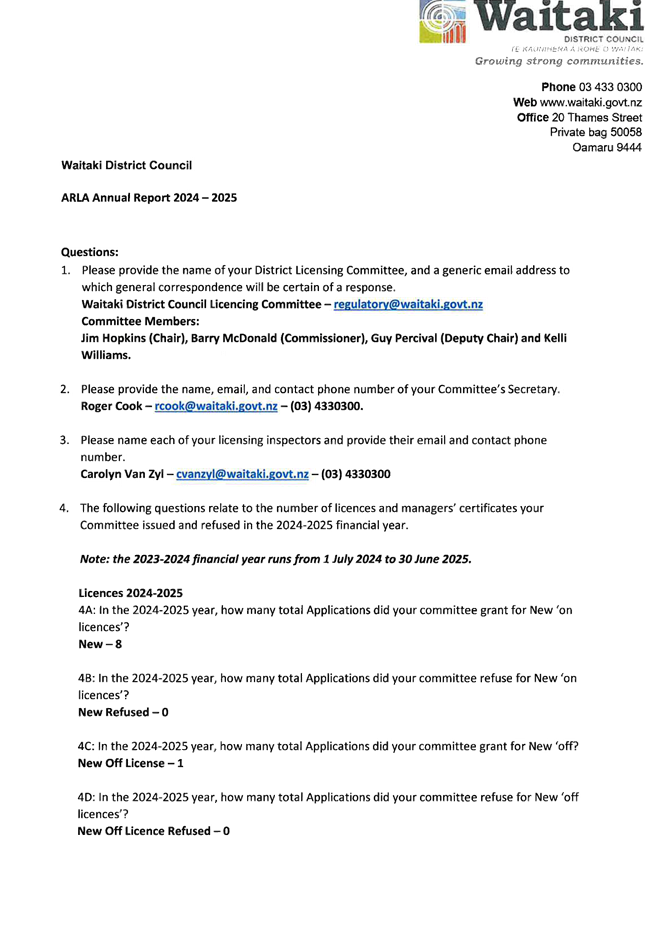
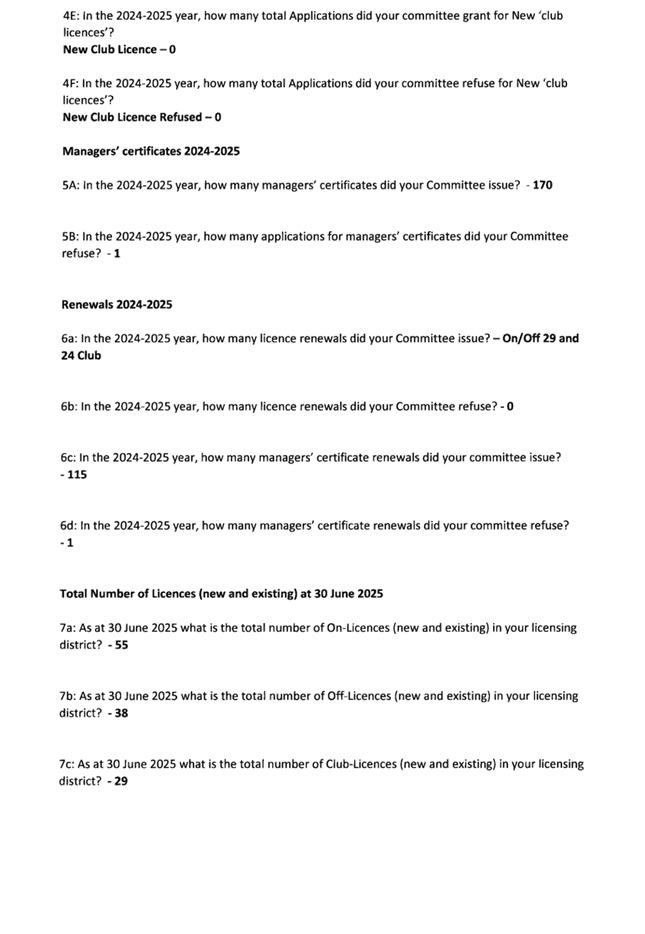
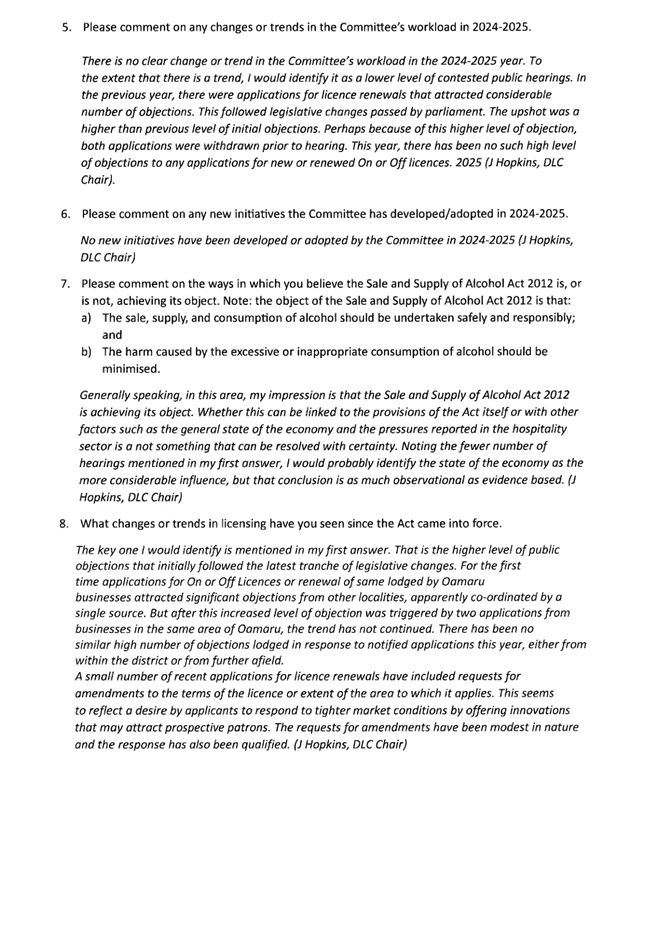

|
Council
Meeting Agenda
|
30 September 2025
|
6.7 Annual Dog
Report
Author: Andrew
Bardsley, Regulatory & Compliance Manager
Authoriser: Roger
Cook, Director Natural and Built Environment
Attachments: 1. Sec
10A Dog Report 2024-25 ⇩
|
Recommendation
That Council:
1. Approves
the Annual Dog Control S10A Policy and Practices Report 2024/25 in order that
the report can be publicly notified and made publicly available
|
Decision
Objective
To seek Council’s approval of the Annual Dog Control
S10A Report for 2024/25 (included as Attachment 1).
Summary
Annual reporting of the information required by Section 10A
of the Dog Control Act 1996 (the Act) enables Council to meet its statutory
obligations.
decision-making
expectations
|
Governance
Decision-Making:
|
The report is approved,
and statutory reporting requirements are met.
|
|
Operational Decision-Making:
|
None
|
|
Communications
|
Media Releases –
contributed to by officers and Elected Members
Media/public enquiries
regarding governance decision-making topics above can be addressed by
governance
Media/public enquiries
regarding operational decision-making topics above can be addressed by
officers
|
Summary
of Decision-Making Criteria
|
|
No/Moderate/Key
|
|
No/Moderate/Key
|
|
Policy/Plan
|
Moderate
|
Environmental Considerations
|
No
|
|
Legal
|
Key
|
Cultural Considerations
|
No
|
|
Significance
|
Key
|
Social Considerations
|
No
|
|
Financial Criteria
|
No
|
Economic Considerations
|
No
|
|
Community Views
|
No
|
Community Board Views
|
No
|
|
Consultation
|
No
|
Publicity and Communication
|
Key
|
Background
Annual reporting of the information required by Section 10A
of the Dog Control Act 1986 (the Act) enables Council to meet its statutory
obligations under the Act. Waitaki District Council is required to report
annually on its dog control policy and practices to comply with that
legislative requirement. The relevant clause from the Act is provided
below, for ease of reference:
‘10A
Territorial authority must report on dog control policy and practices
(1) A territorial authority
must, in respect of each financial year, report on the administration of—
(a) its dog control
policy adopted under section 10; and
(b) its dog control
practices.
(2) The report must include, in
respect of each financial year, information relating to—
(a) the number of
registered dogs in the territorial authority district:
(b) the number of
probationary owners and disqualified owners in the territorial authority
district:
(c) the number of dogs in
the territorial authority district classified as dangerous under section 31 and the relevant provision under which the classification
is made:
(d) the number of dogs in
the territorial authority district classified as menacing under section 33A or section 33C and the relevant provision under which the classification
is made:
(e) the number of
infringement notices issued by the territorial authority:
(f) the number of dog
related complaints received by the territorial authority in the previous year
and the nature of those complaints:
(g) the number of
prosecutions taken by the territorial authority under this Act.
(3) The territorial authority
must—
(a) give public notice, as defined in section 5(1) of the Local Government Act 2002, of the report; and
(b) make the report publicly available, as described in section 5(3) of that Act.’
Summary of
Options Considered
Option 1 –
The 2024/25 Annual Dog Report is approved (Recommended)
Option 2 –
The 2024/25 Annual Dog Report is not approved.
Assessment of
Preferred Option
Approval of the report enables the report to be publicly
notified and made publicly available on Council’s website. This promotes
transparency and accountability of Council to its communities.
Conclusion
The Annual Dog Control Policy and Practices report
summarises key information which is mandatory for Council to report on. It also
provides context to animal management operations which will assist the
community to understand unique challenges of dog control in the district and
the services which are financed through collection of dog registration fees.
Additional
Decision-Making Considerations
Waitaki District Council Strategic Framework
Outcomes
Community Outcomes
Prosperous District
· Attractive
to new opportunities
· Supporting
local businesses
· Fostering
a diverse and resilient economy
Strong Communities
· Enabling
safe, healthy communities
· Connected,
inclusive communities
· Promoting
a greater voice for Waitaki
· Celebrating
our community identity
Quality Services
· Robust
core infrastructure and services
· Community
facilities and services we are proud of
Valued Environment
· Protecting
our diverse landscapes and water bodies
· Meeting
environmental and climate change challenges
Policy and
Plan Considerations
Council and the community be satisfied that the key outcomes
for dog control in Waitaki district are being met.
Legal
Considerations
Council must meet its statutory obligations to report
annually on dog control practices and policy.
Publicity and
Community Considerations
Public notification and publication of the report enables
the community to be informed about dog control practices and policy.
|
Council
Meeting Agenda
|
30 September 2025
|
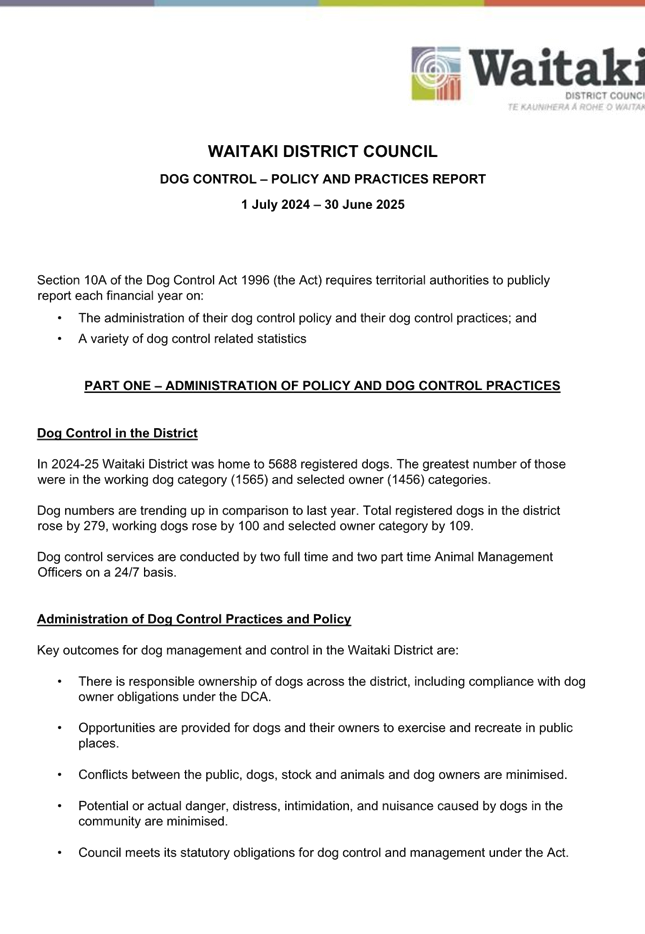
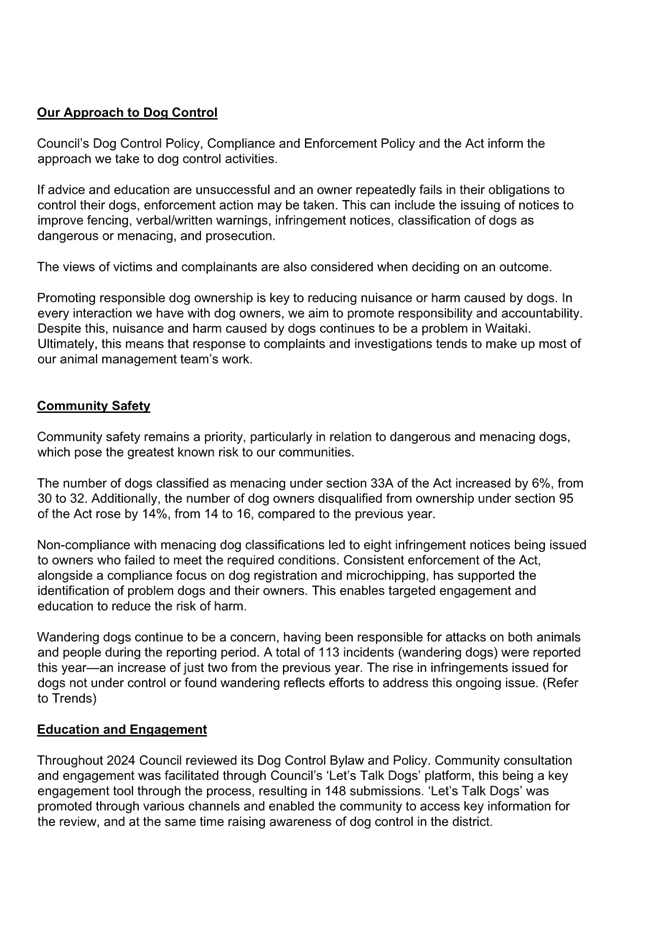
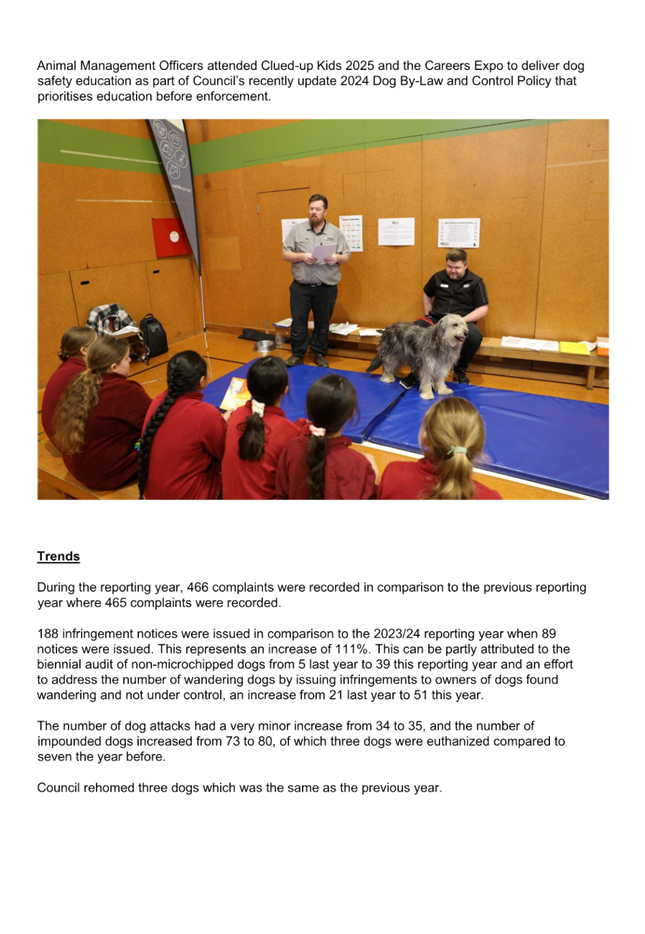
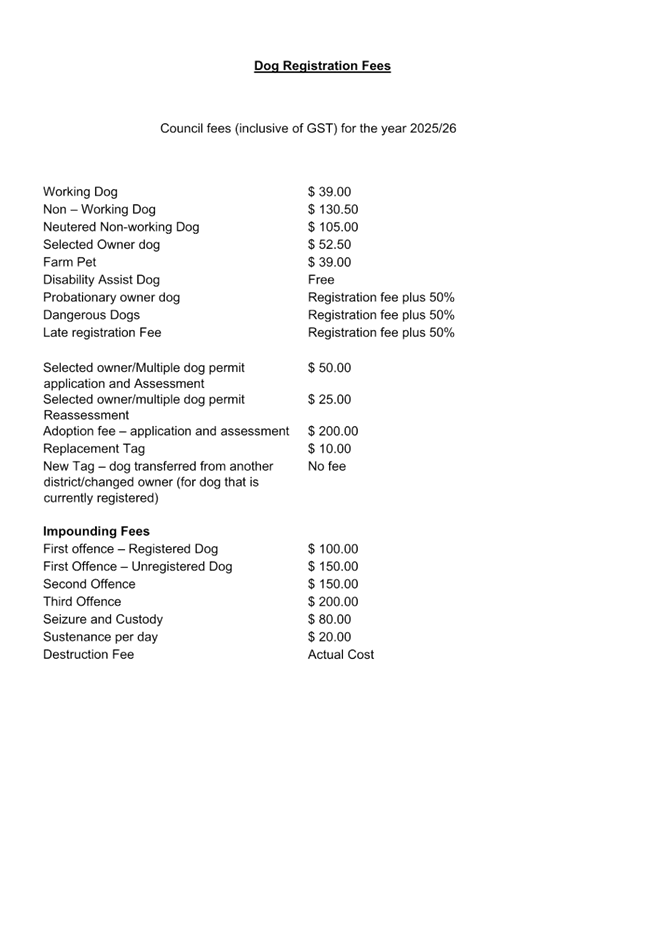
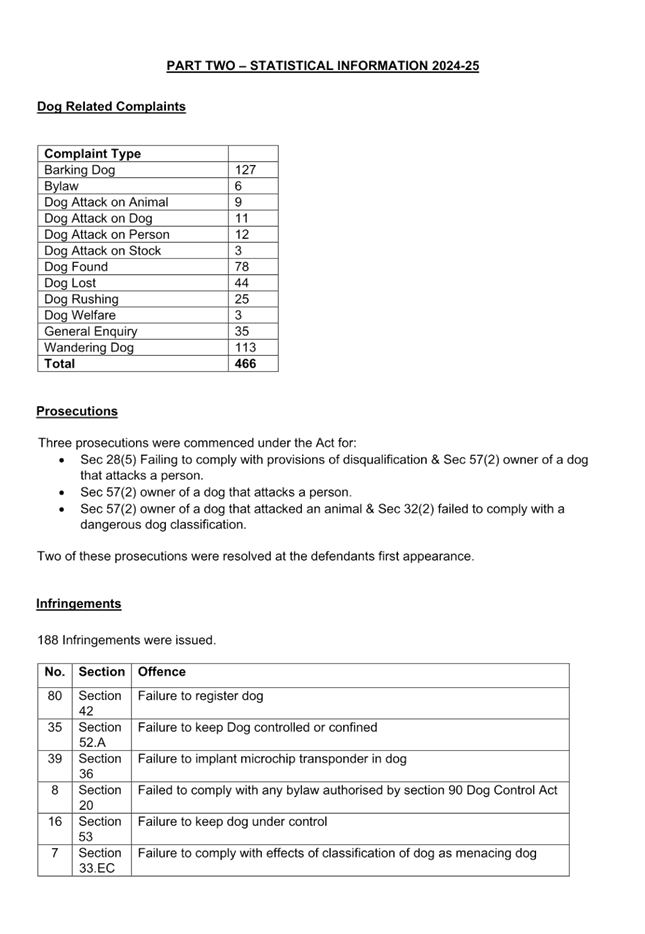
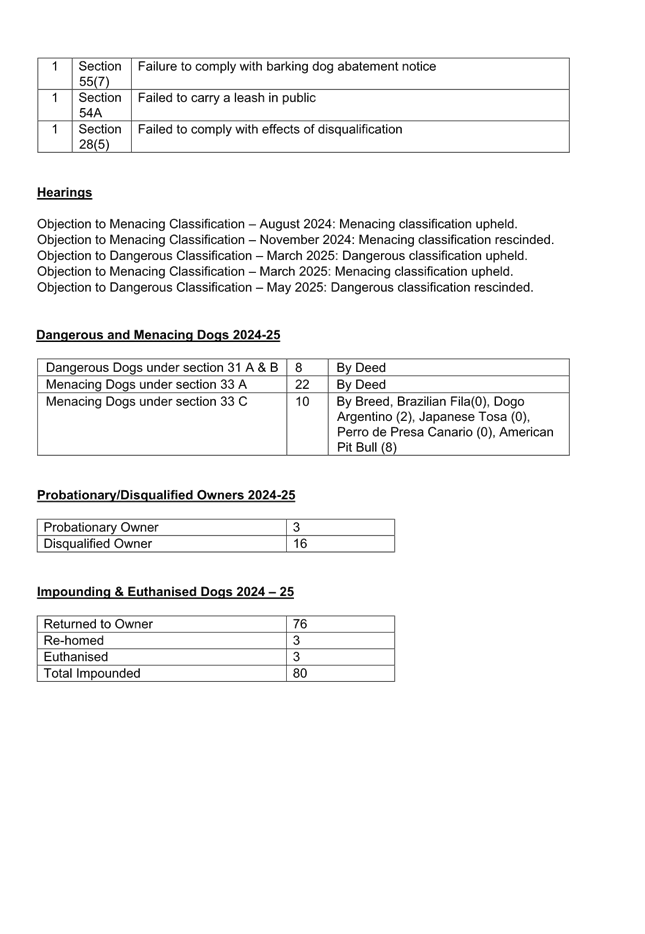
|
Council
Meeting Agenda
|
30 September 2025
|
6.8 Loch Laird
Labour Weekend Liquor Band
Author: Lindsay
Hyde, Recreation Specialist
Authoriser: Roger
Cook, Director Natural and Built Environment
Attachments: 1. 20250930
Alcohol Ban Area 2025 ⇩ 
|
Recommendation
That Council:
1. Agrees to
designate the area in Loch Laird shown in Attachment 1 as a specified public
place under the Waitaki Alcohol Ban Bylaw 2018 from 5.00pm on Friday 24
October 2025 (being the Friday preceding Labour Weekend 2025) to 12.00am on
Tuesday 28 October 2025 (being the Tuesday following Labour Weekend).
|
Decision
Objective
To place an alcohol ban on the upper terrace of Loch Laird
and the foreshore between Loch Laird and Wildlife camp for Labour Weekend in
2025 to protect the community and improve safety.
Summary
The upper terrace of Loch Laird has been a de-facto venue
for an informal party at Labour Weekend. This historically created a variety of
unsafe situations and anti-social behaviour, much of it related to the
consumption of alcohol. Over the past four years, an alcohol ban resulted in
the usual party participants making other arrangements and contributed to a
reduction of the issues that have been experienced in Otematata over the Labour
Weekend period prior to the ban being in place.
It is proposed to put a ban in place for 2025.
In accordance with the Waitaki
Alcohol Ban Bylaw 2018, Council may add an area as a specified public place in
which an alcohol ban is instituted for a specified period. Council must
formally resolve a specified period during which the ban will apply. That
resolution must then be publicly notified at least 14 days before it shall take
effect. Consequently, Council must decide each year whether to institute an
alcohol ban for the Loch Laird area and, if so, for what specified
period.
decision-making
expectations
|
Governance
Decision-Making:
|
Implementation of
Alcohol Ban area for Labour Weekend in 2025
|
|
Operational Decision-Making:
|
Implementation and
delivery of the Alcohol Ban
|
|
Communications
|
Media Releases –
contributed to by officers and Elected Members
Media/public enquiries
regarding governance decision-making topics above can be addressed by
governance
Media/public enquiries
regarding operational decision-making topics above can be addressed by
officers
|
Summary
of Decision-Making Criteria
|
|
No/Moderate/Key
|
|
No/Moderate/Key
|
|
Policy/Plan
|
Moderate
|
Environmental Considerations
|
No
|
|
Legal
|
Moderate
|
Cultural Considerations
|
No
|
|
Significance
|
No
|
Social Considerations
|
Key
|
|
Financial Criteria
|
No
|
Economic Considerations
|
No
|
|
Community Views
|
Key
|
Community Board Views
|
Moderate
|
|
Consultation
|
No
|
Publicity and Communication
|
Key
|
Background
For up to 20 years, the upper terrace at the Loch Laird
Campground has been the de-facto location for predominantly high school-aged
students to ‘party’ on Labour Weekend. While the land is not
provided as a venue for these activities, Council is perceived by some to be
providing an official, managed community event. As an uncontrolled event,
participants and the local community are put at risk. Alcohol is a major
contributor to the anti-social behaviour.
Prior to the 2021 Labour Weekend, a taskforce comprising of
Police representatives, Councillors, Community Board members, Council officers,
and other community representatives discussed options to reduce this risk. The
taskforce identified the following actions for implementation for Labour
Weekend 2021:
1. Council
to implement a temporary alcohol ban for the top paddock by Loch Laird and the
foreshore between Loch Laird and Wildlife campground.
2. Increased Police presence
and extra camp and security staff.
3. Lighting improvements.
4. Increased communication
around the risks.
These actions have successfully mitigated negative
behaviours last three Labour Weekend periods.
Due to the success of the above measures, officers are
recommending the same approach as was undertaken in 2024. Our camp management
staff will be onsite and if any issues arise the team will contact the local
police.
Alcohol Ban
Section 10 of the Waitaki Alcohol Ban Bylaw 2018 provides
for Council to:
• From time to time by resolution, specify
additional periods during which the bringing of alcohol into a public place and
the possession or consumption of alcohol in a public place may be prohibited
and (in conjunction with such a prohibition) the presence or use of vehicles
may be regulated or controlled. The Council may make such a resolution in
relation to any planned public event, function or social gathering to be held
in a public place or in relation to a period when the congregation of a large
number of people in a public place is anticipated.
• From time to time by resolution, specify
additional public places that are to be defined as Specified Public Places and
in relation to which the provisions of this Bylaw relating to the prohibition,
regulation or control of alcohol and vehicles may apply during a Specified
Period.
• Every resolution made shall be publicly notified
at least 14 days before it shall take effect.
Section 11 of the Waitaki Alcohol Ban Bylaw 2018 requires
Council to be satisfied that:
• There is evidence that the area to which the
bylaw applies has experienced a high level of crime or disorder that can be
shown to have been caused or made worse by alcohol consumption in the area; and
• The bylaw is appropriate and proportionate
considering the evidence and can be justified as a reasonable limitation on
people’s rights and freedoms.
A temporary Alcohol Ban is in place in designated areas of
Otematata from Labour Weekend until Queen's Birthday Weekend under the Waitaki
Alcohol Ban Bylaw 2018. This does not cover the reserve area where the main
issues occur. It is proposed that this designated area is continued for 2025 to
include the upper terrace at Loch Laird.
The purpose of the bylaw is to protect the community and
improve safety. The following acts would be prohibited on the upper terrace of
Loch Laird and the foreshore between Loch Laird and Wildlife camp from 5.00pm
on Friday 24 October 2025 (being the Friday preceding Labour Weekend 2025) to
12.00am on Tuesday 28 October 2025 (being the Tuesday following Labour
Weekend):
• The consumption of alcohol in a public place.
• The possession of alcohol in a public place in an
unsealed container.
• The bringing of alcohol into a public place in an
unsealed container.
• Consumption of alcohol in a vehicle in a public
place.
The Police have powers to enforce the bylaw, which includes
powers of arrest and search. This will provide Police with an additional tool
to respond to undesirable behaviour and the ability to be more proactive
without having to wait until the alcohol fuels undesirable behaviour.
Officers and Police are satisfied that there is sufficient
evidence to justify an Alcohol Ban. The police have recommended that we monitor
the boat harbour area to deter anti-social behaviour as well as installation of
signage around the area.
Summary of
Options Considered
Option 1 –
Alcohol Ban. This will provide Police with additional powers and enable
proactive management of the issue. (Recommended)
Option 2 –
Glass Ban. This would remove the problem of broken glass but would not
treat the underlying issue or prevent other unsocial behaviour.
Option 3 –
Site closure. This would have a similar effect to Option 1 but does not
have the same community support.
Option 4 - Do
nothing. This could mean a continuance of the same behaviours experienced in
years prior to the instituting of the liquor ban.
Assessment of
Preferred Option
Option 1 is the preferred
option as it provides additional tools to proactively manage the problem and
prevent unsocial and unsafe behaviour, and it has the support of the local
community.
Conclusion
In 2021 - 2023 and again in 2024, having Alcohol Bans in
place successfully allowed negative behaviour to be mitigated that would
otherwise have presented safety and social issues on the upper terrace at Loch
Laird. Repeating the Alcohol Ban this year will again allow for more proactive
management of any negative behaviours.
Additional
Decision-Making Considerations
Waitaki District Council Strategic Framework
Outcomes
Community Outcomes
Strong Communities
· Enabling
safe, healthy communities
·
Quality Services
· Community
facilities and services we are proud of
Community
Views
The local community has been part of a taskforce looking at
how to change undesirable and unsafe behaviour at Labour Weekend.
Legal
Considerations
The Waitaki Alcohol Ban Bylaw 2018 provides for Council to
specify Alcohol Bans where there is evidence that crime or disorder is made
worse by alcohol consumption.
Publicity and
Community Considerations
The Waitaki Alcohol Ban Bylaw 2018 specifies that public
notification is required at least 14 days prior to the dates being requested.
|
Council
Meeting Agenda
|
30 September 2025
|
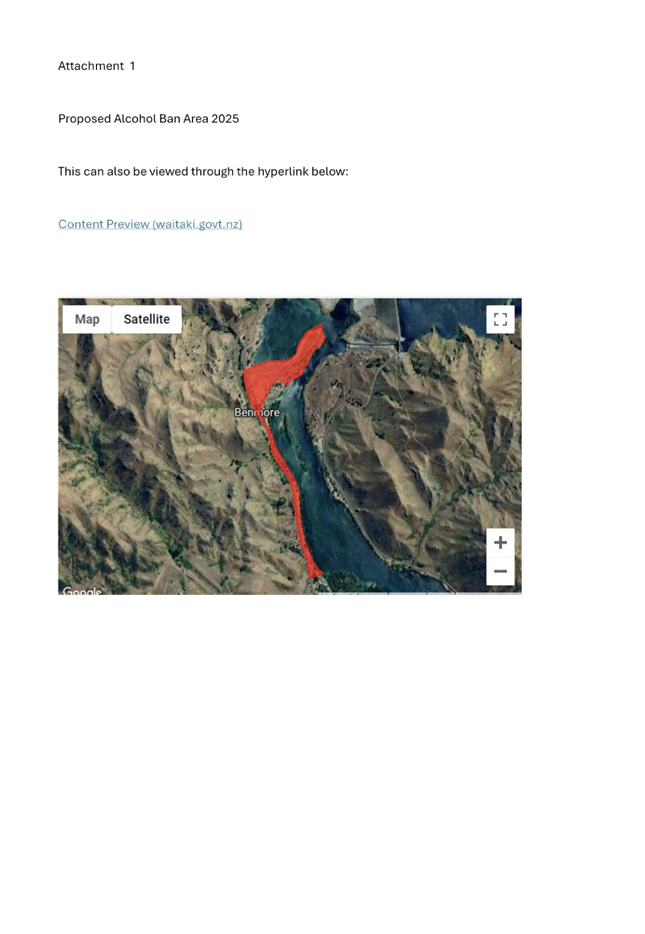
|
Council
Meeting Agenda
|
30 September 2025
|
6.9 Interregnum
Period Delegation to the Chief Executive
Author: Arlene
Goss, Governance Services Lead
Authoriser: Paul
Hope, Director Support Services
|
Recommendation
That Council:
Delegates all of its responsibilities, duties and powers to the Chief
Executive, subject to the limitations set out in clause 32(1) of the Seventh
Schedule of the Local Government Amendment Act 2002, for the election
interregnum period starting from the day after the declaration of the
election results (expected to be on election day 11 October 2025) until the
swearing in of the new Council (scheduled for the evening of Wednesday,
October 22, 2025), subject to a requirement that the Chief Executive may only
exercise this delegation after the following:
· Consultation with the person elected to the position of Mayor.
· May only attend to those matters that cannot reasonably wait until
the first ordinary meeting of the new Council; and
· This shall be reported to the first ordinary meeting of the new
Council, which is scheduled to be held on Tuesday 4 November 2025.
|
Decision
Objective
To seek Council’s approval of delegations during the
upcoming election period that will enable the business of Council to be
conducted during a time when the incoming Council is prevented from exercising
responsibilities, duties, and powers under legislation before it is officially
sworn in.
Summary
The report requests that Council delegate to the Chief
Executive during the election period the responsibilities, duties, and powers
of the Council, except for certain powers set down in the legislation that
cannot be delegated.
Background
Council will need to consider arrangements to ensure the
effective and efficient conduct of the Council’s business during the
election period. For the purposes of this report, the election period is
from the day after the declaration of the electoral result until the new
Council is sworn in at the Inaugural Meeting.
It is referred to as the “interregnum period”,
and the incoming Council cannot make decisions or undertake matters of business
until they have been sworn in. Clause 14(1) of Schedule 7 of the Local
Government Act 2022 applies:
(1) A
person may not act as a member of a local authority until—
(a) that
person has, at a meeting of the local authority following the election of that
person, made an oral declaration (…) and
(b) a
written version of the declaration has been attested (…)
This provision combines with sections 86, 115 and 116 of the
Local Electoral Act 2001 (LEA 2001) which state that, during the election
period, neither the outgoing nor the incoming elected members can act in their
capacity as members of the Council.
To
allow for urgent or emergency decisions to be taken, Council can delegate
powers to the Chief Executive.
This delegation is over and above the existing delegations
to the Chief Executive. It will ensure that the Chief Executive has the
authority to operate the Council effectively and efficiently and is able to
respond to any unforeseen or emergency circumstances that may arise during the
election period.
The delegation is for a limited time, anticipated to be from
11 October 2025 to close of business on 22 October 2025. However, these days
may be subject to change, depending on the timing of the publication of the
election results and the inauguration of the new Council where declarations
will be made and witnessed, and whether there is any challenge to the election
result.
The following conditions will
apply
· The Chief Executive may only act after consultation with
the person elected to the position of Mayor.
· The Chief Executive may only attend to those matters that
cannot reasonably wait until the first meeting of the new Council.
· The Chief Executive is required to report any decisions
made under this election period delegation to the first meeting of the new
Council, which is scheduled to be held on Tuesday 4 November 2025.
Summary of
Options Considered
Option 1
Grant Delegated Authority to the
Chief Executive during the election period
The Council has the option of
delegating to the Chief Executive all of its responsibilities, duties, and
powers for the election period, except those set out in paragraphs (a) to (h)
in clause 32 (1) of Schedule 7 of the LGA 202, subject to the three conditions
proposed above.
Option 2
No delegations are granted to the
Chief Executive during the election period
The Council has the option of not
delegating any of its responsibilities, duties, and power to the Chief
Executive during the election period.
The risks of not delegating authority to the Chief Executive
could prevent the Council from undertaking its business during the election
period. This is a relatively low risk.
Assessment
of Preferred Option
Assessment
of Significance and Engagement
In terms of the
Council’s Significance and Engagement Policy, this matter is of low
significance.
No consultation is
required to be undertaken, but the decision will be publicly available and
the delegations to the
Chief Executive will be included in the Delegations Register.
Legislative
Considerations
Clauses 14, 31 and 32 Schedule 7 of the LGA 2002 and
sections 86, 115 and 116 of the LEA 2001 limits the ability of the existing and
new members to act during the election period and this necessitates a
delegation to the Chief Executive during this time.
Financial/Budget
Considerations
There are no financial or budget considerations.
Consistency
with Plans/Policies/Community Outcomes
This decision is not inconsistent with the provisions of the
LGA 2002, and there is no policy or planning implications.
This matter contributes to all of the Council’s
Community Outcomes:
· We keep our
district affordable
· We enable
opportunities for new and existing business
· We provide and
enable services and facilities, so people want to stay and move here
· We understand the
diverse needs of our community
· Waitaki’s
distinctive environment is valued and protected
· We maintain the
safest community we can
Conclusion
The report requests that Council delegates to the Chief
Executive during the election period the responsibilities, duties, and powers
of the Council, except for certain powers set down in the legislation that
cannot be delegated.
|
Council
Meeting Agenda
|
30 September 2025
|
7 Recommendations
from Committees Reports
7.1 Recommendations
of the District Plan Review Sub-Committee Meeting held on 9 September 2025
Author: David
Campbell, Heritage & Planning Manager
Authoriser: Roger Cook, Director Natural and Built Environment
|
7.1 Proposed Waitaki District
Plan progression
|
|
RecommendationS:
That Council:
1. Seeks an
exemption from the relevant Minister to progress the following parts of the
Proposed Waitaki District Plan:
a) Rezoning and Residential, Settlement and Rural
Lifestyle zone provisions to provide for future housing; and,
b) Listed heritage items that are not opposed by
submitters; and,
c) Geosites that are listed in the Waitaki Whitestone
Geopark that are not opposed by submitters (i.e. seeking deletion); and,
d) Sites that are listed in the Ōamaru Historic Town Centre and Port
National Historic Landmark proposal by Heritage New Zealand; and,
e) Large industry zones for Macraes Mine, Pukeuri
Freezing Works, Lean Meats; and,
f) Energy, Infrastructure, Stormwater and
Transport; and,
g) Designations
h) Provisions that have had unintended consequences, are unworkable,
or have led to inefficient outcomes, limited to the earthworks, temporary
activities and noise provisions in the Operative District Plan.
As set
out below in Table 1: Exemptions Sought
|
|
2.
Notes that those parts of the Proposed District Plan that are automatically
exempt will be progressed (this only includes natural hazards under section
80U(2)(f) Resource Management Act 1991).
As set out below in Table 1:
Exemptions Sought
|
|
3. Delegates to
the Chief Executive to make application for any exemption resulting from the
Council’s decision on this matter.
|
|
4. Requests
that the chief executive recommends to Council the appointment of a hearing
panel comprising of up to six commissioners, three of whom are councillors or
former recent councillors with commissioner training.
|
|
5. Agrees to
compensate the cost to prepare a submission for landowners affected by the
additional heritage listing for the Oamaru Borough water race agreed by
Council on 29 April 2025 due to the short notice period within which to lodge
a submission.
Additional resolution recommended:
That Council withdraws those parts of
the Proposed Waitaki District Plan as set out below in Table 2: Provisions to be withdrawn following the
receipt of the Minister for the Environment’s decision on the Proposed
Waitaki District Plan exemption application.
|
|
Background
This report requested the subcommittee’s direction for which
elements of the proposed District Plan could be progressed by way of an
exemption application to the Minister for Environment.
It also discussed the Hearing Panel appointment membership. An
additional item to request compensation to a submitter affected by the late
inclusion of a heritage item was also included.
To listen to the sub-committee debate on
this item click here. https://youtu.be/wimuKQbXgwo?t=482
OFFICER COMMENT
Following the subcommittee meeting on 9
September 2025, feedback was sought from the Ministry for the Environment via
a draft application for the exemptions recommended by the subcommittee, as
well as consequential provisions to align with these. The Ministry has
provided initial feedback on the draft application and where the provisions
relate to government priorities of housing growth and infrastructure
provisions, these stand a better chance of being supported. They also
indicated that the application needs to demonstrate why those parts of the
PDP seeking exemption should be progressed now rather than wait until
regional plan work is commenced from mid-2027.
Officers have taken on board this
feedback as well as feedback from the subcommittee at the last meeting around
the level of detail for the exemptions sought. In addition, officers have
cross checked related parts of the PDP and noted these for inclusion for
completeness. This is now provided below, along with the supporting comments:
|
Table 1: Exemptions sought
|
Exemption
|
Relevant
parts of the PDP
|
Comments
|
|
Rezoning
and Residential, Settlement and Rural Lifestyle zone provisions to provide
for future housing
|
· GRZ/MRZ/RLZ/LCZ
· FUGO
chapter and overlay
· RESZ
· Zoning
maps
· SUB-R17
· SUB-S1/SUB-S5/SUB-S6/
· SUB-S7/SUB-S8/SUB-S9
· APP11
– MDR design guidelines
· PK rules
and PK chapter to support
· OSZ
· SARZ
· APP12
– flight protection area
· Ōamaru
flight protection overlay
· Ōamaru
airport horizontal/conical surface boundaries overlay
· Ōmārama
flight protection overlay
· Ōmārama
airfield horizontal/conical surface boundaries overlay
· Omarama
airfield height controls overlay
|
· Alignment
issues to be resolved where these zones interface with other zones in the ODP
e.g. business/industrial
· Include
RESZ chapter – contains overarching objectives & policies
· PK rules
in the zone chapters – need to include PK chapter to support
· Include
SUB standards that support INF/TRAN/STORM
· Include
OSZ/SARZ for completeness as these are often located within residential zones
and would otherwise leave blank gaps in the zoning as no comparative zone in
ODP
· Include
APP12 as referenced in GRUZ-S2 (max height)
· Include
Ōamaru/Ōmārama flight overlays as referenced in zone standards
|
|
Listed
heritage items that are not opposed by submitters
|
· SCHED2
(excluding HH 242)
|
· Do not
include Part A of HH - rely on ODP provisions to support SCHED2
· Remove
settings from the mapping as these are not provided for in the ODP.
|
|
Geosites
that are listed in the Waitaki Whitestone Geopark that are not opposed by
submitters (i.e. seeking deletion)
|
· ONF/SNF
– only where geosites not opposed
· SCHED 7
& SCHED9 (geosites not opposed)
· Mapping of
above
|
· Rely on
ODP provisions to support mapping
|
|
Sites that
are listed in the Ōamaru Historic Town Centre and Port National Historic
Landmark proposal by Heritage New Zealand
|
· Ōamaru
Historic Area overlay
· APP4
– OHA Statement of Significance
· SCHED3 +
maps
· Part B
HH(OHA)
|
· Include relevant
parts of HH chapter
|
|
Large
industry zones for Macraes Mine, Pukeuri Freezing Works, Lean Meats
|
· HIZ
· HIZ
mapping
· SPZMM
· SPZMM
mapping
|
· Includes
zone provisions and mapping
· SPZMM
provisions will need to be revised to remove cross references to SNA related
provisions/sensitive environments/RSLs etc.
|
|
Energy,
Infrastructure, Stormwater and Transport
|
· ENG (include
WPS) (excluding provisions related to withdrawn overlays)
· INF
(excluding provisions related to withdrawn overlays)
· TRAN
· STORM
· Related
SUB provisions
· APP1
– Stormwater tanks
· APP2
– Road design standards
· SCHED1
· All INF
related mapping overlays
· EW-S5 to
EW-S10
|
· Will need
to remove provisions (parts of provisions) that relate to overlays/zones not
being progressed.
· Will need
to include earthworks standards that are referenced in the INF rules
|
|
Designations
|
· Designations
chapter and mapping
|
· Standalone
and straight forward to deal with
|
|
Provisions
that have had unintended consequences, are unworkable, or have led to
inefficient outcomes, limited to the Earthworks, Temporary activities and
Noise provisions in the Operative District Plan
|
· EW (EW-S1
GRUZ only)
· TEMP
· NOISE
|
· Excluding EW
Part B (Quarrying) and Part C (Mining)
· Only
progress EW-S1 (increased m2 and m3) threshold for GRUZ
|
|
Automatic
Exemption
|
Relevant
parts of the PDP
|
Comments
|
|
Natural
Hazards
|
· NH chapter
· CE (in
part for coastal hazards)
· All
hazards overlay mapping
· SUB (in
part)
|
· Specifically: CE-O5, CE-O6,
CE-O7, CE-O8, CE-P3, CE-P8, CE-P-12, CE-P13, CE-P14, CE-P15, CE-P16, CE-P18, CE-R4,
CE-R5, CE-R7, CE-R8, CE-R11.
· Specifically: SUB-R4,
SUB-R6, SUB-R15, SUB-R16, SUB-R18, SUB-S2, SUB-S3
|
|
Consequential
Provisions Exemption
|
Relevant
parts of the PDP
|
Comments
|
|
Definitions
|
· All
definitions included in the chapters under the exemptions
|
· Inclusion
of definitions that support the retained chapters
|
|
LCZ/MUZ/TCZ/LFRZ/LIZ/GIZ
|
· LCZ
· MUZ
· TCZ
· LFRZ
· LIZ
· GIZ
· PREC2
chapter
· APP13
– Ōamaru TC design guidelines
· Ōamaru
Harbour Precinct overlay
· Visitor
Accommodation overlay
|
· Include
these to support Spatial Plan implementation (i.e. housing and business
growth) and overall economic growth
|
|
Strategic
Direction chapter
|
· Objectives
to support provisions being progressed
|
· Relevant
matters refined to support future growth and remaining issues
|
It is recommended that the DPRSC
recommendations 1 and 2 be replaced by the above table as it provides clarity
and certainty (as requested by DPRSC members) if Council decides to accept the
DPRSC recommendations (1 and 2). Specific chapters/provisions within the PDP
are included so that it is clear what parts are being included in the exemption
application to the Minister.
For clarity, officers have also included a
list of PDP chapters and overlays that would be withdrawn from the PDP if the
Minister grants an exemption for the provisions sought to progress. Those to be
removed are listed below:
Table 2: Provisions to be withdrawn
|
Chapter
|
Notes
|
|
Part 1 (excluding Definitions/nesting tables)
|
Some definitions to be withdrawn where not required
to support exempted chapters
|
|
Mana Whenua
|
|
|
Contaminated Land
|
|
|
Hazardous Substances
|
|
|
Historic Heritage – (Part A only)
|
Part B will be needed to support the OHA maps
|
|
Notable Trees
SCHED4 Notable Trees overlay
|
|
|
Sites and Areas of Significance to Māori
SCHED5 SASM overlay
|
|
|
Ecosystems & Indigenous Biodiversity
SCHED6 SNA overlay
Skink Habitat Management Area
|
|
|
Natural Character
|
|
|
Natural Features & Landscapes
SCHED8 ONL overlay
SCHED10 Rural Scenic Landscape overlay
|
Recalibrate for those that do not include geosites
as per the resolution
|
|
Public Access
SCHED11
|
|
|
Activities on the Surface of Water
|
|
|
Coastal Environment (excluding those provisions relating
to coastal hazards)
Coastal Environment overlay
Coastal Protection overlay
Coastal areas with opportunities for restoration and
rehabilitation overlay
Coastal Conservation Land overlay
|
|
|
Earthworks (excluding EW-S1 GRUZ threshold)
|
|
|
Light
|
|
|
Signs
|
|
|
APP3 –
Heritage New Zealand Pouhere Taonga Accidental Discovery Protocol.
|
|
|
APP5 –
Criteria for identifying areas that quality as significant natural areas
(SNAs)
|
|
|
APP6 –
Principles for Biodiversity Offsetting
|
|
|
APP7 –
Principles for Biodiversity Compensation
|
|
|
APP8 – ECO
chapter information requirements for resource consents
|
|
|
APP9 –
Threatened Environment Classification 2012
|
|
|
APP10 –
Lighting fixtures
|
|
|
Motorised and Powered Vessel Exclusion overlay
|
|
It is also recommended that Council
resolves to withdraw these parts (Table 2 above) of the PDP.
Abbreviations:
APP:
Appendix
CE:
Coastal Environment
ENG:
Engineering
EW:
Earthworks
FUGO:
Future Urban Growth Overlay
HIZ:
Heavy Industrial Zone
HH:
Historic Heritage
HPL:
Highly Productive Land
INF:
Infrastructure
GIZ:
General Industrial Zone
GRZ:
General Residential Zone
GRUZ:
General Rural Zone
LCZ:
Local Centre Zone
LFRZ:
Large Format Retail Zone
LIZ:
Light Industrial Zone
MDR:
Medium Density Residential
MRZ:
Medium Density Residential Zone
MUZ:
Mixed Use Zone
NH:
Natural Hazards
NOISE:
Noise
ODP:
Operative District Plan
OHA:
Oamaru Historic Area
ONF:
Outstanding Natural Feature
OSZ:
Open Space Zone
PDP:
Proposed District Plan
PREC:
Oamaru Harbour Precinct
RESZ:
Residential Zone
RLZ:
Rural Lifestyle Zone
SARZ:
Sport and Active Recreation Zone
SASM:
Sites and Areas of Significance to Maori
SCHED:
Schedule
SNA:
Significant Natural Area
SNF:
Significant Natural Feature
SPZMM:
Special Purpose Zone - Macraes Mining
STORM:
Stormwater
SUB:
Subdivision
TEMP:
Temporary
TCZ:
Town Centre Zone
TRAN:
Transport
WPS:
Waitaki Power Scheme
|
Council
Meeting Agenda
|
30 September 2025
|
7.2 Recommendations
of the Harbour Area Sub-Committee Meeting held on 12 August 2025
Author: Arlene
Goss, Governance Services Lead
Authoriser:
RECOMMENDATIONS from the Harbour Area
Sub-Committee:
That Council:
1. Carries
out the minimum work (on the Wharf at Oamaru Harbour) as listed in the report
to the Harbour Area Sub-committee. This being to get the power out to the wharf
buildings with a transformer and lighting, including installation of the
ducting for future services, installing a power supply and installing street
lighting.
2. Considers
compliance with Health and Safety matters, and any potential revenue generating
opportunities at the Wharf.
|
Council
Meeting Agenda
|
30 September 2025
|
8 Confirmation
of Previous Meeting Minutes
8.1 Public
minutes of the Council Meeting held on 26 August 2025
Author: Arlene
Goss, Governance Services Lead
Authoriser: Paul
Hope, Director Support Services
Attachments: 1. Public
minutes of the Council Meeting held on 26 August 2025
|
Recommendation
That the Council confirms the Public minutes of the
Council Meeting held on 26 August 2025, as circulated, as a true and correct record of that meeting.
|
|
Council
Meeting UNCONFIRMED
Minutes
|
26 August 2025
|
UNCONFIRMED MINUTES
OF THE Council Meeting
HELD IN THE Council Chamber, Third
Floor, Office of the Waitaki District Council, 20 Thames Street, Oamaru
ON Tuesday, 26 August 2025 AT 11:00 am
PRESENT: Mayor
Gary Kircher, Cr Hana Halalele, Cr Rebecca Ryan, Cr Jim Hopkins, Cr Tim
Blackler Cr Jeremy Holding, Cr Brent Cowles, Cr Guy Percival, Cr Courtney
Linwood (online), Cr Jim Thomson, Cr John McCone
IN
ATTENDANCE: PAR Committee Chair Simon Neale
Roger
Cook (Director Natural and Built Environment)
Alex
Parmley (Chief Executive)
Paul
Hope (Director, Support Services)
Joanne
O’Neill (Director, Strategy, Performance & Design)
Lisa
Baillie (Director, Community Engagement and Experience)
Amanda
Nicholls (Finance Manager)
Joshua
Rendell (Infrastructure Manager)
Jason
Lilley (Livestream Support)
Arlene
Goss (Governance Lead/Minutes)
Andrew
Ashton (Otago Daily Times and Oamaru Mail)
Louise
van der Voort (Organisation Transition Manager)
Paul
Hayes (Assets Planning Manager)
John
Palethorpe (Media and Communications Specialist)
Frans
Schlack (public)
David
Wilson (public)
Mike
Sweeney (public)
This
meeting was livestreamed and can be watched at https://www.youtube.com/live/jNV3xC-y8BY?si=-nyROR3me1zp1R-a
The Chair declared the meeting open at 11am and
welcomed everyone present.
1 Apologies
There were no apologies.
2 Declarations
of Interest
The Mayor and the Chief Executive both declared an interest
in Item 9.2: Council Controlled Organisation Directorships, and will leave the
room for that item.
3 Public
Forum
2.12 Frans
Schlack joined the table. He said he previously emailed the councillors
some reference material in advance of this meeting.
Mr Schlack read from a written statement on the topic of the
Water Services Delivery Plan. He expects that central government will reject
the plan submitted by Council.
He complimented Finance Manager Amanda Nicholls and
Infrastructure Manager Josh Rendell and their teams on their work. Anyone who
followed the workshops was now very much the wiser for it.
He gave his views and supported an increased investment
scenario, whether that was in-house or as a council controlled organisation. He
also challenged central government for putting an unnecessary burden on
communities in a cost-of-living crisis.
12.58 Mike
Sweeney then joined the table. He also spoke about the Water Services
Delivery Plan and the costs involved. He considered that the costs would be the
same under different structures.
He did not believe that the Southern Water Done Well model
would have the same regard for local issues, and implementing it would require
the community to pay for an additional structure. An assumption that a regional
water company would have operational savings due to its size was incorrect, he
said.
Councillors asked some questions of Mr Sweeney and he
answered them. The situation at Wellington Water was raised and the issues that
arose in Wellington recently. This was compared to the situation in Waitaki.
The Mayor then moved to Item 7.1 on page 41 of the agenda.
|
7.1 Local
Water Done Well Water Services Delivery Plan Model Confirmation and Adoption
|
|
25.29
The chief executive presented this report. He thanked staff for their work on
the plan and said the final plan reflected advice given by the governance
team in their workshops.
He went through the budgets and reminded the elected
members these were budgets and not commitments to spend the money. Before
spending money, they would go through a formal procurement process.
The council was legally committed to the Water Services
Delivery Plan. There were some things not included in the plan, as they were
not yet considered, and this detail would come in the next step, which was to
form an implementation plan. Mr Parmley said he did not want to include
things in the plan that would create “trip hazards” for future
councils.
Paul Hope (Director, Support Services) said the original
advice from the Department of Internal Affairs was that the plan was a
high-level document. The information in the plan was mostly already seen by
councillors and already discussed, and collated in a different form. This
plan had a life of less than two years, and Council would need to develop a
strategy in line with the next Long Term Plan in 2027.
There were opportunities to refine the financial costs on
the community. But the increase will still be significant. The next step was
a water services strategy which would add a lot more detail.
Cr Holding asked how confident Mr Hope was that this
document would be accepted by DIA. Mr Hope said staff had done everything
they could to produce a compliant document, but going alone was contrary to
what the government was trying to achieve in getting councils to work
together.
Cr Hopkins asked about projected rates increases. Paul
Hope said this would be 40% next year and double digit in the years after
that. (Note: At the end of this meeting Mr Hope apologised for his
error in this statement and clarified that projected rates increases added up
to 25% next year and 40% over the next two years).
Cr Hopkins asked whether councillors were happy to impose
these rates increases on ratepayers and Cr Thomson raised a point of order.
He said Cr Hopkins was not in a position to judge whether everyone around the
table was happy with that. The Mayor said it was a question, not a judgement.
Further questions were asked about what would happen in
the future.
Cr Thomson then moved recommendations numbered 1 to 5, and
this was seconded by Cr Blackler.
1.15.09
Several councillors spoke to the motions, starting with Cr Blackler, followed
by Cr Hopkins, the Mayor, and Cr Holding.
1.29.45
Cr Thomson responded.
The Mayor then put the motions to the vote and they were
carried.
|
|
Resolved WDC 2025/084
Moved: Cr
Jim Thomson
Seconded: Cr Tim
Blackler
That Council:
Approves the following changes to
information previously considered to be included in the Water Services
Delivery Plan:
a) Additional budgeted expenditure of $9,790,000 to address
compliance issues identified in the WSDP development process.
b) Additional expenditure of $9,450,000 to address
resilience and renewal issues identified in the WSDP development process.
c) To increase charges in an approach to achieve a balanced
budget and revenue sufficiency to meet operational, investment and borrowing
costs.
Carried
The Mayor and Cr Hopkins asked for their votes against
the motion to be recorded.
|
|
Resolved WDC 2025/085
Moved: Cr
Jim Thomson
Seconded: Cr Tim
Blackler
Approves the Water Services Delivery Plan, subject to any
adjustments required by the above decisions, set out in Attachment 1 for
submission to the Department of Internal Affairs by 3 September 2025 for
acceptance.
Carried
The
Mayor and Cr Hopkins asked for their votes against the motion to be recorded.
|
|
Resolved WDC 2025/086
Moved: Cr
Jim Thomson
Seconded: Cr Tim
Blackler
Notes that in accordance with section 18 of the Local
Government (Water Services Preliminary Arrangements) Act 2024, the Chief
Executive must provide certification to the Department of Internal Affairs in
respect of the information provided by Waitaki District Council that the
Water Services Delivery Plan complies with the Local Government (Water
Services Preliminary Arrangements) Act 2024 and that the information
contained in the plan is true and accurate.
Carried
|
|
Resolved WDC 2025/087
Moved: Cr
Jim Thomson
Seconded: Cr Tim
Blackler
Delegates to the Chief Executive the authority to finalise
the plan including making minor amendments to the Water Services Delivery
Plan (if required) in advance of submission to the Department of Internal
Affairs.
Carried
|
|
Resolved WDC 2025/088
Moved: Cr
Jim Thomson
Seconded: Cr Tim
Blackler
Notes the willingness of the Council to explore future
opportunities for collaboration with other Councils in relation to water
services delivery.
Carried
|
|
|
|
Council adjourned for lunch at 12.34pm and reconvened
at 1.02pm.
|
|
|
|
7.3 Revocation
of Reserve and Gifting of land
|
|
2.02.13 The purpose of this
report was to seek Council approval to initiate the statutory process for
revoking the reserve status of Section 1 SO 605185, Kurow (corner of Gordon
and Wynyard Streets, adjacent to Kurow Memorial Hall) from local purpose
(community buildings) reserve to fee simple title, and to obtain approval for
the subsequent transfer of the property to Waitaki Valley Health Trust to
enable development of a community medical centre facility.
The existing medical
centre at 10 Wynyard Street, also on Council land, was no
longer suitable for future community use. As part of the agreement, the
Trust would remove all buildings and improvements from the current
site at 6–10 Wynyard Street before returning it to Council.
Cr Holding asked if it was
possible to add a clause to the agreement that the land be gifted back to
council if the medical centre doesn’t go ahead.
Cr Hopkins said if the land was
gifted, ratepayers would be missing out on the proceeds of an asset. He
suggested selling 51 Gordon Street as an alternative site to reimburse
ratepayers for the loss of the asset.
He asked to add a fifth
recommendation as follows: That as part of this process Council commits to
the sale of 51 Gordon Street, with the proceeds to be used to reimburse
ratepayers. The motion lapsed with no seconder.
|
|
Resolved WDC 2025/089
Moved: Cr
Brent Cowles
Seconded: Cr
Rebecca Ryan
That Council:
1. Approve
pursuant to section 24(1) of the Reserves Act 1977 that the Local Purpose
Reserve classification over the land on the corner of Gordon Street and
Wynyard Street, Kurow, Section 1 SO 605185 is revoked and the land to remain
vested in Council in a fee simple estate on the basis the site is no longer
needed for reserve purposes due to change in community needs.
2. Approve
the land being declared as surplus land.
3. Approve
the land being gifted to Waitaki Valley Health Trust on the following basis:
a) The
sale is subject to the reserves revocation process being completed as
required under the Reserves Act 1977;
b) The
agreement requires the removal of improvements from the existing site at 6-10
Wynyard Street, Kurow.
4. Delegate
to the Chief Executive the authority to take such action and sign such
documents as may be reasonably necessary to implements Council’s
resolutions above, and matter ancillary to them.
Carried
|
|
7.4 Palmerston
Squash Racquets Club - Gifting of Building
|
|
2.15.52
Joanne O’Neill, Director, Strategy, Performance & Design,
introduced this report. This will bring this squash club into line with other
sports clubs in the district. They are financially viable and can bring the
squash court building up to standard. There would be a condition in the lease
that if the club folded, the building would return to Council.
|
|
Resolved WDC 2025/090
Moved: Cr
Jim Thomson
Seconded: Cr
Rebecca Ryan
That Council:
1. Approves
the transfer by way of gift to the Palmerston Squash Racquets Club, the
Palmerston squash courts building located at 33 Gilligan Street, Palmerston
on Section 82 Block XXXIII Town of Palmerston.
2. Delegates
authority to the Chief Executive to conclude the transfer of the building.
Carried
|
|
7.5 Ratification
of Submissions on Changing Resource Management National Directions
|
|
2.21.39 David Campbell and
Victoria van der Spek joined the meeting.
The
purpose of this report was to retrospectively ratify Waitaki District
Council’s (WDC’s) submissions on Resource Management Act (RMA)
national direction packages, being Infrastructure and Development, Primary
Sector, Freshwater and Going for Housing Growth, as submitted to the Ministry
for the Environment on 25 July 2025.
Discussion
took place on the short time frame to submit this feedback, and that some
councillors did not agree with aspects of it. Cr McCone said he could not
support the submissions.
|
|
Resolved WDC 2025/091
Moved: Cr
Jim Hopkins
Seconded: Mayor
Gary Kircher
That Council:
1. Formally
ratifies Waitaki District Council’s submissions on updating RMA
national direction, as submitted to the Ministry for the Environment on 25
July 2025.
Carried
Cr McCone asked for his vote against the motion to be
recorded.
|
|
7.6 Development
Contributions Decisions Made Under Delegated Authority
|
|
Cr John McCone declared a
conflict of interest and left the room.
2.35.37 The purpose of this
report is to inform Council of the decisions made by the Development
Contributions Subcommittee under delegated authority.
Mandy McIntosh, Strategy and
Commissioning Lead, joined the table and answered questions from the
councillors.
|
|
Resolved WDC 2025/092
Moved: Cr
Guy Percival
Seconded: Cr
Jeremy Holding
That Council receives
and notes the information.
Carried
|
|
7.2 Notice
of Motion - Establishment of Local Water Done Well Independent Advisory Group
|
|
2.38.09 The
Chief Executive received a Notice of Motion from Cr Tim Blackler with the
request that it be placed on the agenda for this meeting. The purpose of the
notice of motion was to request that a Local Water Done Well Advisory Group
be established.
There was some discussion on whether Council needed to
pass a resolution to receive the notice of motion before considering the
proposal from Cr Blackler. It was decided that the chief executive had
accepted the notice of motion so this was all that was required.
Cr Blackler outline his argument for establishing a Local
Water Done Well Independent Advisory Group. Questions were asked by
councillors on various issues. A point of order was raised by Cr Blackler in
response to a statement from Cr Hopkins.
The Mayor said he was concerned about setting up a group
that allowed full council to abdicate its responsibilities. He was also
concerned about the advisory group getting into the operational space.
The Mayor suggested that the governance team meet next
Tuesday afternoon to discuss the terms of reference.
Cr Blackler moved the following recommendations from the
notice of motion, and this was seconded by Cr McCone:
That Council;
a.
Request the Chief Executive to establish a Future Water Services
Advisory Group.
b.
Agree that the remit of the Future Water Services Advisory Group is to
provide advice and support to Council and the CE on:
i. Further
development of the Water Services Delivery Plan should this be required.
ii. The
development of the Implementation Plan for delivering water services in-house
efficiently and effectively.
iii. engagement
with a Government Water Services Facilitator or Specialist should one be
appointed.
c.
Appoint an Elected Member to the Future Water Services Portfolio to
work with the CE.
d.
Request the Chief Executive, working with the Future Water Services
Portfolio Holder, appoint up to six members to the advisory group with the
required skills and attributes highlighted in this report by mid-September.
e.
Delegate to the Chief Executive working with the Future Water Services
Portfolio Holder the authority to establish any necessary further
expectations, scope or structure to enable meaningful input.
The Mayor then suggested
an alternative motion as follows. A short break was taken to get the wording
correct. It was seconded by Cr Hopkins:
That Council;
a.
Establishes a Future Water Services
Advisory Group.
b.
Agrees that the remit of the Future
Water Services Advisory Group is to provide advice and support to Council and
the CE on:
i. Further development of the Water Services Delivery Plan
should this be required.
ii. The development of the Implementation Plan for
delivering water services in-house efficiently and effectively.
iii. Engagement with a Government Water Services
Facilitator or Specialist should one be appointed.
c. Delegates
to the Mayor, in consultation with councillors, at a session to be held as
soon as possible, the finalising of the membership and terms of reference for
the advisory group
The amendment was put to the vote and lost by majority
vote.
The recommendations from Cr Blackler were then put to the
vote and carried as below.
|
|
Resolved WDC 2025/093
Moved: Member
Tim Blackler
Seconded: Member
John McCone
That Council;
a.
Requests the Chief Executive to establish a Future Water Services
Advisory Group.
b.
Agrees that the remit of the Future Water Services Advisory Group is
to provide advice and support to Council and the CE on:
iv. Further
development of the Water Services Delivery Plan should this be required.
v. The
development of the Implementation Plan for delivering water services in-house
efficiently and effectively.
vi. engagement
with a Government Water Services Facilitator or Specialist should one be
appointed.
c.
Appoints an Elected Member to the Future Water Services Portfolio to
work with the CE.
d.
Requests the Chief Executive, working with the Future Water Services
Portfolio Holder, to appoint up to six members to the advisory group with the
required skills and attributes highlighted in this report by mid-September.
e.
Delegates to the Chief Executive working with the Future Water
Services Portfolio Holder the authority to establish any necessary further
expectations, scope or structure to enable meaningful input.
Carried
|
4 Confirmation
of Previous Meeting Minutes
|
4.1 Public
minutes of the Council Meeting held on 29 July 2025
|
|
Resolved WDC 2025/094
Moved: Cr
Rebecca Ryan
Seconded: Cr Jim
Hopkins
That the Council confirms the Public minutes of the
Council Meeting held on 29 July 2025, as circulated, as a true and correct
record of that meeting.
.Carried
|
5 Leadership
Reports
|
5.1 Chief
Executive's Report
|
|
3.38.20
The chief executive went through the highlights of his report and answered
questions from the councillors. This included a request for details about
issues with the governance support area and the library.
|
|
Resolved WDC 2025/095
Moved: Mayor
Gary Kircher
Seconded: Cr Jim
Thomson
That Council receives and notes the information.
Carried
|
6 Recommendations
from Committees Report
|
6.1 Recommendations of the Performance, Audit and Risk Committee
Meeting held on 29 July 2025
|
|
Resolved WDC 2025/096
Moved: Cr Jim Hopkins
Seconded: Cr
John McCone
That Council:
1. Adopts a Treasury Strategy
for the first quarter of the 2025-26 financial year which includes:
a) Monitoring available cash and
projecting future cash requirements
b) Liaising with the Local
Government funding Agency (LGFA) to ensure Council’s ability to
function and deliver on behalf of its communities is not impeded by lack of
funds
c) Obtaining advice and support from
Bancorp Treasury Services on key projects in addition to ensuring compliance
with policy limits
d) Investing funds considered
surplus to immediate requirements based on current forecasts to best
advantage to maximise returns.
Carried
|
Correction: Paul Hope, Director Support Services, clarified that a comment he
made earlier in the meeting under Item 7.1, about a 40% rates increase next
year was incorrect. The proposed rates rise for next year is 25%.
9 Resolution
to Exclude the Public
|
Resolved WDC 2025/097
Moved: Cr
Jim Hopkins
Seconded: Cr
Rebecca Ryan
That the public be excluded from the following parts of
the proceedings of this meeting.
The general subject matter of each matter to be considered
while the public is excluded, the reason for passing this resolution in
relation to each matter, and the specific grounds under section 48 of the
Local Government Official Information and Meetings Act 1987 for the passing
of this resolution are as follows:
|
General subject of each matter to be
considered
|
Reason for passing this resolution in
relation to each matter
|
Ground(s) under section 48 for the
passing of this resolution
|
|
9.1 - Buzan Road Quarry Lease -
Seeking Council Direction
|
s7(2)(b)(ii) - the withholding of the information
is necessary to protect information where the making available of the
information would be likely unreasonably to prejudice the commercial
position of the person who supplied or who is the subject of the information
s7(2)(h) - the withholding of the information is
necessary to enable Council to carry out, without prejudice or
disadvantage, commercial activities
|
s48(1)(a)(i) - the public conduct of the relevant
part of the proceedings of the meeting would be likely to result in the
disclosure of information for which good reason for withholding would exist
under section 6 or section 7
|
|
9.2 - 2025 Council Controlled
Organisation Directorships
|
s7(2)(a) - the withholding of the information is
necessary to protect the privacy of natural persons, including that of
deceased natural persons
|
s48(1)(a)(i) - the public conduct of the relevant
part of the proceedings of the meeting would be likely to result in the
disclosure of information for which good reason for withholding would exist
under section 6 or section 7
|
|
9.3 - Public Excluded minutes of the
Council Meeting held on 29 July 2025
|
s7(2)(h) - the withholding of the information is
necessary to enable Council to carry out, without prejudice or
disadvantage, commercial activities
|
s48(1)(a)(i) - the public conduct of the relevant
part of the proceedings of the meeting would be likely to result in the
disclosure of information for which good reason for withholding would exist
under section 6 or section 7
|
Carried
|
9 Public
Excluded Section
10 Resolution
to Return to the Public Meeting
|
Resolved WDC 2025/098
Moved: Cr
Jim Hopkins
Seconded: Cr
Jeremy Holding
That Council resumes in open meeting and decisions made in
the public excluded session are confirmed and made public as and when
required and considered.
Carried
|
11 Release
of Public Excluded Information
12 Meeting
Close
The Chair declared the meeting closed at 3.26pm.
TO BE CONFIRMED at the Council Meeting to be held on Tuesday,
30 September 2025.
|
Council
Meeting Agenda
|
30 September 2025
|
8.2 Retiring
Elected Members - Valedictory Speeches
Author: Arlene
Goss, Governance Services Lead
Authoriser: Paul
Hope, Director Support Services
|
Recommendation
That Council receives the valedictory speeches from the
retiring members.
|
Purpose
and summary
To provide an opportunity at this final Council Meeting for
the 2022-2025 triennium for some of the elected members who are retiring to
deliver their valedictory speeches and to have them recorded in the public
minutes of the meeting.
The retiring elected members are as listed below.
1. Mayor Gary Kircher
– Mayor.
2. Cr Tim Blackler –
Oamaru Ward Councillor.
3. Cr Jim Thomson –
Waihemo Ward Councillor and Waihemo Community Board member.
4. Member Carol Watson -
Waihemo Community Board.
(Mrs Watson gave her valedictory speech at her final
meeting of the Waihemo Community Board on Monday, September 1, and will not be
speaking at the council meeting)
|
Council
Meeting Agenda
|
30 September 2025
|
9 Resolution
to Exclude the Public
|
Recommendation
That the public be excluded from the following parts of
the proceedings of this meeting.
The general subject matter of each matter to be considered
while the public is excluded, the reason for passing this resolution in
relation to each matter, and the specific grounds under section 48 of the
Local Government Official Information and Meetings Act 1987 for the passing
of this resolution are as follows:
|
General subject of each matter to be
considered
|
Reason for passing this resolution in
relation to each matter
|
Ground(s) under section 48 for the
passing of this resolution
|
|
10.1 - Lower Waitaki Irrigation
Company Shareholding and Upgrades for the Provision of Raw Water to the
Ōamaru Water Scheme
|
s7(2)(h) - the withholding of the information is
necessary to enable Council to carry out, without prejudice or
disadvantage, commercial activities
|
s48(1)(a)(i) - the public conduct of the relevant
part of the proceedings of the meeting would be likely to result in the
disclosure of information for which good reason for withholding would exist
under section 6 or section 7
|
|
10.2 - Public Excluded minutes of the
Council Meeting held on 26 August 2025
|
s7(2)(h) - the withholding of the information is
necessary to enable Council to carry out, without prejudice or
disadvantage, commercial activities
|
s48(1)(a)(i) - the public conduct of the relevant
part of the proceedings of the meeting would be likely to result in the
disclosure of information for which good reason for withholding would exist
under section 6 or section 7
|
|
|
Council
Meeting Agenda
|
30 September 2025
|
10 Public
Excluded Section
11 Resolution
to Return to the Public Meeting
|
Recommendation
That Council resumes in open meeting and decisions made in
public excluded session are confirmed and made public as and when required
and considered.
|
12 Release
of Public Excluded Information
13 Meeting
Close